Streaming buys a dramatic improvement in perceived speed and costs you the ability to check an answer before anyone reads it.
ConceptWhat it is
Streaming delivers tokens to the interface as the model produces them, so a reader sees words within a few hundred milliseconds instead of waiting several seconds for a complete answer. On any surface a person watches, it is the difference between a product that feels alive and one that feels stuck.
It also inverts the safety order. In a buffered response you can inspect the whole answer before anyone sees it. In a stream the first tokens are already on the screen while the rest is being written, and there is no way to recall them.
How it worksThe mechanics
The transport is server-sent events or a websocket, with the model's stream relayed through the application rather than exposed directly, so the server keeps control of what is forwarded. The interface renders incrementally and handles the disconnect case, because a dropped stream mid-answer is common and must not look like a completed one.
Guardrails then have three options, and choosing between them is the real design decision. Check the input before generation starts, which is free but blind to the output. Buffer a short window so a few tokens of latency buys a sliding check. Or stream optimistically and retract visibly, which is honest but jarring. Most systems use the first plus the second.
At a glanceSee it
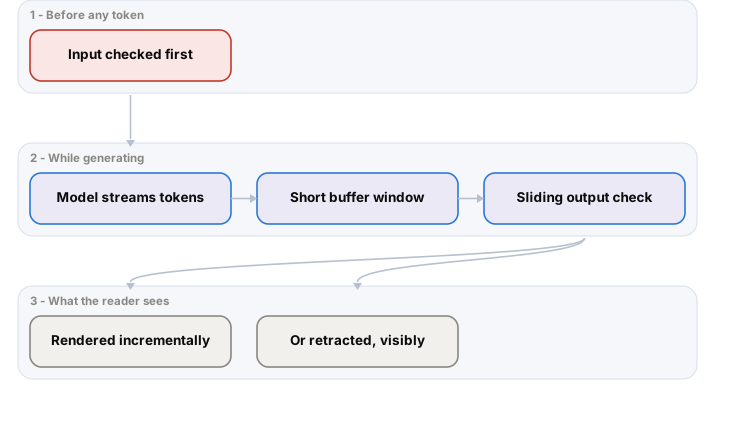
A short buffer is the compromise: a few hundred milliseconds of latency buys a sliding check on output that a pure stream cannot have.
When to use itWhere it fits
- Chat and assistant surfaces, where a person is watching the answer appear.
- Long generative answers, where total time is seconds and waiting in silence reads as failure.
- Anywhere perceived responsiveness drives adoption more than raw completion time.
- When you want the reader able to stop a wrong answer early rather than waiting for all of it.
When NOT to use itLimits & anti-patterns
- Machine-to-machine calls, where nothing benefits and the parsing gets harder.
- Outputs that must be validated as a whole, such as structured data or anything with a strict schema.
- High-assurance domains where an unchecked sentence reaching a reader is itself the incident.
- Short answers, where the complexity buys a saving nobody perceives.
Trade-offsAdvantages & costs
Advantages
- Time to first token is a fraction of total time, which is the metric users actually feel.
- The reader can interrupt or redirect early, saving both tokens and their patience.
- Progress is visible, so long answers do not read as a hung request.
- Widely supported by providers and by browsers, with no unusual infrastructure.
Trade-offs & costs
- Output guardrails must run on partial text or accept a latency penalty, and neither is free.
- A retraction after tokens are visible is a bad experience and is remembered.
- Error handling mid-stream is genuinely harder — a failure halfway looks like an answer that stopped.
- Caching, logging and retrying all become more involved than with a single buffered response.
ExampleIn the real world
A support assistant streams its reply. A question about a refund policy produces a confident opening sentence quoting a figure from a superseded document, and the guardrail that would have caught it runs on the completed answer. The user has already read the number. The team's fix was not a better guardrail but a two-hundred-millisecond buffer, which cost less perceived speed than anyone expected.
ToolsHow to implement it
- Server-sent eventssimpler than websockets for one-way token delivery and works through ordinary proxies.
- Vercel AI SDK or similarhandles the incremental rendering and disconnect cases you would otherwise write twice.
- A sliding-window output checkrunning the guardrail over a short buffer rather than the whole answer.
- Input classification before generationthe one check that is genuinely free, because it happens before any token exists.
Cost & effortWhat it takes
Token cost is identical to a buffered call; what changes is infrastructure and attention. Streaming holds a connection open per active user, so concurrency planning matters more than it does for short requests. Engineering effort is moderate, and most of it goes into the failure paths rather than the happy one.