The obligations that actually change an AI design are erasure, purpose limitation and explainability, and all three are cheap early and expensive late.
ConceptWhat it is
A compliance regime is a set of obligations attached to a category of data or a category of use. Most of what they require of an AI system is ordinary good practice already covered elsewhere on this tile. A small number of clauses genuinely constrain the architecture, and those are worth knowing before the index is built.
Three recur. Erasure — a person can require their data be deleted. Purpose limitation — data gathered for one purpose may not be freely used for another. Explainability — a decision affecting someone may have to be explained. Each collides with a default choice in a typical retrieval or fine-tuning pipeline.
How it worksThe mechanics
Erasure is the sharp one. Deleting a source document does not remove it from the vector index, from a cache, from a log, or from a model that was fine-tuned on it. A design that can honour erasure keeps a mapping from subject to every derived artefact, and treats fine-tuning on personal data as a decision requiring a retraining plan rather than a one-way door.
Purpose limitation decides whether production traffic may become training data, which is a question about consent rather than about tooling. Explainability is answered by the audit record and by grounding — an answer that cites its retrieved sources is explainable in a way an unsourced generation is not.
At a glanceSee it
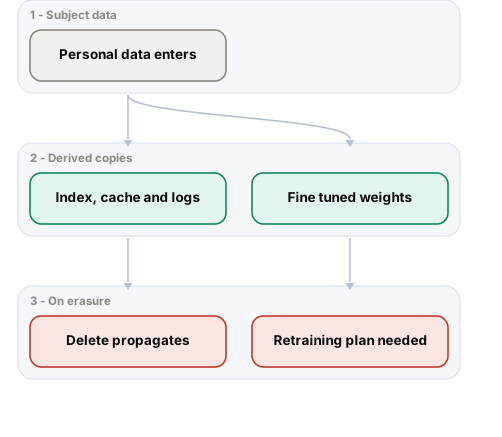
An erasure request has to reach every derived copy. The index and the logs are deletable; fine-tuned weights are a retraining commitment made at design time.
When to use itWhere it fits
- Before choosing whether to fine-tune on personal data, which is the decision hardest to reverse.
- When the corpus contains health, financial or biometric records, where the category alone triggers obligations.
- When deploying into the EU, where the AI Act adds duties keyed to the use rather than the data.
- At procurement, because a buyer's security review will ask these questions whether or not you prepared for them.
When NOT to use itLimits & anti-patterns
- As a reason not to build — most obligations are satisfiable by design choices that are also good engineering.
- By copying another organisation's controls; obligations attach to your data and your use, not to a template.
- As a substitute for legal advice, which this page is not — it names the clauses that change designs.
- As an end-of-project review gate; every clause here is cheap before the index exists and painful after.
Trade-offsAdvantages & costs
Advantages
- The constraints push toward retrieval over fine-tuning, which is usually also the cheaper and more maintainable choice.
- Grounded, citing answers satisfy explainability and improve trust at the same time.
- Designing for erasure forces a data map that is useful for a dozen other reasons.
- Clearing a buyer's review quickly is a commercial advantage, not only a legal one.
Trade-offs & costs
- Erasure across fine-tuned weights has no cheap answer, only a retraining plan or a decision not to train.
- Obligations differ by jurisdiction and by sector, so a single global answer is usually over-strict somewhere and under-strict elsewhere.
- Purpose limitation can cut off the production traffic that would otherwise be your best eval data.
- The rules are moving, so a design settled against today's text needs revisiting.
ExampleIn the real world
A recruitment screening tool fine-tunes on historical applications to match house style. A candidate exercises erasure. The application row is deleted and the index entry with it, but the model trained on that text cannot be unwound, so honouring the request means a retraining cycle nobody scheduled. Choosing retrieval over fine-tuning at the start would have made this a delete.
ToolsHow to implement it
- A subject-to-artefact data mapthe unglamorous register that makes erasure a query rather than an investigation.
- Soft-delete plus index tombstonesso a removal propagates to the vector store on the same transaction as the source.
- Retrieval instead of fine-tuningthe single most effective compliance decision available for personal data.
- Citation-carrying answersthe audit record and the visible source together answer most explainability duties.
Cost & effortWhat it takes
No runtime cost. The expense is entirely in design freedom and in engineering the data map and deletion paths — days if planned, a re-architecture if not. The one genuinely large cost is retraining to satisfy erasure on fine-tuned weights, which is why the recommended answer is to avoid creating that obligation.
What changedWhat changed here
Updated this page Claude outputs will now carry detectable watermarks, affecting provenance and downstream redistribution.
Updated this page Anthropic now offers a real data-residency option for managed API use, so regulated enterprises can keep data in their own cloud without self-hosting.
Three kinds of claim, strongest first. Signal runs every morning.