An unversioned prompt is an unversioned dependency, and it is the one most likely to be edited in production by someone who is not deploying.
ConceptWhat it is
Prompt versioning is the practice of treating prompts as artefacts with identities, histories and releases, rather than as strings living in a file or a database row that anyone can edit.
It matters because the prompt has as much influence on behaviour as the model, and far less ceremony around changing it. A one-word edit can shift output across the whole traffic distribution, and without a version there is no way to say which prompt produced a recorded answer, no way to compare two candidates honestly, and no way to roll back.
How it worksThe mechanics
Each prompt has an identifier and an immutable version. The version is recorded on every trace, so an answer in the log can always be tied to the exact text that produced it. Templates and the values filled into them are stored separately, which keeps the log queryable and keeps sensitive values out of a shared prompt store.
Changes go through the same path as code: review, an eval run against the held-out set, then release. Where prompts are edited in a hosted tool rather than a repository, the requirement does not change — the tool must expose immutable versions and the version must reach the trace, or the convenience has bought an untracked dependency.
At a glanceSee it
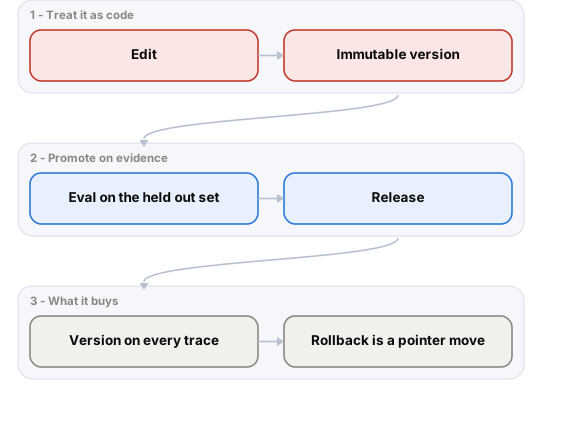
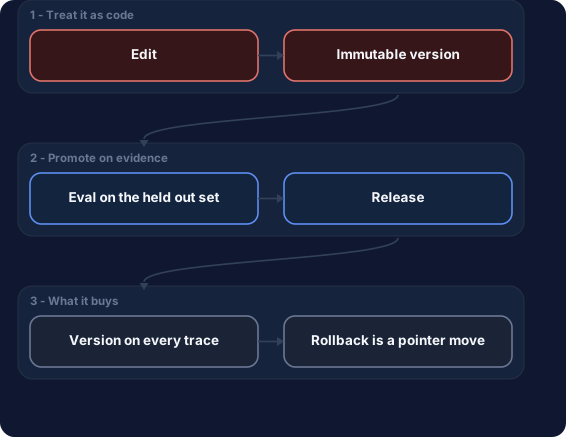
The version on the trace is what ties a recorded answer to the exact text that produced it. Without it, rollback and comparison are both guesswork.
When to use itWhere it fits
- Any prompt in production, which is the whole of the honest answer.
- Wherever more than one person can change a prompt, since that is when attribution stops being obvious.
- When running A/B comparisons, which are meaningless without stable identities for the variants.
- Alongside the improvement loop, where a change has to be attributable to a measured result.
When NOT to use itLimits & anti-patterns
- In genuine throwaway exploration, where the ceremony would slow the iteration that is the point.
- As versioning alone; a version without an eval run tells you what changed and not whether it helped.
- Storing filled-in prompts rather than templates, which copies user data and secrets into the prompt store.
- As a reason to avoid changing prompts, which is the opposite of the intent.
Trade-offsAdvantages & costs
Advantages
- Makes rollback possible, which is the control that matters most when a change goes wrong.
- Ties every recorded answer to the exact text that produced it, so investigations terminate.
- Enables honest comparison between candidates rather than argument from impression.
- Costs almost nothing and reuses infrastructure that already exists.
Trade-offs & costs
- Adds friction to a change people are used to making instantly.
- Hosted prompt tools vary in whether they offer genuinely immutable versions.
- A version identifier on a trace is only useful if the store keeps that version forever.
- Discipline decays quickly unless the version is required by the code rather than by a convention.
ExampleIn the real world
An assistant starts refusing a category of legitimate request. The change is traced to a prompt edit made three weeks earlier to fix an unrelated complaint, applied directly in the hosted tool with no version and no eval run. Nobody could say what the previous text had been, so the rollback was a reconstruction from memory rather than a revert.
ToolsHow to implement it
- Gitprompts as files in the repository, reviewed and released with the code that uses them.
- Langfuse or PromptLayera prompt store with immutable versions, when editing outside a deploy is genuinely required.
- The version id on every tracethe field that makes an answer explainable after the fact.
- An eval run gating releaseso a version is promoted on evidence rather than on confidence.
Cost & effortWhat it takes
No runtime cost beyond storing an identifier. Effort is genuinely small — an id, a store and a field on the trace — and the return is disproportionate the first time a change has to be reverted. The expensive alternative is reconstructing a prompt from memory during an incident.