Fetching public web content is easy and legal permission to use it in your product is a separate question nobody answers by default.
ConceptWhat it is
Web content is the most available corpus in existence and the one whose terms are least often checked. Public means visible; it does not mean licensed for reuse, and it certainly does not mean licensed for training.
The technical work is largely solved — fetch, parse, deduplicate. The question that actually decides whether a corpus is shippable is whether you may use it, and that answer lives in terms of service, robots directives and copyright rather than in code.
How it worksThe mechanics
Collection respects the stated rules: robots directives, crawl rate, and any terms attached to the source. Each fetched item is stored with its URL, fetch time and the licence determination made for it, so a later question about provenance is a lookup rather than an investigation.
Extraction then has to separate content from furniture. A modern page is mostly navigation, cookie notices and related-article rails, and naive text extraction produces chunks that are largely boilerplate. Deduplication matters more here than in any other source, because the same article legitimately appears at several URLs.
At a glanceSee it
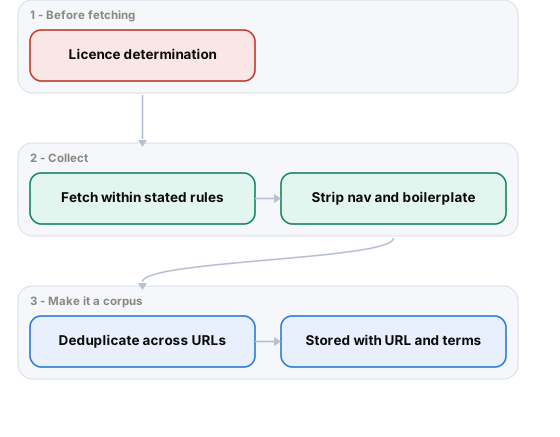
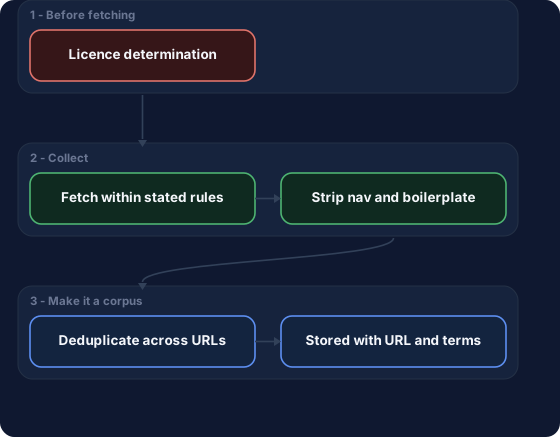
The licence determination comes first and is stored with the content. Boilerplate stripping and deduplication are what separate a corpus from a pile of pages.
When to use itWhere it fits
- Public reference material your product genuinely needs and is licensed to use.
- Your own web properties, where the terms question answers itself.
- Documentation sites that publish under a permissive licence and say so.
- Monitoring a small, named set of sources, where the volume is low and the terms are checkable one by one.
When NOT to use itLimits & anti-patterns
- Anywhere the terms of service prohibit it, which is the common case for anything commercially valuable.
- As training data without an explicit licence, which is a materially different permission from reading.
- Behind a login or paywall, where access was granted to a person and not to your pipeline.
- For a demo corpus, where a self-authored one removes the entire question at almost no cost.
Trade-offsAdvantages & costs
Advantages
- Vast coverage, immediately available, no negotiation with a data owner.
- Genuinely current for sources that update frequently.
- Well-served by mature tooling; almost none of the technical work is novel.
- For your own properties, provenance and licence are settled before you start.
Trade-offs & costs
- The licence question is real, unresolved by default, and not answerable by engineering.
- Boilerplate contamination is severe and degrades retrieval quality in ways that are hard to see.
- Content changes or disappears, so a citation may not resolve when someone follows it.
- Quality is wildly uneven, and a confident wrong page retrieves exactly as well as a correct one.
ExampleIn the real world
A competitor-intelligence assistant indexes a set of industry news sites. It works well, and the licence review at procurement discovers that two of the sources prohibit automated collection in their terms. The corpus has to be rebuilt without them, the eval numbers are no longer comparable, and the fix at the start would have been a ten-minute read of two pages.
ToolsHow to implement it
- trafilatura or readabilitycontent extraction that strips navigation and furniture rather than keeping everything.
- A licence field on every recordthe determination stored beside the content, so provenance is a lookup.
- MinHash or SimHash deduplicationnear-duplicate detection, because the same article appears at several URLs.
- A self-authored corpusfor demos and kits, this removes the licence question instead of answering it.
Cost & effortWhat it takes
Cheap to collect and cheap to store. The costs that matter are legal review, which is not an engineering line item, and the quality work of stripping boilerplate and deduplicating, which is more effort than the fetching. Treat the licence determination as a gate before the pipeline, not a review after it.