A webhook turns an answer into an action in someone else's system, so idempotency and a kill switch stop being optional.
ConceptWhat it is
A webhook automation takes the model's output and calls another system with it — opening a ticket, moving a record, starting a workflow. It is the point where a system stops advising and starts doing, and the point where the cost of being wrong stops being a bad paragraph.
The distinguishing property is that the consequence lands somewhere you do not control, on a timescale you cannot pause. Between an unreliable component and an irreversible effect, everything depends on what sits in the middle.
How it worksThe mechanics
The model's decision is validated against a schema and a policy — is this an action it is permitted to take, on a target it is permitted to touch, with values in an acceptable range. The call is then made with an idempotency key so a retry cannot duplicate the effect, and the outcome is recorded against the trace that produced it.
Around that sit three operational controls that are always needed and often added late: a rate limit, so a loop cannot fire a thousand times; a dry-run mode that logs what would have happened, which is how the automation earns trust before it is armed; and a kill switch that stops it without a deploy.
At a glanceSee it
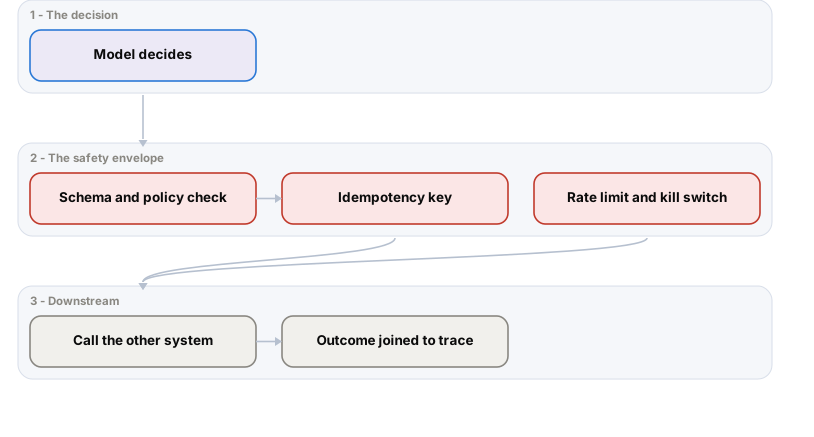
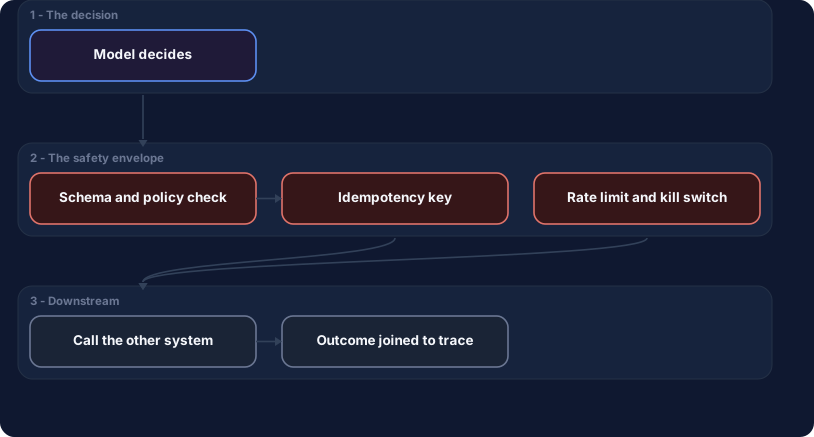
Dry-run first, then arm. The idempotency key makes a retry safe, and the kill switch has to work without a deploy.
When to use itWhere it fits
- High-volume, low-stakes routing where a human step adds delay without adding judgement.
- Actions that are reversible or cheap to correct — creating a draft, adding a label, opening a ticket.
- After a dry-run period has produced evidence that the decision quality is good enough.
- Where the downstream system has its own validation, giving you a second line of defence.
When NOT to use itLimits & anti-patterns
- Irreversible or financially material actions, which belong behind an approval step.
- Before you have measured decision quality on real traffic in dry-run.
- When the downstream system has no idempotency and a duplicate call causes real harm.
- Where a wrong action is expensive to detect, which is more dangerous than one that is expensive to fix.
Trade-offsAdvantages & costs
Advantages
- Removes latency and toil from routine decisions, which is the clearest return on an agent.
- Standard integration pattern that almost every SaaS system already supports.
- Dry-run makes the quality question answerable with evidence rather than argument.
- Trace-joined outcomes give you a ground-truth signal most systems never collect.
Trade-offs & costs
- Errors compound silently at machine speed until something downstream notices.
- Retry logic without idempotency is a duplicate-action generator.
- Debugging spans two systems and two teams, which is more than twice as hard.
- The blast radius grows quietly as people add targets to an automation that was scoped narrowly.
ExampleIn the real world
A triage agent classifies inbound tickets and fires a webhook to route them. A provider timeout causes a retry, the downstream system has no idempotency key, and a busy afternoon produces several hundred duplicate tickets that then need triaging themselves. The model was right every time. The defect was entirely in the plumbing around it.
ToolsHow to implement it
- Idempotency keys on every callderived from the trace id, so a retry is recognised as the same intent.
- A durable queue between decision and deliveryso a downstream outage delays actions instead of dropping them.
- Temporal or a workflow enginewhen the action is multi-step and partial completion has to be recoverable.
- A feature flag as a kill switchthe control you will want at the exact moment a deploy is too slow.
Cost & effortWhat it takes
The model call is the cheap part. The cost is engineering the safety envelope — validation, idempotency, dry-run and the switch — which is typically more code than the automation itself and is what makes it shippable. Budget the dry-run period as part of delivery rather than as a delay to it.