OverviewWhat it is
Orchestration frameworks connect prompts, retrieval, memory, tools, and control flow so you build an application rather than one-off API calls. LangChain is the best-known; LangGraph adds stateful graphs, LlamaIndex focuses on data/RAG, Semantic Kernel targets .NET, DSPy optimises prompts programmatically.
At a glanceOrchestration Frameworks
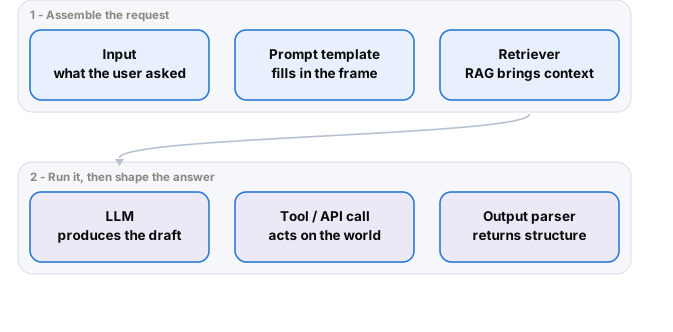
Frameworks wire these steps together, add memory, and handle branching and retries.
CompareThe framework landscape, side by side
The frameworks people actually build on, grouped by what they're for — filter or search across language, focus, and state model. Prove a use case on one before you commit; the seam you leave decides whether you can ever switch.
Every row has a page — what it does, what it costs you, and how to tell when it is the thing biting you.
MechanicsHow it works
You compose steps - a prompt template, a retriever, an LLM call, a tool, an output parser - into a chain or graph, with memory and branching. The framework handles plumbing, retries, and integrations.
Ground levelWhat you actually build


A graph of steps with plumbing attached. The seam you leave around the framework is what decides whether you can ever leave it.
LandscapeTypes & approaches
Click a highlighted type to open its own page — concept, use case, and diagram.
FeasibilityArchitecture & feasibility
Architecture & feasibility
- Framework vs build-your-own is a real feasibility trade-off: speed and ecosystem vs abstraction overhead and lock-in. Many teams graduate to thinner stacks.
- Keep a thin seam around the framework so you can swap models, stores, and tools without rewrites.
- Graphs (LangGraph) buy you loops, retries, and state - needed once flows branch beyond a straight line.
In practiceWhat it means for building
These accelerate prototyping. Know the concept - 'a graph of steps' - more than any single library's syntax; libraries change fast.
Choose framework vs custom deliberately, and isolate it behind interfaces so you are not locked in as the ecosystem shifts.
GlossaryKey terms
CheckCheck your understanding
Why use LangChain instead of raw API calls?
Ready-made components (retrievers, memory, tools, parsers) ship faster. The trade-off is abstraction; some teams drop it once patterns stabilise.
Chain vs graph?
A chain is linear; a graph supports branching, loops, and state - needed for agents and multi-step reasoning.
How do you avoid framework lock-in?
Wrap it behind your own interfaces for model, store, and tools so components can be swapped.
What changedWhat changed here
Updated this page The paper argues a governed, standardised coding-agent harness drives enterprise agent performance more than model choice or orchestration layers, a prioritisation signal for teams building agents.
Updated this page A survey of multimodal agentic frameworks gives readers a single reference for how perception, memory, and decision-making are orchestrated around LLM backbones.
Three kinds of claim, strongest first. Signal runs every morning.