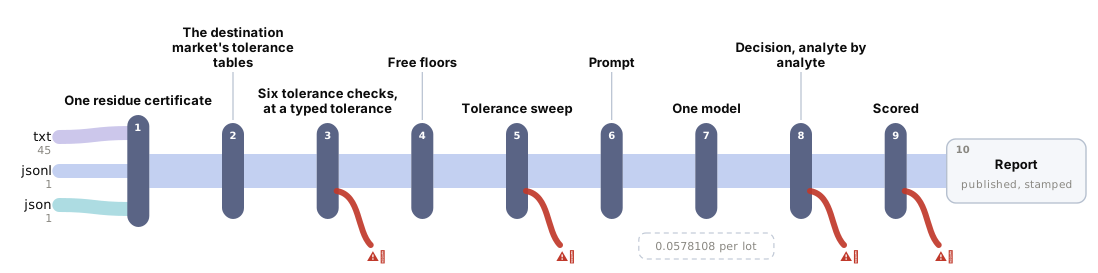
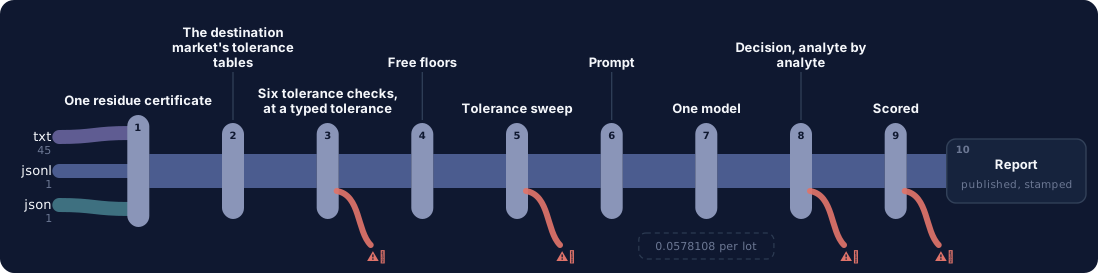
COUNTED244 · 216 · 188 · 90 / 270residue decision accuracy pct — residue decision accuracy -- the decision, the ground, the governing provision, the record, and nothing invented, all at onceDecided by == against a fixed gold value. No model graded this and it reproduces to the digit — which makes it checkable, not necessarily right: it is only as good as the gold behind it.
COUNTED247 · 216 · 188 · 112 / 270hold disposition accuracy pct — the same three-way call without the citation and record requirements -- what a comparator can scoreDecided by == against a fixed gold value. No model graded this and it reproduces to the digit — which makes it checkable, not necessarily right: it is only as good as the gold behind it.
COUNTED114 · 114 · 114 · 114 / 270majority release pct — what RELEASE-everything scores on the same resultsDecided by == against a fixed gold value. No model graded this and it reproduces to the digit — which makes it checkable, not necessarily right: it is only as good as the gold behind it.
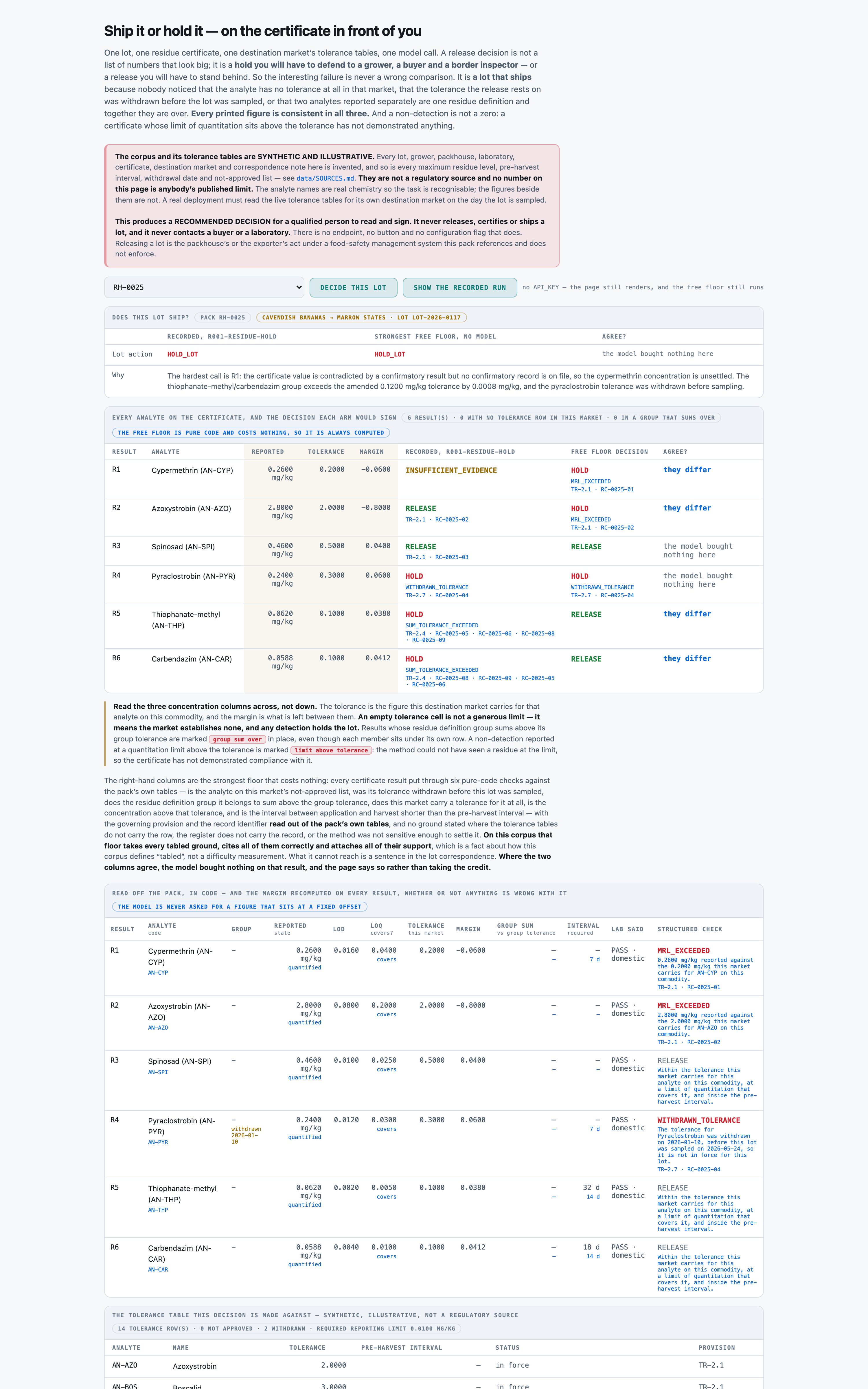
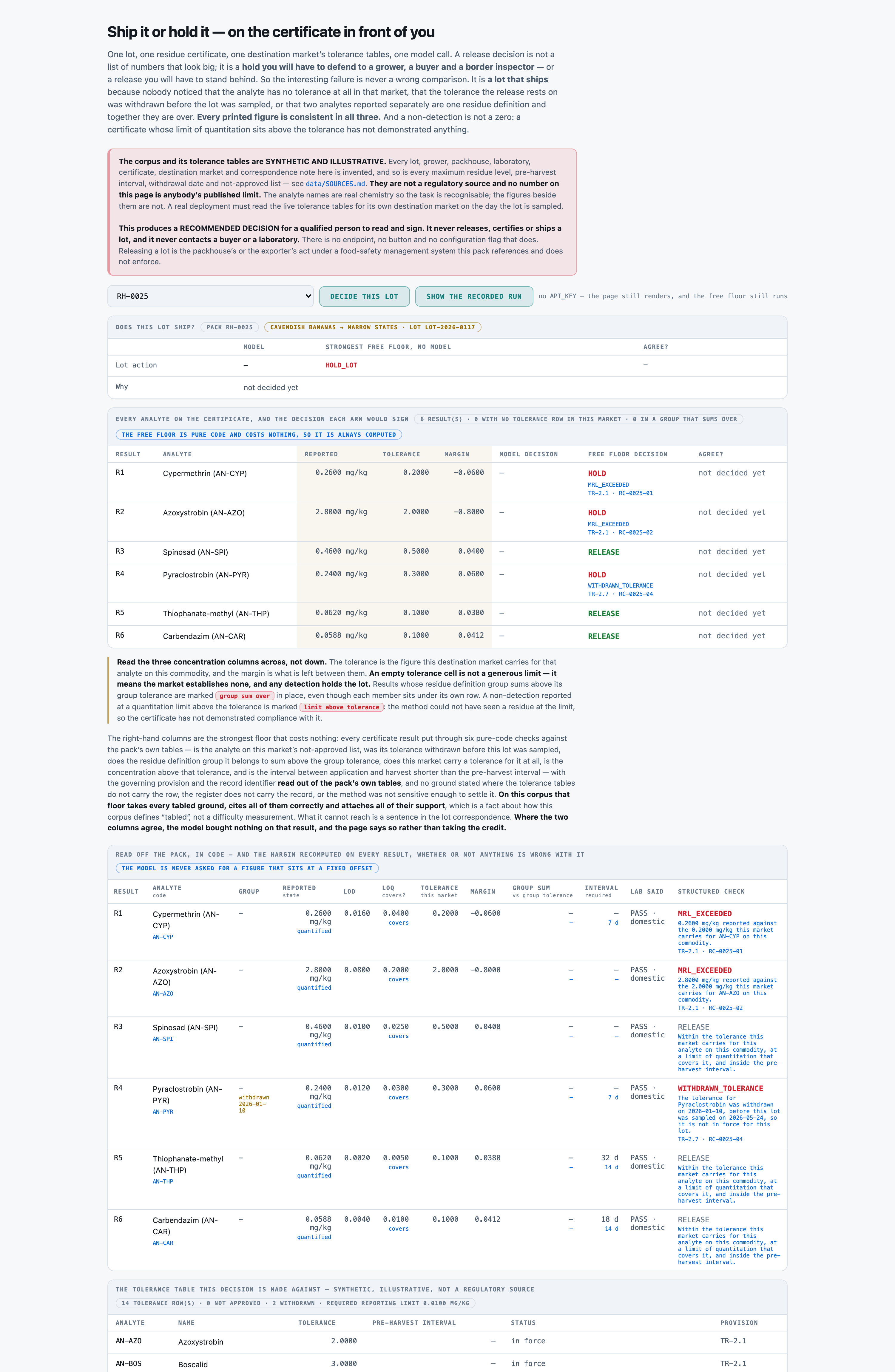
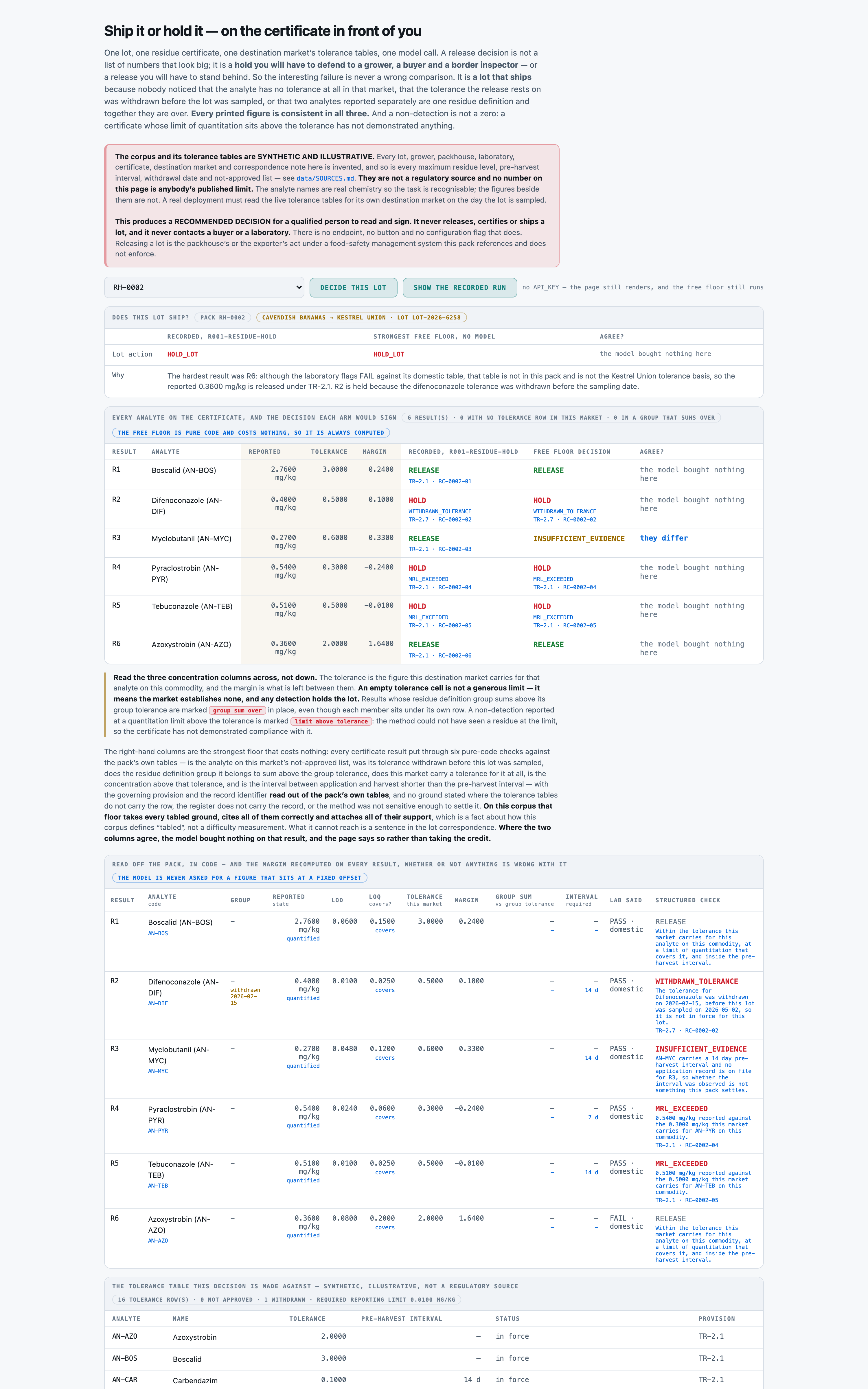
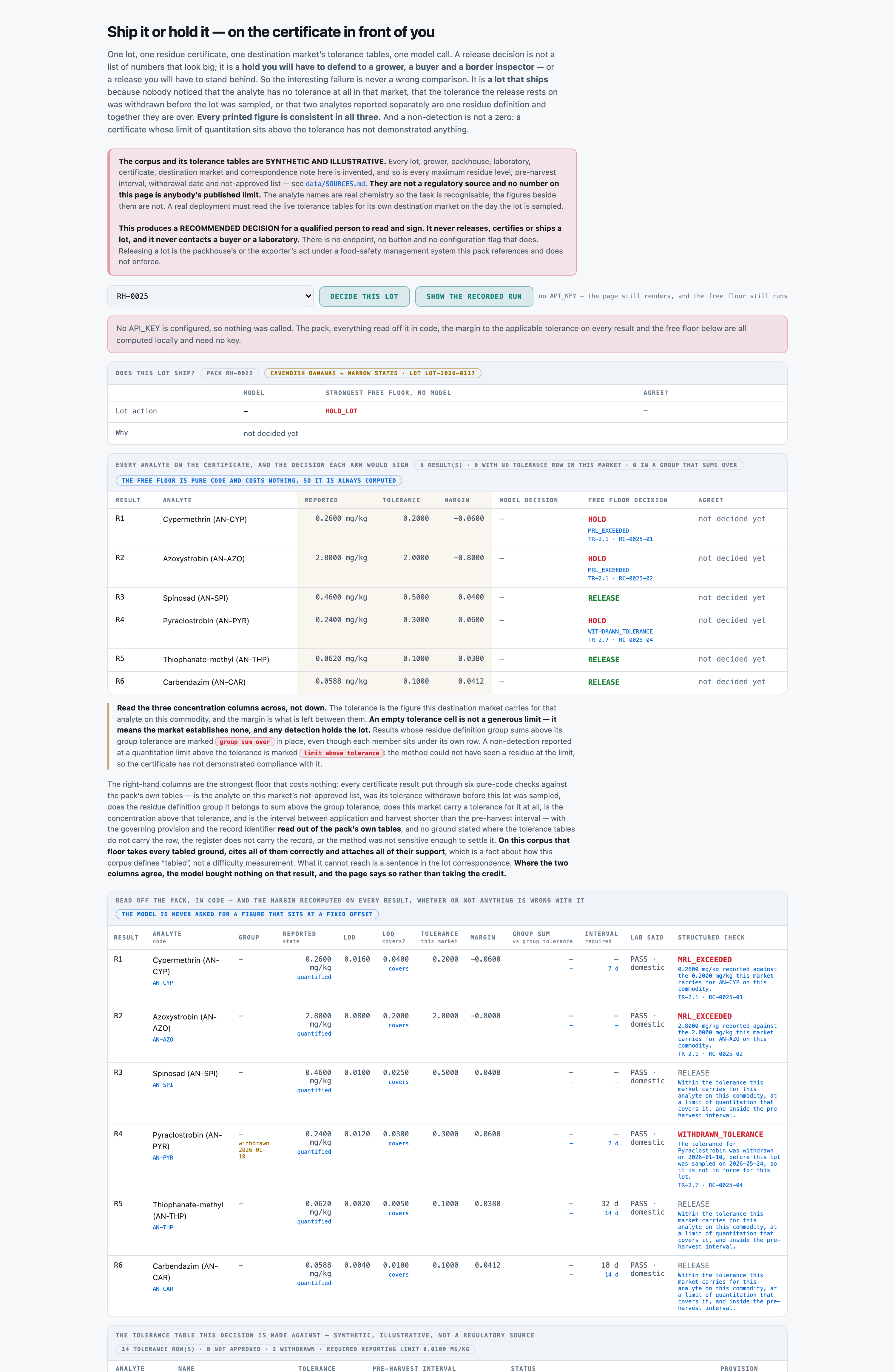
COUNTED128 · 108 · 108 · 22 / 128holds caught pct — of the results that hold the lot, how many the arm heldDecided by == against a fixed gold value. No model graded this and it reproduces to the digit — which makes it checkable, not necessarily right: it is only as good as the gold behind it.
COUNTED0 · 20 · 20 · 106 / 128false clear pct — FALSE CLEAR -- of the results that hold the lot, how many the arm RELEASED. Lower is better and it is never averaged with anythingDecided by == against a fixed gold value. No model graded this and it reproduces to the digit — which makes it checkable, not necessarily right: it is only as good as the gold behind it.
COUNTED0 · 34 · 34 · 24 / 114over hold rate pct — of the results that do NOT hold the lot, how many the arm held anyway. Lower is betterDecided by == against a fixed gold value. No model graded this and it reproduces to the digit — which makes it checkable, not necessarily right: it is only as good as the gold behind it.
COUNTED108 · 108 · 108 · 22 / 108tabled ground caught pct — grounds the pack's own tables prove. Free code does this by constructionDecided by == against a fixed gold value. No model graded this and it reproduces to the digit — which makes it checkable, not necessarily right: it is only as good as the gold behind it.
COUNTED20 · 0 · 0 · 0 / 20note ground caught pct — grounds only a sentence in the lot correspondence reveals. Free code cannot reach these at allDecided by == against a fixed gold value. No model graded this and it reproduces to the digit — which makes it checkable, not necessarily right: it is only as good as the gold behind it.
COUNTED40 · 20 · 20 · 0 / 40sum tolerance caught pct — THE NAMED TRAP -- a residue definition group whose members sum above its group toleranceDecided by == against a fixed gold value. No model graded this and it reproduces to the digit — which makes it checkable, not necessarily right: it is only as good as the gold behind it.
COUNTED20 · 20 · 20 · 0 / 20sum tolerance table caught pct — of the group sums, the half reported under a printed group rowDecided by == against a fixed gold value. No model graded this and it reproduces to the digit — which makes it checkable, not necessarily right: it is only as good as the gold behind it.
COUNTED20 · 0 · 0 · 0 / 20sum tolerance note caught pct — of the group sums, the half where the amendment lives only in the correspondenceDecided by == against a fixed gold value. No model graded this and it reproduces to the digit — which makes it checkable, not necessarily right: it is only as good as the gold behind it.
COUNTED0 · 34 · 34 · 24 / 34silent over hold pct — SILENT OVER-HOLD -- results whose apparent breach the pack itself has already answered, held anyway. Lower is betterDecided by == against a fixed gold value. No model graded this and it reproduces to the digit — which makes it checkable, not necessarily right: it is only as good as the gold behind it.
COUNTED17 · 28 · 0 · 0 / 28unsettleable named pct — results the pack does not settle, named as unsettleable rather than decidedDecided by == against a fixed gold value. No model graded this and it reproduces to the digit — which makes it checkable, not necessarily right: it is only as good as the gold behind it.
COUNTED128 · 108 · 108 · 22 / 128analyte ground accuracy pct — of the holds stated, the right one of the six groundsDecided by == against a fixed gold value. No model graded this and it reproduces to the digit — which makes it checkable, not necessarily right: it is only as good as the gold behind it.
COUNTED126 · 108 · 108 · 0 / 128tolerance cited accuracy pct — of the holds stated, the governing provision the pack itself prints for that groundDecided by == against a fixed gold value. No model graded this and it reproduces to the digit — which makes it checkable, not necessarily right: it is only as good as the gold behind it.
COUNTED128 · 108 · 108 · 0 / 128residue record attached pct — of the holds stated, every record identifier the ground needsDecided by == against a fixed gold value. No model graded this and it reproduces to the digit — which makes it checkable, not necessarily right: it is only as good as the gold behind it.
COUNTED140 · 213 · 213 · 213 / 191margin arithmetic pct — the margin between the applicable tolerance and the concentration, correct to four decimal places -- scored apart from the decisionDecided by == against a fixed gold value. No model graded this and it reproduces to the digit — which makes it checkable, not necessarily right: it is only as good as the gold behind it.
COUNTED4 · 0 · 0 / 267invented provision pct — INVENTED CITATION -- of the results citing any identifier, how many cited one the pack does not carry as a provision or a record. A FLOOR, not a ceilingDecided by == against a fixed gold value. No model graded this and it reproduces to the digit — which makes it checkable, not necessarily right: it is only as good as the gold behind it.
COUNTED0 · 0 · 0 · 0 / 270results omitted pct — results left off the decision entirelyDecided by == against a fixed gold value. No model graded this and it reproduces to the digit — which makes it checkable, not necessarily right: it is only as good as the gold behind it.
COUNTED40 · 39 · 36 · 28 / 45lot action accuracy pct — the lot action, three-wayDecided by == against a fixed gold value. No model graded this and it reproduces to the digit — which makes it checkable, not necessarily right: it is only as good as the gold behind it.
COUNTED35 · 35 · 35 · 35 / 45majority lot action pct — what the single phrase HOLD_LOT scores at the lot levelDecided by == against a fixed gold value. No model graded this and it reproduces to the digit — which makes it checkable, not necessarily right: it is only as good as the gold behind it.
COUNTED0 · 0 · 0 · 8 / 35lot false clear pct — LOTS SHIPPED THAT SHOULD HAVE BEEN HELD -- of the lots the key holds, how many the arm's own lot action releasedDecided by == against a fixed gold value. No model graded this and it reproduces to the digit — which makes it checkable, not necessarily right: it is only as good as the gold behind it.
NOT YET KNOWN—A person confirmed the gold is rightThe grader is == and needs no confirming. The gold does: it is machine-derived from the registry's structured modules, and every rate on this page rests on that derivation being faithful to what the prose actually says. Nobody has read a document against its gold record by hand.