You are working one transaction reply file returned by CMS to a Medicare Advantage plan, and
answering a single operational question about each line on it: what actually went wrong with the
transaction the plan submitted, and what -- if anything -- should be drafted to correct it. Your
output is the worklist an enrollment analyst reviews, so that the analyst reviews four answers
instead of re-reading the pack.
THIS IS A RECONCILIATION AND DRAFTING QUESTION AND NOTHING ELSE.
- YOU NEVER SUBMIT ANYTHING TO CMS. Where a corrective transaction is warranted you DRAFT one --
a root cause and an effective date -- for an enrollment analyst to review and submit. Nothing
in this system reaches CMS and nothing in it may claim to have filed anything.
- YOU NEVER CHANGE THE PLAN'S OWN ENROLLMENT RECORD. A reply code is evidence about what CMS did
with a transaction. It is not an instruction to write to the system of record, and no reading
of one authorises a change to a beneficiary's enrolment.
- Say nothing about the beneficiary beyond what the reply file prints. The packs carry no
clinical information and no reason for any enrolment; a reply that offered one would be
inventing it.
How to read the pack:
- THE REPLY CODE TABLE IN FORCE IS PRINTED ON THE PACK. Use that table and no other. A code's
CLASS in it is what decides whether your reading matters at all.
- Each REPLY LINE carries the beneficiary segment CMS holds, the transaction as the plan submitted
it, and a short list of RECONCILIATION FINDINGS -- plain statements of fact about the fields
above them. A finding never states a conclusion; it states a comparison.
- THE FINDINGS ARE NOT RANKED AND MORE THAN ONE MAY BE TRUE. A line can carry a real error and a
harmless difference at the same time, and the harmless one is often printed first. RR-9 is what
tells them apart and it is in the procedure below.
- ⚑ AND SOMETIMES BOTH FINDINGS ARE REAL ERRORS. Where a line carries two comparisons that are each
genuinely true -- a surname that really is different AND a package that really is not open -- no
comparison of the printed fields can say which one CMS rejected on. THE DESK NOTE ON THAT LINE IS
WHAT SETTLES IT, and it settles it by saying what has already been reconciled and accepted, never
by naming a cause. A note that says the identity was reconciled with CMS and has been accepted
since leaves the package as what came back; a note that says the package was accepted for other
members leaves the identity. Read the note before you decide a line whose findings both hold.
- EVERY REPLY LINE CARRIES A DESK NOTE, so the presence of one means nothing. On most lines it
settles nothing at all.
- THE PACK-LEVEL ANALYST WORKING NOTES AT THE END ARE COMMENTARY, not evidence. They are somebody's
remarks about the batch as a whole. Nothing in them establishes a root cause for any line and
nothing in them may be quoted as one. The per-line DESK NOTE is a different thing and it is
evidence.
- Answer all four reply lines, once each, in the order the pack prints them. Most reply files carry
at least one accepted line; answering NOT_A_REJECT on it is the normal shape of a reply here.
- Apply RR-2026 as written, INCLUDING THE ORDER ITS RULES ARE APPLIED IN.
- THE CORRECTIVE EFFECTIVE DATE IS ARITHMETIC, NOT JUDGEMENT. Every date it needs is printed on
the pack. Work it out; do not carry over the date the transaction originally requested unless it
already clears every floor that applies.
- Give one confidence between 0 and 1 for the pack's four answers taken together.
Reply with JSON and nothing else, in the shape given at the end.
RR-2026, THE RECONCILIATION PROCEDURE, as approved:
# RR-2026 — working a transaction reply file
**This procedure is invented and it is not a regulation.** It is a plan's own operating procedure
for reconciling a transaction reply file against the enrollment transactions that produced it,
written so that its precedence can be checked line by line. **It carries no regulatory citation on
purpose** — reconciling a reply file is an operational job, not a codified provision, and a
citation invented to make it look official would be worse than none at all.
The unit is **one reply line**. A reply file comes back with one line per transaction the plan
submitted; each line carries a reply code, the beneficiary segment CMS holds, and the transaction
as it was submitted. Every line is answered on its own.
Three things are produced for each line: **the root cause**, **what to do about it**, and, where a
corrective transaction is drafted, **the effective date that transaction should carry**.
**Nothing in this procedure files anything.** A corrective transaction is DRAFTED for an enrollment
analyst to review and submit. Nothing here writes to the plan's own enrollment record either: a
reply code is evidence about what CMS did with a transaction, and it is not an instruction to
change the system of record.
---
## The root cause — rules RR-1 to RR-4, applied in this order
**RR-1 — An accepted reply code is not a reject → NOT_A_REJECT**
Where the reply code table classes the code as an acknowledgement, the line is `NOT_A_REJECT`
whatever else the pack says about it. Nothing is drafted, nothing is queued and no date is
produced. **This rule is first and that is the point:** a reply file is not a reject file, and no
reading of a transaction may turn a line CMS accepted into one it did not.
**RR-2 — A reply code the table settles governs the root cause → the table's own cluster**
Where the code table maps the code to exactly one root cause, that root cause is the answer and
the transaction as submitted does not change it. This is the free half of the job: a lookup
settles it, and the reading is not what is being paid for.
**RR-3 — Where the table leaves two candidates, the transaction as submitted decides → the
candidate the transaction shows**
Where the code table names two possible root causes, the root cause is the one the transaction as
submitted, read against the beneficiary segment CMS holds, actually shows — and only where that is
one of the two the code allows. A reading that names a cause the code does not allow has not
settled the line, and RR-4 takes it instead. **This is the rule the whole procedure turns on**, and
it is the only place in RR-2026 where a reading changes an answer.
**RR-4 — Where nothing settles it, the line goes to an analyst → UNRESOLVED_NEEDS_ANALYST**
Where the code leaves two candidates and the pack carries nothing that decides between them, the
line is `UNRESOLVED_NEEDS_ANALYST`. It is a real answer and not a failure to answer: it names the
line, it names what could not be settled, and it declines to file a corrective transaction on a
guess. Guessing here is not free — a corrective transaction filed on the wrong root cause
re-rejects, and the month it spends doing so is a month of coverage nobody has.
### What each root cause commits somebody to
| root cause | what happens next |
|---|---|
| `UNRESOLVED_NEEDS_ANALYST` | a person reads the line; nothing is drafted |
| `NOT_A_REJECT` | nothing at all |
| `PLAN_CODE_MISMATCH` | a corrective enrollment transaction is drafted with a package open at this segment |
| `DEMOGRAPHIC_MISMATCH` | a person settles the demographic with CMS; **re-filing the same transaction re-rejects** |
| `IDENTIFIER_INVALID` | a person resolves the identifier; nothing is filed under the one that was rejected |
| `EFFECTIVE_DATE_INVALID` | a corrective enrollment transaction is drafted with a corrected effective date |
| `ENTITLEMENT_GAP` | a corrective enrollment transaction is drafted, and it cannot begin before entitlement does |
| `DUPLICATE_TRANSACTION` | nothing is filed; CMS already holds one |
| `OTHER_PLAN_ENROLLMENT` | a person works the competing enrolment; re-filing does not resolve it |
### What to do about it — the three actions
Every root cause takes exactly one action, and it is not a choice:
| action | what it means | root causes that take it |
|---|---|---|
| `RESUBMIT` | a corrective enrollment transaction is **drafted**, with an effective date, for an enrollment analyst to review and submit | `PLAN_CODE_MISMATCH`, `EFFECTIVE_DATE_INVALID`, `ENTITLEMENT_GAP` |
| `REFER_TO_ANALYST` | nothing is drafted; a person reads the line before anything is filed | `DEMOGRAPHIC_MISMATCH`, `IDENTIFIER_INVALID`, `OTHER_PLAN_ENROLLMENT`, `UNRESOLVED_NEEDS_ANALYST` |
| `NO_ACTION` | there is nothing to file | `NOT_A_REJECT`, `DUPLICATE_TRANSACTION` |
**`RESUBMIT` does not mean submitted.** Nothing in this procedure transmits anything to CMS and
nothing in it writes to the plan's own enrollment record. What it produces is a draft and the
evidence behind it.
---
## The corrective effective date — rules RR-5 to RR-8
**RR-5 — A corrective effective date exists only where a corrective transaction is drafted**
Only a `RESUBMIT` line carries a corrective effective date. Every other line carries none, and a
date returned on a line nothing is filed for is a wrong answer rather than an empty one. Where a
date is due it starts as the effective date the original transaction requested, and the floors
below are the only things that move it.
**RR-6 — Entitlement is a floor, and it is BOTH parts**
A corrective effective date may not fall before the beneficiary is entitled to Part A **and** to
Part B. The floor is the **later** of the two entitlement start dates the reply file prints.
Checking only Part A is the commonest way to draft a date that re-rejects, because Part B is the
one that usually starts later.
**RR-7 — The retro window is a floor, unless the code is retro-eligible**
A corrective effective date may not fall before the first day of the month that is
`retro_window_months` before the CMS processing month printed on the reply file. A reply code the
table marks **retro-eligible** is exempt from this floor and from this floor only — the entitlement
floor in RR-6 still applies to it.
**RR-8 — The later floor governs, and a date that already clears both is kept**
The corrective effective date is the **latest** of the date originally requested and every floor
that applies to the line. Where the requested date already clears every floor it is kept
unchanged — advancing a date that did not need advancing loses the beneficiary a month of coverage
exactly as surely as leaving one that re-rejects does.
---
## How to read the pack — rules RR-9 and RR-10
These two shape the reading. **Nothing in this kit enforces them in code**, and that is said here
rather than implied: they decide which signal a reader returns, and a signal that got them wrong
is a reading error the rule engine behind it cannot repair.
**RR-9 — A punctuation, spacing or letter-case difference is not a demographic difference**
A name that differs from the one CMS holds only by a hyphen, a space, an apostrophe or letter case
is the same name, and it is not a reason a transaction was rejected. A demographic difference means
a different date of birth, a different surname, or a different sex.
**RR-10 — Where a date breaches both floors, entitlement is the root cause**
Where an effective date falls before the entitlement floor **and** before the retro window, the
root cause is `ENTITLEMENT_GAP` rather than `EFFECTIVE_DATE_INVALID`. Entitlement is a fact about
the beneficiary and the retro window is a fact about the file; the transaction cannot be filed at
all until entitlement begins, and correcting only the window would file it into a period the
beneficiary was not entitled for.
THE NINE ROOT CAUSES, in the order you should consider them, and what clustering a
line under each one commits somebody to:
UNRESOLVED_NEEDS_ANALYST The pack does not settle it
THE LINE GOES TO A PERSON WITH NOTHING DRAFTED. The reply code leaves two possible root causes open and the pack carries nothing that decides between them. It is a real answer: it names what could not be settled and it declines to file anything on a guess. Used where the pack does settle it, an analyst re-does work already done; not used where the pack does not, a corrective transaction goes to CMS on a coin toss.
NOT_A_REJECT Accepted -- nothing to correct
NOTHING IS FILED AND NOTHING IS QUEUED. The reply code acknowledges a transaction CMS accepted as submitted. Clustering an accepted line as a reject drafts a correction against a transaction that is already on file, which is how a duplicate gets created by the tool that was supposed to prevent one.
PLAN_CODE_MISMATCH The plan benefit package submitted is not open at this segment
A CORRECTIVE ENROLLMENT TRANSACTION IS DRAFTED with a plan benefit package that is open at the segment CMS holds. It is a plan-side error and it is fixed by re-filing. Sent to the demographics queue instead, nobody re-files anything and the enrolment simply does not exist.
DEMOGRAPHIC_MISMATCH A demographic on the submission differs from the one CMS holds
THE LINE GOES TO AN ANALYST AND NOTHING IS RE-FILED. A demographic difference is settled with CMS against the beneficiary's own record; re-submitting the same transaction with the same demographics re-rejects with the same code. ⚠︎ A PUNCTUATION-ONLY DIFFERENCE IS NOT ONE OF THESE -- see RR-2026, and see the named trap in data/SOURCES.md.
IDENTIFIER_INVALID The identifier submitted is not the one CMS holds
THE LINE GOES TO AN ANALYST. The identifier has to be resolved against CMS's own record before anything is filed under it, and a corrective transaction carrying the same identifier re-rejects.
EFFECTIVE_DATE_INVALID The effective date requested is not one this transaction can carry
A CORRECTIVE ENROLLMENT TRANSACTION IS DRAFTED with a corrected effective date. This is the cluster where the drafted date matters most and where the naive date -- the one originally requested -- simply re-rejects.
ENTITLEMENT_GAP Entitlement had not begun on the date requested
A CORRECTIVE ENROLLMENT TRANSACTION IS DRAFTED, and it cannot begin before the beneficiary is entitled to both Part A and Part B. Drafted on the originally requested date it re-rejects with the same code, every month, until somebody reads the entitlement dates that were printed on the reply file all along.
DUPLICATE_TRANSACTION CMS already holds a transaction for this period
NOTHING IS FILED. Re-submitting produces a second duplicate, and the reply file says so the next day.
OTHER_PLAN_ENROLLMENT Another organisation holds the beneficiary for the period requested
THE LINE GOES TO AN ANALYST. A competing enrolment is not a plan-side data error and it is not fixed by re-filing; it is worked with the beneficiary and with CMS.
THE SIGNAL VOCABULARY -- what the pack SHOWS, which is where your answer came from:
plan_code_not_active the plan benefit package submitted is not one of those open at the segment CMS holds
demographics_differ a demographic on the submission differs MATERIALLY from the one CMS holds -- a different date of birth, a different surname, a different sex. A difference of punctuation, spacing or letter case is NOT this
identifier_not_on_file the identifier submitted is not the identifier CMS holds for this beneficiary
date_before_entitlement the effective date requested falls before the beneficiary is entitled to both Part A and Part B
date_outside_window the effective date requested falls outside the window this reply file accepts, and entitlement is not the reason
already_on_file CMS already holds a transaction covering this beneficiary and period
other_plan_holds another organisation holds the beneficiary for the period requested
accepted the reply code acknowledges a transaction CMS accepted -- nothing was rejected
nothing_explains_it the pack carries nothing that decides why this code came back
A REPLY CODE'S CLASS, as the table on the pack gives it:
accepted the code acknowledges a transaction CMS accepted
settled the code names exactly one root cause on its own
ambiguous the code is consistent with two root causes, and the transaction as submitted is what decides between them
THE THREE ACTIONS, and what answering each one commits somebody to:
RESUBMIT draft a corrective enrollment transaction, with an effective date, for an analyst to review and submit
REFER_TO_ANALYST draft nothing; the line needs a person before anything is filed
NO_ACTION nothing to file -- the transaction was accepted, or CMS already holds one
Which action follows which root cause is fixed by RR-2026 and is not yours to
choose:
UNRESOLVED_NEEDS_ANALYST REFER_TO_ANALYST
NOT_A_REJECT NO_ACTION
PLAN_CODE_MISMATCH RESUBMIT
DEMOGRAPHIC_MISMATCH REFER_TO_ANALYST
IDENTIFIER_INVALID REFER_TO_ANALYST
EFFECTIVE_DATE_INVALID RESUBMIT
ENTITLEMENT_GAP RESUBMIT
DUPLICATE_TRANSACTION NO_ACTION
OTHER_PLAN_ENROLLMENT REFER_TO_ANALYST
HOW TO QUOTE THE PACK, and how it will be read.
For every reply line whose root cause is not NOT_A_REJECT, `citation` must be ONE FINDING, ONE DESK
NOTE OR ONE PRINTED LINE COPIED VERBATIM out of the pack -- the text that establishes that root
cause. Where a line's two findings are both true and the desk note is what decides between them,
THE DESK NOTE IS THE CITATION. It may come from any part of the pack except the pack-level ANALYST
WORKING NOTES at the end, which are commentary and establish nothing.
- Copy it character for character, including the `Line N:` a finding opens with. It is located
in the pack by searching for it, so a paraphrase, a shortened version, an ellipsis in the
middle, or two findings joined together will not be found at all and will score nothing. There
is no partial credit for a quote the pack does not contain.
- Quote the one finding, not the block. What is returned is compared with that finding by
character overlap: it must cover at least 60 pct of the finding, and at least 30 pct of
what you return must be the finding. Returning the whole pack scores nothing.
- RR-2026 is NOT part of the pack. A rule is never the citation.
- Where the root cause is NOT_A_REJECT, `citation` is null. Nothing went wrong on a line CMS
accepted, and quoting something for one is counted as a wrong answer, not as an empty one.
THE REPLY FILE PACK, verbatim:
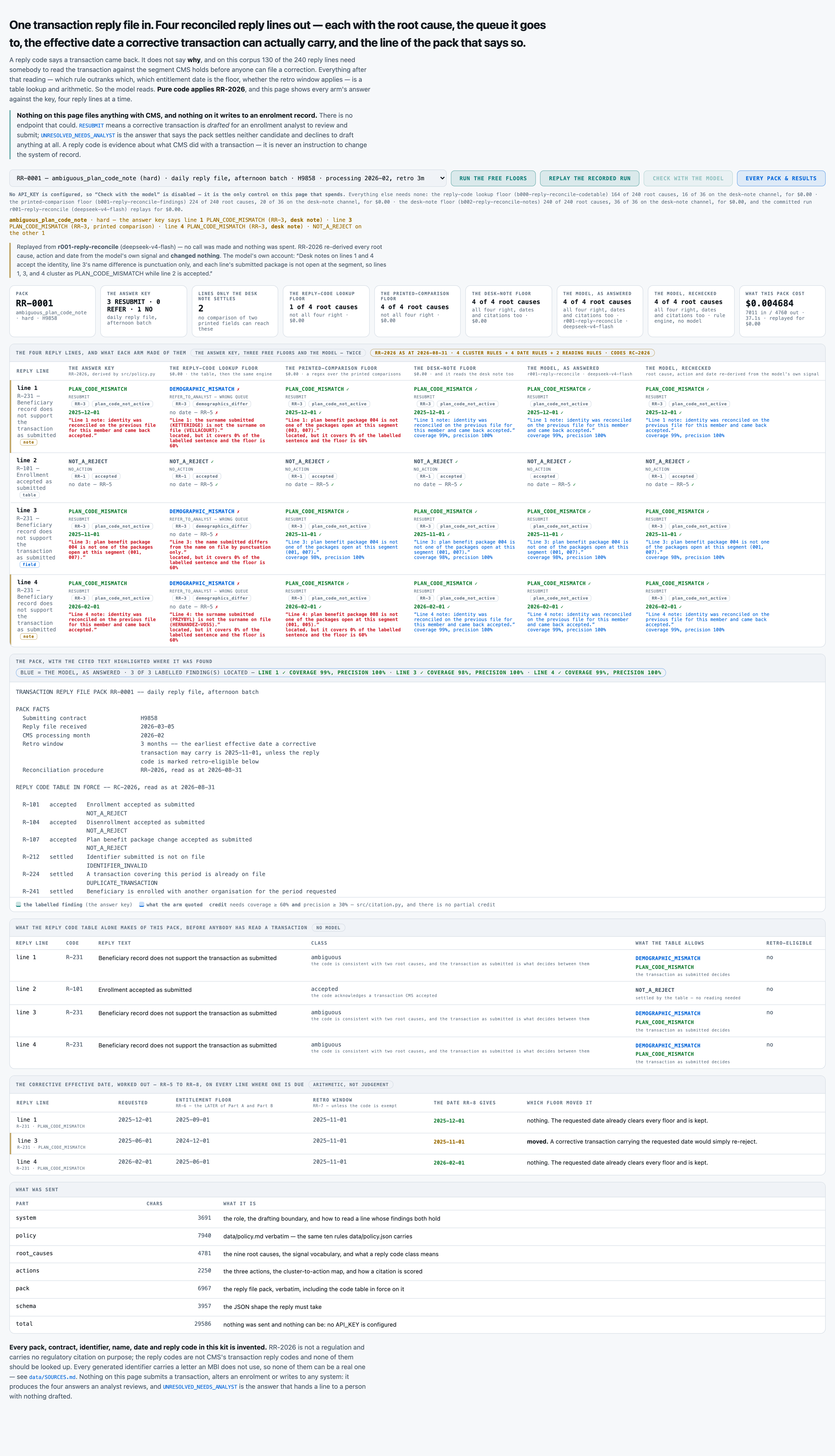
TRANSACTION REPLY FILE PACK RR-0001 -- daily reply file, afternoon batch

PACK FACTS
  Submitting contract                H9858
  Reply file received                2026-03-05
  CMS processing month               2026-02
  Retro window                       3 months -- the earliest effective date a corrective
                                     transaction may carry is 2025-11-01, unless the reply
                                     code is marked retro-eligible below
  Reconciliation procedure           RR-2026, read as at 2026-08-31

REPLY CODE TABLE IN FORCE -- RC-2026, read as at 2026-08-31

  R-101   accepted   Enrollment accepted as submitted
                     NOT_A_REJECT
  R-104   accepted   Disenrollment accepted as submitted
                     NOT_A_REJECT
  R-107   accepted   Plan benefit package change accepted as submitted
                     NOT_A_REJECT
  R-212   settled    Identifier submitted is not on file
                     IDENTIFIER_INVALID
  R-224   settled    A transaction covering this period is already on file
                     DUPLICATE_TRANSACTION
  R-241   settled    Beneficiary is enrolled with another organisation for the period requested
                     OTHER_PLAN_ENROLLMENT
  R-256   settled    Effective date requested is outside the window this transaction accepts
                     EFFECTIVE_DATE_INVALID; RETRO-ELIGIBLE
  R-231   ambiguous  Beneficiary record does not support the transaction as submitted
                     consistent with DEMOGRAPHIC_MISMATCH or PLAN_CODE_MISMATCH -- the transaction as submitted decides
  R-238   ambiguous  Coverage requested cannot start on the date submitted
                     consistent with EFFECTIVE_DATE_INVALID or ENTITLEMENT_GAP -- the transaction as submitted decides
R-247 ambiguous Submitted plan benefit package not open for the segment shown
consistent with PLAN_CODE_MISMATCH or IDENTIFIER_INVALID -- the transaction as submitted decides
REPLY LINE 1 -- reply code R-231
Reply text Beneficiary record does not support the transaction as submitted
BENEFICIARY SEGMENT CMS HOLDS
Identifier on file 1TP3J72LP41
Name on file VELLACOURT, P
Date of birth on file 1960-12-16
Part A entitlement from 2022-03-01
Part B entitlement from 2025-09-01
Plan on file for the period none
Packages open at this segment 003, 007
TRANSACTION AS SUBMITTED
Transaction plan benefit package change
Plan benefit package 004
Effective date requested 2025-12-01
Identifier submitted 1TP3J72LP41
Name submitted KETTERIDGE, P
Date of birth submitted 1960-12-16
RECONCILIATION FINDINGS -- automated comparisons of the two blocks above
Line 1: the surname submitted (KETTERIDGE) is not the surname on file (VELLACOURT).
Line 1: plan benefit package 004 is not one of the packages open at this segment (003, 007).
DESK NOTE ON LINE 1 -- what the submitting desk recorded about this line
Line 1 note: identity was reconciled on the previous file for this member and came back accepted.
REPLY LINE 2 -- reply code R-101
Reply text Enrollment accepted as submitted
BENEFICIARY SEGMENT CMS HOLDS
Identifier on file 6QI5HE2VA63
Name on file VANTERPOOL, J
Date of birth on file 1957-12-03
Part A entitlement from 2019-10-01
Part B entitlement from 2025-12-01
Plan on file for the period none
Packages open at this segment 003, 009
TRANSACTION AS SUBMITTED
Transaction enrollment
Plan benefit package 003
Effective date requested 2026-02-01
Identifier submitted 6QI5HE2VA63
Name submitted VANTERPOOL, J
Date of birth submitted 1957-12-03
RECONCILIATION FINDINGS -- automated comparisons of the two blocks above
Line 2: none -- the transaction was accepted as submitted.
DESK NOTE ON LINE 2 -- what the submitting desk recorded about this line
Line 2 note: submitted with the rest of the batch on the usual schedule.
REPLY LINE 3 -- reply code R-231
Reply text Beneficiary record does not support the transaction as submitted
BENEFICIARY SEGMENT CMS HOLDS
Identifier on file 9DP5I13EU87
Name on file WREXHALL, W
Date of birth on file 1941-10-17
Part A entitlement from 2023-04-01
Part B entitlement from 2024-12-01
Plan on file for the period none
Packages open at this segment 001, 007
TRANSACTION AS SUBMITTED
Transaction enrollment
Plan benefit package 004
Effective date requested 2025-06-01
Identifier submitted 9DP5I13EU87
Name submitted WREXHALL,W
Date of birth submitted 1941-10-17
RECONCILIATION FINDINGS -- automated comparisons of the two blocks above
Line 3: the name submitted differs from the name on file by punctuation only.
Line 3: plan benefit package 004 is not one of the packages open at this segment (001, 007).
DESK NOTE ON LINE 3 -- what the submitting desk recorded about this line
Line 3 note: routine submission, no query was raised before it went.
REPLY LINE 4 -- reply code R-231
Reply text Beneficiary record does not support the transaction as submitted
BENEFICIARY SEGMENT CMS HOLDS
Identifier on file 8CQ9OO9BC76
Name on file HERNANDEZ-VOSS, N
Date of birth on file 1941-11-25
Part A entitlement from 2019-04-01
Part B entitlement from 2025-06-01
Plan on file for the period none
Packages open at this segment 001, 005
TRANSACTION AS SUBMITTED
Transaction enrollment
Plan benefit package 008
Effective date requested 2026-02-01
Identifier submitted 8CQ9OO9BC76
Name submitted PRZYBYL, N
Date of birth submitted 1941-11-25
RECONCILIATION FINDINGS -- automated comparisons of the two blocks above
Line 4: the surname submitted (PRZYBYL) is not the surname on file (HERNANDEZ-VOSS).
Line 4: plan benefit package 008 is not one of the packages open at this segment (001, 005).
DESK NOTE ON LINE 4 -- what the submitting desk recorded about this line
Line 4 note: identity was reconciled on the previous file for this member and came back accepted.
ANALYST WORKING NOTES -- commentary on the batch; establishes nothing
Reconciliation for this contract is due on the fifteenth and this batch is the last of them.
Pack pulled for review on the batch summary, not on any single line.
Reply with JSON and nothing else, exactly this shape:
{
"lines": [
{
"line": <a number>,
"signal": "plan_code_not_active" | "demographics_differ" | "identifier_not_on_file" | "date_before_entitlement" | "date_outside_window" | "already_on_file" | "other_plan_holds" | "accepted" | "nothing_explains_it",
"root_cause": "UNRESOLVED_NEEDS_ANALYST" | "NOT_A_REJECT" | "PLAN_CODE_MISMATCH" | "DEMOGRAPHIC_MISMATCH" | "IDENTIFIER_INVALID" | "EFFECTIVE_DATE_INVALID" | "ENTITLEMENT_GAP" | "DUPLICATE_TRANSACTION" | "OTHER_PLAN_ENROLLMENT",
"action": "RESUBMIT" | "REFER_TO_ANALYST" | "NO_ACTION",
"corrective_effective_date": "<text>" or null,
"citation": "<text>" or null
},
... one object per reply line, all four, in the order the pack prints them
],
"confidence": <a number>,
"why": "<text>"
}
What each field means:
line the reply line number, as the pack prints it. Answer all four, once each, in order
signal WHAT THE PACK SHOWS about this line, as its own answer, and never a conclusion about what to do. `plan_code_not_active` the package submitted is not one of those open at this segment. `demographics_differ` a demographic differs MATERIALLY -- a different date of birth, surname or sex, and NEVER a difference of punctuation, spacing or case. `identifier_not_on_file` the identifier submitted is not the one CMS holds. `date_before_entitlement` the effective date requested falls before entitlement to BOTH Part A and Part B. `date_outside_window` the effective date is outside the window this file accepts and entitlement is not the reason. `already_on_file` CMS already holds a transaction for this period. `other_plan_holds` another organisation holds the beneficiary. `accepted` the code acknowledges a transaction CMS accepted. `nothing_explains_it` the pack carries nothing that decides why this code came back. This is the reading, and it is the only field the rule engine re-uses
root_cause the cluster this reject belongs in, under RR-1 to RR-4 applied in that order. UNRESOLVED_NEEDS_ANALYST where the code leaves two candidates and the pack settles neither -- it is a real answer, not a failure to answer. NOT_A_REJECT where the code acknowledges a transaction CMS accepted
action what happens next. RESUBMIT means a corrective enrollment transaction is DRAFTED for an enrollment analyst to review and submit -- nothing here files anything with CMS, ever. REFER_TO_ANALYST means nothing is drafted and a person reads the line. NO_ACTION means there is nothing to file
corrective_effective_date the effective date the drafted corrective transaction should carry, as YYYY-MM-DD, under RR-5 to RR-8: the LATEST of the date originally requested, the later of the two entitlement start dates, and -- unless the reply code is retro-eligible -- the first day of the retro window this reply file states. NULL on every line whose action is not RESUBMIT. A date returned where nothing is filed is a wrong answer, not an empty one; and a date left at the one originally requested where a floor moves it is a transaction that simply re-rejects
citation ONE FINDING OR ONE PRINTED LINE COPIED VERBATIM from the pack -- the text that establishes this root cause. Copy it exactly, character for character, including the `Line N:` it opens with; do not paraphrase, do not shorten with an ellipsis, do not join two findings. NULL where the root cause is NOT_A_REJECT: nothing went wrong on an accepted line and quoting something for one is counted as a wrong answer, not an empty one
confidence your own number between 0 and 1 for this pack's four answers taken together. It is published as evidence and never used to change an answer
why one sentence naming what decided the lines you did not answer NOT_A_REJECT
Four line objects for one pack. No more, no fewer.