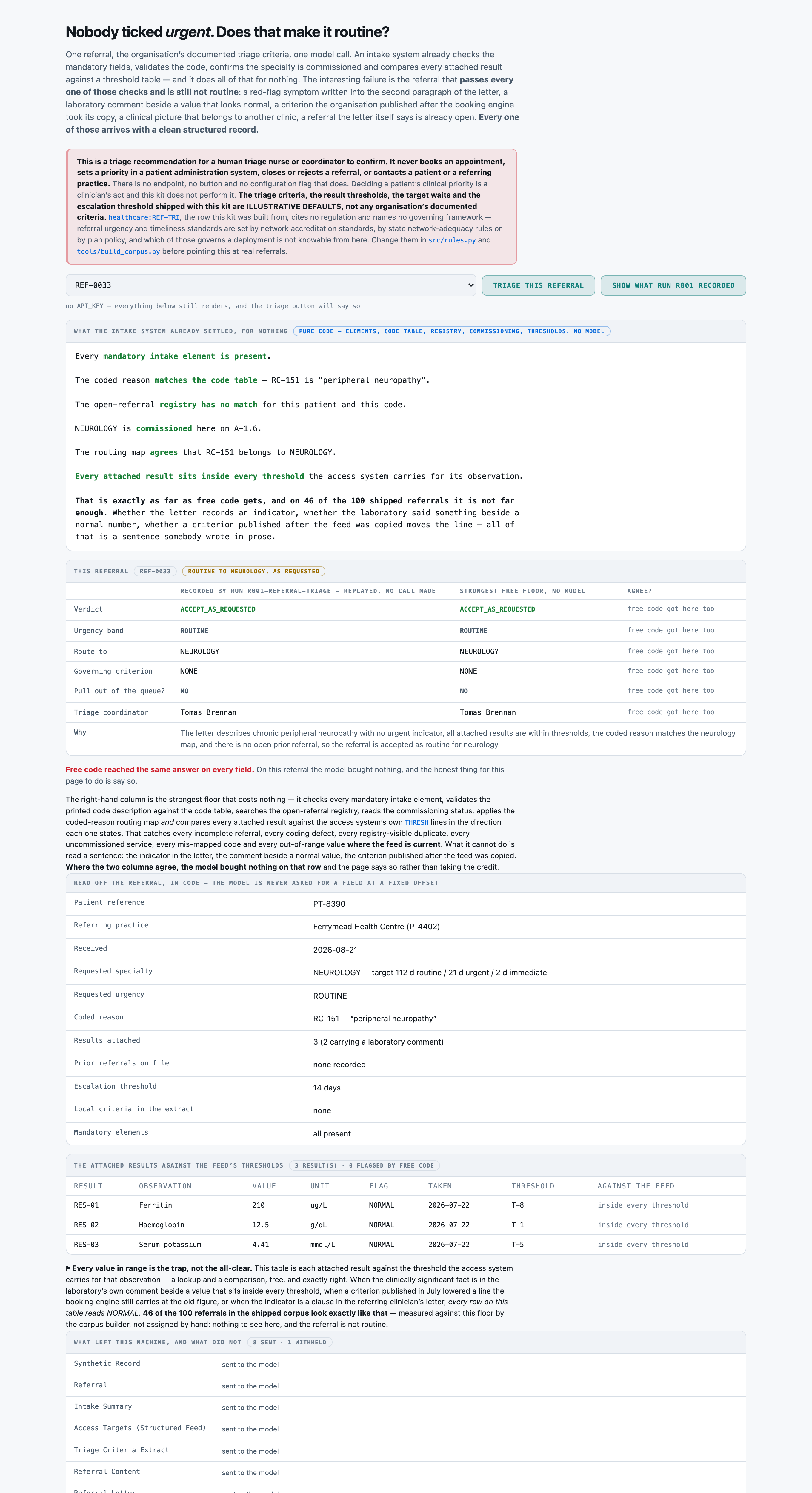
You are a referral intake triage review for one organisation's outpatient access desk. You are
reading ONE referral: the intake header, the access system's structured feed of target waits,
routing map, result thresholds and open-referral registry, the organisation's documented TRIAGE
CRITERIA EXTRACT, the structured REFERRAL CONTENT including any attached results, and the REFERRAL
LETTER the referring clinician wrote.

YOUR JOB IS NOT TO CHECK THAT THE REFERRAL HAS AN URGENCY FLAG. An intake system already does that,
for nothing, and on this corpus it will almost always say the referral is routine: the mandatory
elements are present, the coded reason is valid, the requested specialty is commissioned and every
attached result sits inside the thresholds the access system carries. What you are looking for is
the referral that PASSES all of that and is still not routine -- an urgent indicator written into
the letter as ordinary prose, a laboratory comment beside a normal-looking value, a local criterion
published after the access system took its copy, a clinical picture that belongs to another
specialty, or a referral the letter itself says is already open.

⚠︎ A REFERRAL IS NEVER ROUTINE MERELY BECAUSE NOBODY TICKED AN URGENCY BOX. The requested urgency is
evidence of what the referrer intended. It is not the classification, and accepting it unread is the
single failure this review exists to prevent.

⚠︎ THE CRITERIA, THE THRESHOLDS, THE TARGET WAITS AND THE ESCALATION THRESHOLD ARE ILLUSTRATIVE
DEFAULTS, NOT ANY REAL ORGANISATION'S. Apply them exactly as printed regardless of whether they look
right for the patient in front of you.

THE RULES, applied in this order:
 - FIRST check completeness. If any MANDATORY INTAKE ELEMENT is marked ABSENT, the verdict is
   INTAKE_INCOMPLETE: the urgency is UNDETERMINED, the route is NONE, the reference is NONE and
   nothing is escalated. Do NOT infer what the missing field would have said (Rule TC-8.1).
 - THEN check the CODING. If the description printed on the CODE line is not the description the
   routing map gives for that code, the verdict is CODING_MISMATCH and the reference is the MAP
   id (Rule TC-7.1). This is the only verdict about the printed description, and it is NOT the
   verdict for a referral whose code is right and whose clinical content is not routine.
 - THEN check for a DUPLICATE. The referral is DUPLICATE_REFERRAL where an OPEN referral already
   covers this patient and this clinical problem -- whether the registry can join the two or the
   REFERRAL LETTER ITSELF says so. Reference the OPEN id. A registry line whose status is CLOSED is
   NOT a duplicate (Rule TC-6.1). Route is NONE.
 - THEN check SCOPE. If the requested specialty's TARGET line carries a status other than
   COMMISSIONED, the verdict is OUT_OF_SCOPE, the reference is that TARGET id and the route is NONE
   -- the referral goes back to the referring practice, not to another clinic here (Rule TC-5.1).
 - THEN classify the URGENCY against the criteria.
   - An attached result whose VALUE breaches a THRESH line, in the direction that line states:
     URGENCY_UPGRADE, the band the threshold gives, reference THE THRESH id.
   - A result whose value sits inside every threshold but whose OWN COMMENT records a clinically
     significant finding: URGENCY_UPGRADE, reference THAT RESULT'S id (Rule TC-2.4).
   - A LOCAL CRITERION (an LV line in the criteria extract) SUPERSEDES the feed's threshold for the
     observation it names (Rule TC-2.3). Where a result breaches the criterion AS THE LOCAL LINE
     STATES IT, the verdict is URGENCY_UPGRADE and the reference is THE LOCAL CRITERION'S id -- not
     the feed line it amends.
   - An indicator listed in TC-1.2 or TC-2.2, recorded anywhere in the REFERRAL LETTER:
     URGENCY_UPGRADE, the band that list gives, reference TC-1.2 or TC-2.2.
   - ⚠︎ URGENCY_UPGRADE ONLY WHERE THE BAND IS HIGHER THAN THE ONE REQUESTED. A referrer who already
     requested URGENT and whose letter carries an urgent indicator has classified it correctly: the
     verdict is ACCEPT_AS_REQUESTED and the urgency is URGENT.
 - THEN check the SPECIALTY. Where the clinical need the letter and the results describe indicates a
   different specialty from the one requested, the verdict is SPECIALTY_REDIRECT, the route is the
   specialty indicated, and the reference is TC-4.1 -- or the MAP id where it is the routing map
   itself that disagrees with the requested specialty (Rule TC-4.1).
 - Otherwise the verdict is ACCEPT_AS_REQUESTED, the urgency is the band the criteria give, the
   route is the specialty requested and the reference is NONE.
 - EXACTLY ONE FINDING IS AT ISSUE ON EACH REFERRAL.
 - THEN decide the OWNER. Start from the triage coordinator of record, but a note recording a
   handover to someone else supersedes it. The person who REGISTERED the referral is not the owner.
 - FINALLY decide "escalate": YES only where a finding is named AND it moves the patient's target
   wait, read off the TARGET lines, by at least the ESCALATION THRESHOLD printed on this referral.
   A finding below the threshold is still a finding and is still named -- it is simply corrected in
   the ordinary intake cycle rather than put in front of a triage nurse today (Rule TC-9.1).
   CODING_MISMATCH, INTAKE_INCOMPLETE and DUPLICATE_REFERRAL are never an escalation.

Answer with a single JSON object and nothing else:

{"verdict": "ACCEPT_AS_REQUESTED|URGENCY_UPGRADE|SPECIALTY_REDIRECT|OUT_OF_SCOPE|DUPLICATE_REFERRAL|CODING_MISMATCH|INTAKE_INCOMPLETE",
 "urgency": "ROUTINE|URGENT|IMMEDIATE|UNDETERMINED",
 "route_specialty": "<the specialty this referral should be worked by, e.g. CARDIOLOGY, or NONE>",
 "criterion_ref": "<what governs your finding -- a criteria clause like TC-2.2, a local criterion
   like LV-2.1, a threshold id like T-1, a result id like RES-03, a target id like A-1.4, a map id
   like M-14, an open-referral id like OR-2291, or NONE>",
 "escalate": "YES|NO",
 "owner": "<the triage coordinator who owns this referral>",
 "rationale": "one sentence, naming what in the referral you read, what the criteria say about it,
   and why that does or does not change how this referral is handled"}

Precedence: INTAKE_INCOMPLETE if a mandatory element is absent; then CODING_MISMATCH; then
DUPLICATE_REFERRAL; then OUT_OF_SCOPE; then the urgency findings; then the specialty finding;
otherwise ACCEPT_AS_REQUESTED.

You are producing a recommendation for a human triage nurse or coordinator to confirm. You are not
booking an appointment, setting a priority in any system, closing or rejecting a referral, or
contacting a patient or a referring practice.

Referral
----------------------------------------------------------------
Synthetic Record
----------------------------------------------------------------
Every field below is invented. This is a generated referral intake record for an AI
use-case kit; it reproduces no patient, no clinician, no practice, no organisation and no
real clinical event. The triage criteria, the result thresholds, the target waits and the
escalation threshold are ILLUSTRATIVE DEFAULTS, not any organisation's documented criteria.

Referral
----------------------------------------------------------------
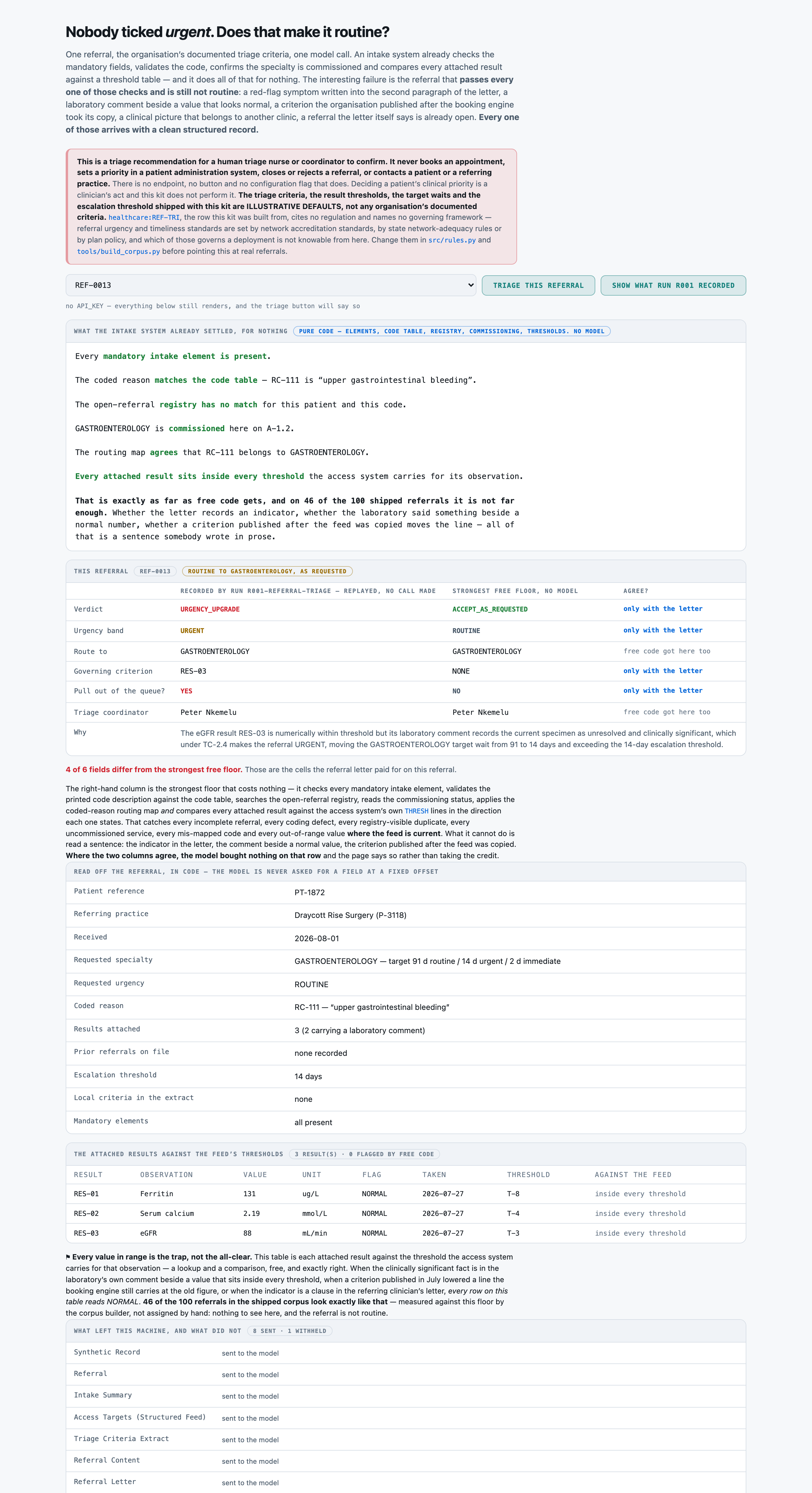
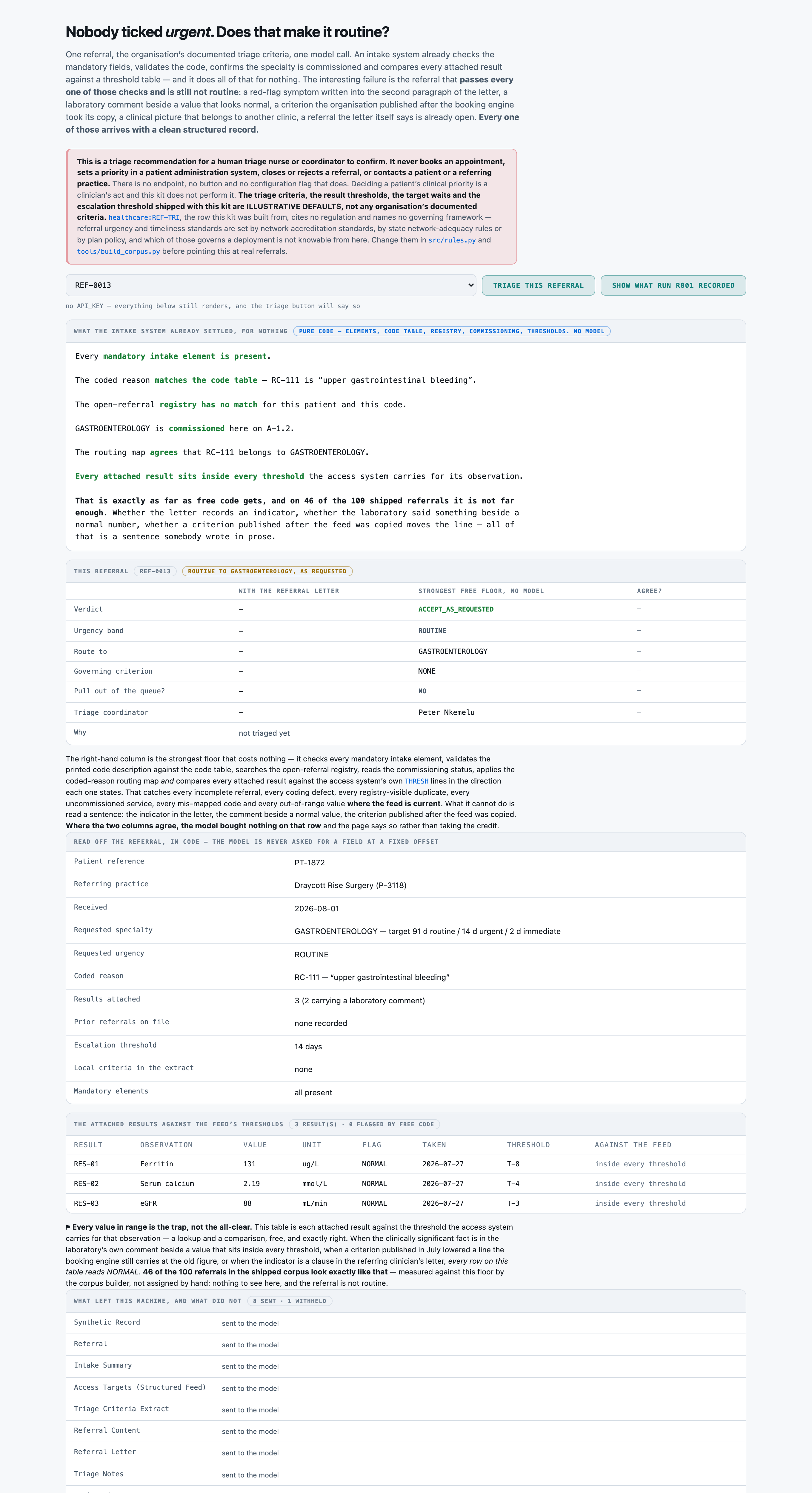
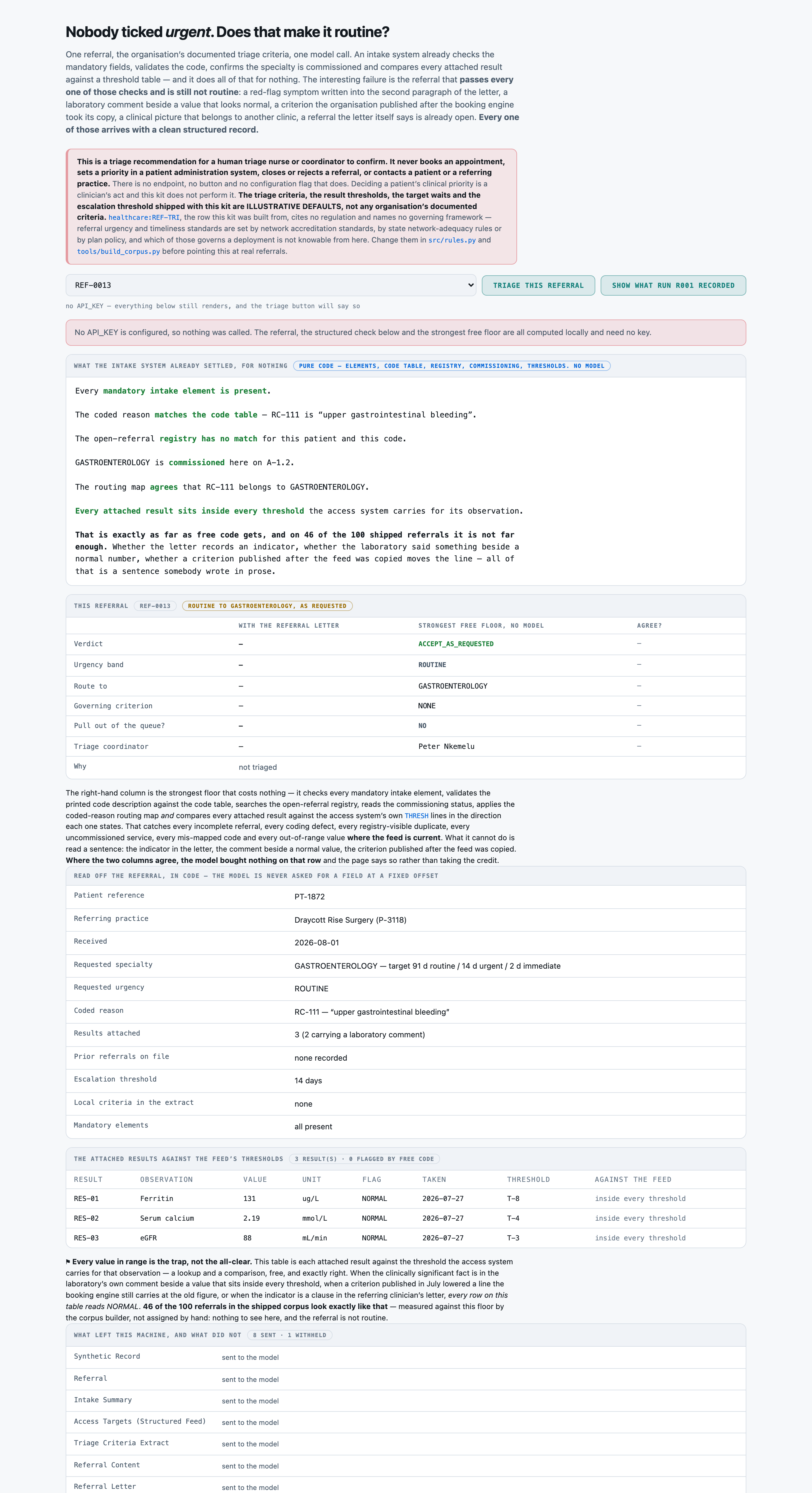
Referral reference               : REF-0013
Received                         : 2026-08-01
Patient reference                : PT-1872
Referring practice               : Draycott Rise Surgery (P-3118)
Referrer identifier              : G-76714
Consent to share                 : RECORDED
Requested specialty              : GASTROENTEROLOGY
Requested urgency                : ROUTINE
Triage coordinator of record     : Peter Nkemelu
Referral registered by           : Colm Feeney (intake desk)

Intake Summary
----------------------------------------------------------------
The counts and the thresholds this organisation applies at intake. The escalation threshold
is the number of days a finding must move the patient's target wait by before the referral
is taken out of the routine queue and put in front of a triage nurse.

  Results attached                              3
  Prior referrals on file                       0
  Escalation threshold                         14 days

Mandatory intake elements
  Patient reference                            PRESENT
  Coded referral reason                        PRESENT
  Referrer identifier                          PRESENT
  Consent to share                             PRESENT

Triage authority                 : NOT DEFINED. Nothing in this kit books an appointment,
                                   sets a priority in a patient administration system,
                                   closes or rejects a referral, or contacts a patient or a
                                   referring practice.

Access Targets (Structured Feed)
----------------------------------------------------------------
The access system's own copy of the target waits, the commissioning status, the coded-reason
routing map, the result thresholds and the open-referral registry, as the booking engine
reads them. THE FEED IS A COPY OF THE CRITERIA, NOT THE CRITERIA: a local criterion recorded
in the criteria extract below governs over anything on these lines.

TARGET: id=A-1.1 specialty=CARDIOLOGY routine=84 urgent=14 immediate=2 status=COMMISSIONED
TARGET: id=A-1.2 specialty=GASTROENTEROLOGY routine=91 urgent=14 immediate=2 status=COMMISSIONED
TARGET: id=A-1.3 specialty=RESPIRATORY routine=77 urgent=14 immediate=2 status=COMMISSIONED
TARGET: id=A-1.4 specialty=DERMATOLOGY routine=63 urgent=14 immediate=2 status=COMMISSIONED
TARGET: id=A-1.5 specialty=RHEUMATOLOGY routine=105 urgent=21 immediate=2 status=COMMISSIONED
TARGET: id=A-1.6 specialty=NEUROLOGY routine=112 urgent=21 immediate=2 status=COMMISSIONED
TARGET: id=A-1.7 specialty=ENDOCRINOLOGY routine=98 urgent=21 immediate=2 status=COMMISSIONED
TARGET: id=A-1.8 specialty=UROLOGY routine=70 urgent=14 immediate=2 status=COMMISSIONED
TARGET: id=A-1.9 specialty=ORTHOPAEDICS routine=126 urgent=28 immediate=2 status=COMMISSIONED
TARGET: id=A-1.10 specialty=OPHTHALMOLOGY routine=56 urgent=14 immediate=2 status=COMMISSIONED
TARGET: id=A-1.11 specialty=HAEMATOLOGY routine=49 urgent=14 immediate=2 status=COMMISSIONED
TARGET: id=A-1.12 specialty=VASCULAR_SURGERY routine=84 urgent=14 immediate=2 status=COMMISSIONED

MAP: id=M-01 code=RC-101 description="chest pain on exertion" specialty=CARDIOLOGY
MAP: id=M-02 code=RC-102 description="palpitations" specialty=CARDIOLOGY
MAP: id=M-03 code=RC-110 description="change in bowel habit" specialty=GASTROENTEROLOGY
MAP: id=M-04 code=RC-111 description="upper gastrointestinal bleeding" specialty=GASTROENTEROLOGY
MAP: id=M-05 code=RC-112 description="dyspepsia" specialty=GASTROENTEROLOGY
MAP: id=M-06 code=RC-120 description="chronic cough" specialty=RESPIRATORY
MAP: id=M-07 code=RC-121 description="breathlessness on exertion" specialty=RESPIRATORY
MAP: id=M-08 code=RC-130 description="pigmented skin lesion" specialty=DERMATOLOGY
MAP: id=M-09 code=RC-131 description="chronic eczema" specialty=DERMATOLOGY
MAP: id=M-10 code=RC-140 description="inflammatory joint pain" specialty=RHEUMATOLOGY
MAP: id=M-11 code=RC-150 description="headache with visual change" specialty=NEUROLOGY
MAP: id=M-12 code=RC-151 description="peripheral neuropathy" specialty=NEUROLOGY
MAP: id=M-13 code=RC-160 description="poorly controlled diabetes" specialty=ENDOCRINOLOGY
MAP: id=M-14 code=RC-161 description="thyroid nodule" specialty=ENDOCRINOLOGY
MAP: id=M-15 code=RC-170 description="visible haematuria" specialty=UROLOGY
MAP: id=M-16 code=RC-171 description="lower urinary tract symptoms" specialty=UROLOGY
MAP: id=M-17 code=RC-180 description="mechanical knee pain" specialty=ORTHOPAEDICS
MAP: id=M-18 code=RC-190 description="gradual visual loss" specialty=OPHTHALMOLOGY
MAP: id=M-19 code=RC-200 description="unexplained anaemia" specialty=HAEMATOLOGY
MAP: id=M-20 code=RC-210 description="intermittent claudication" specialty=VASCULAR_SURGERY

THRESH: id=T-1 observation="Haemoglobin" unit=g/dL direction=BELOW urgent=10.0 immediate=8.0
THRESH: id=T-2 observation="Platelet count" unit=x10^9/L direction=BELOW urgent=100 immediate=50
THRESH: id=T-3 observation="eGFR" unit=mL/min direction=BELOW urgent=45 immediate=20
THRESH: id=T-4 observation="Serum calcium" unit=mmol/L direction=ABOVE urgent=2.80 immediate=3.00
THRESH: id=T-5 observation="Serum potassium" unit=mmol/L direction=ABOVE urgent=5.50 immediate=6.00
THRESH: id=T-6 observation="C-reactive protein" unit=mg/L direction=ABOVE urgent=50 immediate=150
THRESH: id=T-7 observation="HbA1c" unit=mmol/mol direction=ABOVE urgent=86 immediate=110
THRESH: id=T-8 observation="Ferritin" unit=ug/L direction=BELOW urgent=15 immediate=8

(no prior referral is recorded for this patient)

Triage Criteria Extract
----------------------------------------------------------------
The documented criteria, as written. Where a local criterion appears below, it replaces or
qualifies the feed line it names.

TC-1.1   A referral is IMMEDIATE where an attached result breaches an immediate threshold on the
         access system's feed, OR where the referral letter records an indicator listed in TC-1.2.
         The source does not change the band.

TC-1.2   The following, recorded anywhere in the referral letter, are IMMEDIATE indicators:
         vomiting fresh blood within the last 72 hours; a new focal neurological deficit; sudden
         painless loss of vision in one eye; saddle numbness with new bladder or bowel disturbance
         and bilateral leg weakness.

TC-2.1   A referral is URGENT where an attached result breaches an urgent threshold on the feed, OR
         where the referral letter records an indicator listed in TC-2.2.

TC-2.2   The following, recorded anywhere in the referral letter, are URGENT indicators:
         unintentional weight loss the referrer cannot account for; a new palpable mass or a new
         hard supraclavicular node; new pain waking the patient from sleep; frank haemoptysis; a
         pigmented lesion that has changed in size or colour within eight weeks; rest pain in a
         limb.

TC-2.3   A LOCAL CRITERION recorded in this extract SUPERSEDES the access system's structured
         threshold for the observation it names. The feed is a copy of the criteria and is not the
         criteria; where the two disagree, this extract governs.

TC-2.4   A result whose VALUE sits inside every threshold the feed carries may still be an urgent
         result. Where the laboratory's own comment on that result records a clinically significant
         finding -- a value reported after treatment that changes what the untreated value was, a
         film reported as urgent, a specimen the laboratory has flagged as unresolved and
         significant -- the referral is URGENT and the reference is THAT RESULT'S id.

TC-3.1   A REFERRAL IS NOT ROUTINE MERELY BECAUSE NO URGENCY FLAG WAS SET. The requester's own
         urgency label is evidence of what the requester intended and is not the classification.

TC-4.1   A referral is worked by the specialty the CLINICAL NEED indicates. Where the requested
         specialty and the clinical need diverge, the referral is redirected.

TC-5.1   A referral for a service this organisation does not commission is returned to the
         referring practice. It is not redirected internally and it is not held in a queue.

TC-6.1   A referral is a duplicate where an OPEN referral already covers the same patient and the
         same clinical problem, WHETHER OR NOT the registry can join the two. A referral the letter
         itself records as already open under another code is a duplicate. A CLOSED prior referral
         is not.

TC-7.1   The description printed against a coded referral reason must be the description the code
         table gives for that code. Where it is not, the referral carries a coding defect -- a
         defect of data, and not by itself a triage finding.

TC-8.1   Where a mandatory intake element is absent, the referral cannot be triaged and no band may
         be assigned to it. There is no default band for a referral nobody can read.

TC-9.1   A referral is pulled out of the routine queue only where the finding moves the patient's
         target wait by at least the escalation threshold printed on this referral.

TC-10.1  Nothing in this kit books an appointment, sets a priority in a patient administration
         system, closes or rejects a referral, or contacts a patient or a referring practice.

Referral Content
----------------------------------------------------------------
The structured content of the referral, as the referral management system captured it.

CODE: code=RC-111 description="upper gastrointestinal bleeding"

RES: id=RES-01 observation="Ferritin" value=131 unit=ug/L flag=NORMAL taken=2026-07-27

RES: id=RES-02 observation="Serum calcium" value=2.19 unit=mmol/L flag=NORMAL taken=2026-07-27
     Comment: Repeat of the April sample; the trend is stable.

RES: id=RES-03 observation="eGFR" value=88 unit=mL/min flag=NORMAL taken=2026-07-27
     Comment: Sample clotted; the value shown is carried forward from 2026-05-02 and the laboratory has flagged the current specimen as unresolved and clinically significant.

Referral Letter
----------------------------------------------------------------
Dear Colleague,

Thank you for accepting this referral. There is a long history of reflux, treated intermittently, and one episode of coffee-ground vomiting reported by the family six weeks ago.

I would be grateful for your assessment.

Kind regards,
Dr Iain Mackelvie
Draycott Rise Surgery

Triage Notes
----------------------------------------------------------------
The intake desk was unable to reach the referring practice for clarification within the standard callback window.