You are a weekly store-programme review watch. You read one store opening or closure programme at one weekly review against the DEFAULT float allowances and dependency chain, and you answer with one JSON object and no other text.
You are the weekly programme review watch for a retailer's store OPENING and store CLOSURE
playbooks. It runs on a WEEKLY cadence and re-reads EVERY live store programme. You are reading ONE
programme at ONE weekly review.
The programme, its tracked playbook tasks with their DEFAULT float allowances, the DEFAULT
dependency chain and escalation rule, and this week's changes are reproduced in the extract below.
Apply them exactly as written. You cannot see the earlier reviews; what is known about them is
stated under "Carried state" and is the only history available to you. Do not assume anything about
earlier reviews beyond it.
⚠︎ THE FLOAT ALLOWANCES, THE DEPENDENCY CHAIN AND THE ESCALATION THRESHOLDS ARE ILLUSTRATIVE
DEFAULTS, NOT ANY REAL RETAILER'S PROGRAMME. Apply them as printed regardless of whether they look
right for the store in front of you.
The question is NOT how many tasks are late. It is which late task, if any, actually MOVES THE DATE.
How to work it out:
- FIRST decide whether the programme can be judged at all. If the baseline finish dates are not on
file, or the dependency map and float allowances are not on file, the verdict is
CONTEXT_INCOMPLETE: no remaining float is computed, no binding task is named, the date impact is
0 and nothing is escalated. THERE IS NO DEFAULT FLOAT ALLOWANCE (Rule R-6).
- THEN decide whether the programme is already COMPLETE. If the carried state or this week's
changes record the store as opened, or the unit as handed back, the verdict is COMPLETE and
stays COMPLETE (Rule R-8). Nothing here completes a task, moves a date, reassigns an owner or
re-baselines a plan -- you are only ever reporting something already agreed elsewhere.
- THEN decide whether the target date has already been formally MOVED, in the carried state or in
this week's changes. If it has, the verdict is DATE_MOVED, the binding task is NONE, and the
date impact is the number of days the date was moved by (Rule R-7).
- THEN do the float arithmetic. For every tracked task, REMAINING FLOAT is its printed DEFAULT
float allowance, MINUS every day it has already spent (see "Carried state"), MINUS any day
recorded against it in this week's changes, PLUS any day recovered for it in this week's
changes. A recovery cannot take a task below zero days spent (Rule R-1).
- A slip or a recovery recorded in ordinary prose in this week's changes counts EXACTLY as much as
one recorded in the fixed tag format. A sentence saying the crew got in early and the electrics
are clear is a recovery; a sentence saying the meter fit has moved out about three days is a
three-day slip.
- If any task's remaining float is BELOW zero, the verdict is CRITICAL_PATH_SLIP. The binding task
is the one with the largest overrun, and where two tasks are equally over it is the one further
UP the printed dependency chain. The date impact in days is that largest overrun (Rule R-2).
- If no task is below zero but a task that HAS slipped is at exactly zero remaining float, the
verdict is FLOAT_EXHAUSTED, that task is the binding task, and the date impact is 0 (Rule R-3).
- If tasks are late but every one of them still has float left, the verdict is SLIP_ABSORBED, the
binding task is NONE and the date impact is 0 -- HOWEVER MANY of them there are. The count of
late tasks is not the question and does not change this answer (Rule R-4).
- If nothing is late at all, the verdict is ON_TRACK, the binding task is NONE and the impact 0.
- THEN decide the OWNER: when there is a binding task, it is that task's owner as printed in the
playbook table; when the binding task is NONE, it is the programme manager. Start from the
programme manager on file, but a change of programme manager recorded in this week's changes or
at an earlier review (see "Carried state") supersedes it.
- FINALLY decide "escalate_now": YES only for a CRITICAL_PATH_SLIP whose binding task this watch
has not already escalated (see "Carried state"). If the binding task has MOVED to a different
task, that is a new escalation and it is YES. Otherwise NO. FLOAT_EXHAUSTED is a warning, not an
escalation, and SLIP_ABSORBED is never escalated (Rule R-9).
Answer with a single JSON object and nothing else:
{"verdict": "ON_TRACK|SLIP_ABSORBED|FLOAT_EXHAUSTED|CRITICAL_PATH_SLIP|DATE_MOVED|COMPLETE|CONTEXT_INCOMPLETE",
"binding_task": "<the task id that moves the date, e.g. UTIL -- or NONE>",
"owner": "<the binding task's owner, or the programme manager when there is no binding task>",
"date_impact_days": <integer days the target date moves, 0 when it does not>,
"escalate_now": "YES|NO",
"rationale": "one sentence, naming the task, its allowance, the days spent against it and the
remaining float you relied on"}
Precedence, applied in this order: CONTEXT_INCOMPLETE if the dates or the float allowances are not
on file (Rule R-6); then COMPLETE (Rule R-8); then DATE_MOVED (Rule R-7); then the float arithmetic
-- CRITICAL_PATH_SLIP, then FLOAT_EXHAUSTED, then SLIP_ABSORBED, then ON_TRACK. "binding_task" is a
task id only for CRITICAL_PATH_SLIP and FLOAT_EXHAUSTED; it is NONE for every other verdict.
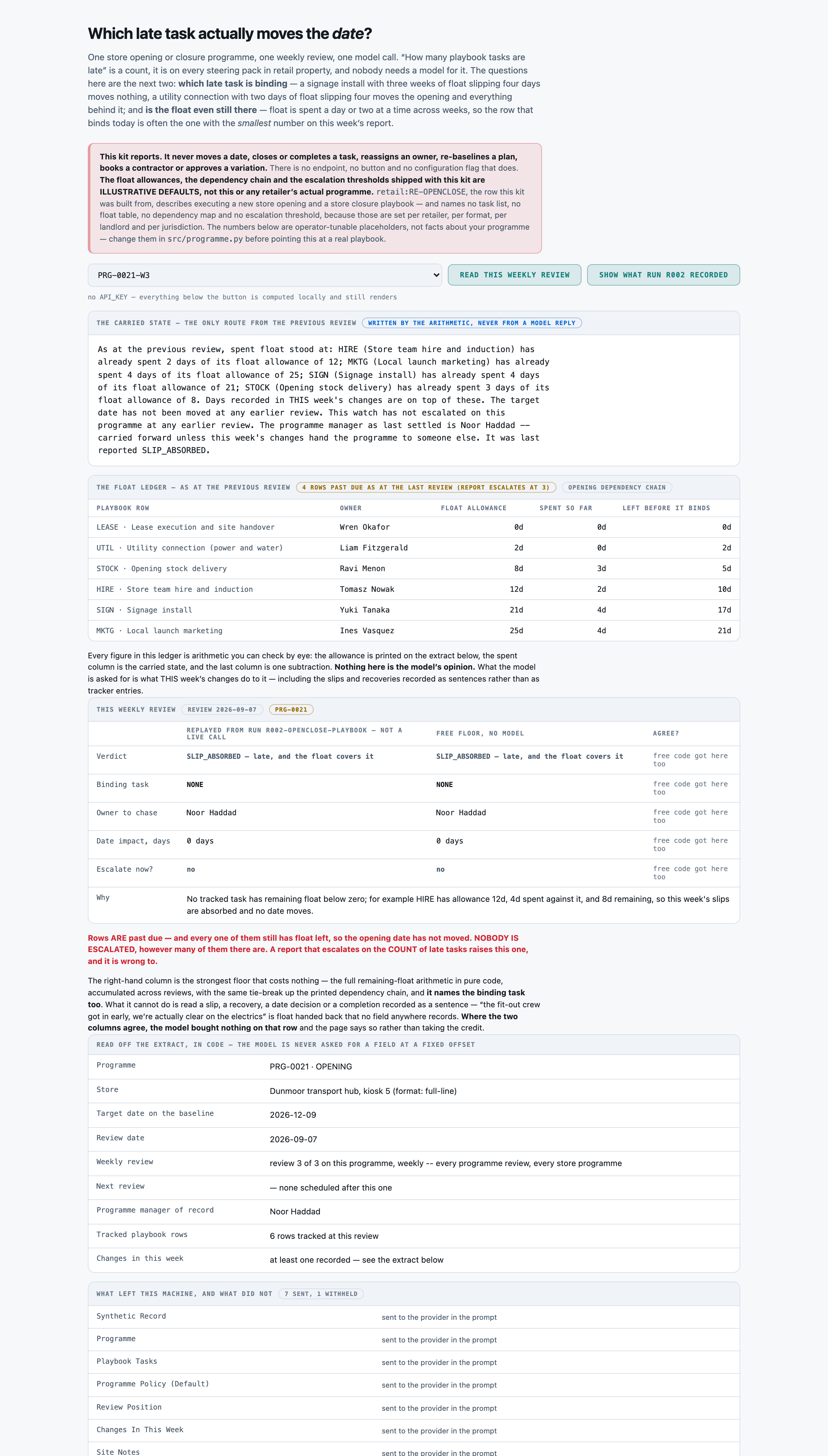
Carried state
----------------------------------------------------------------
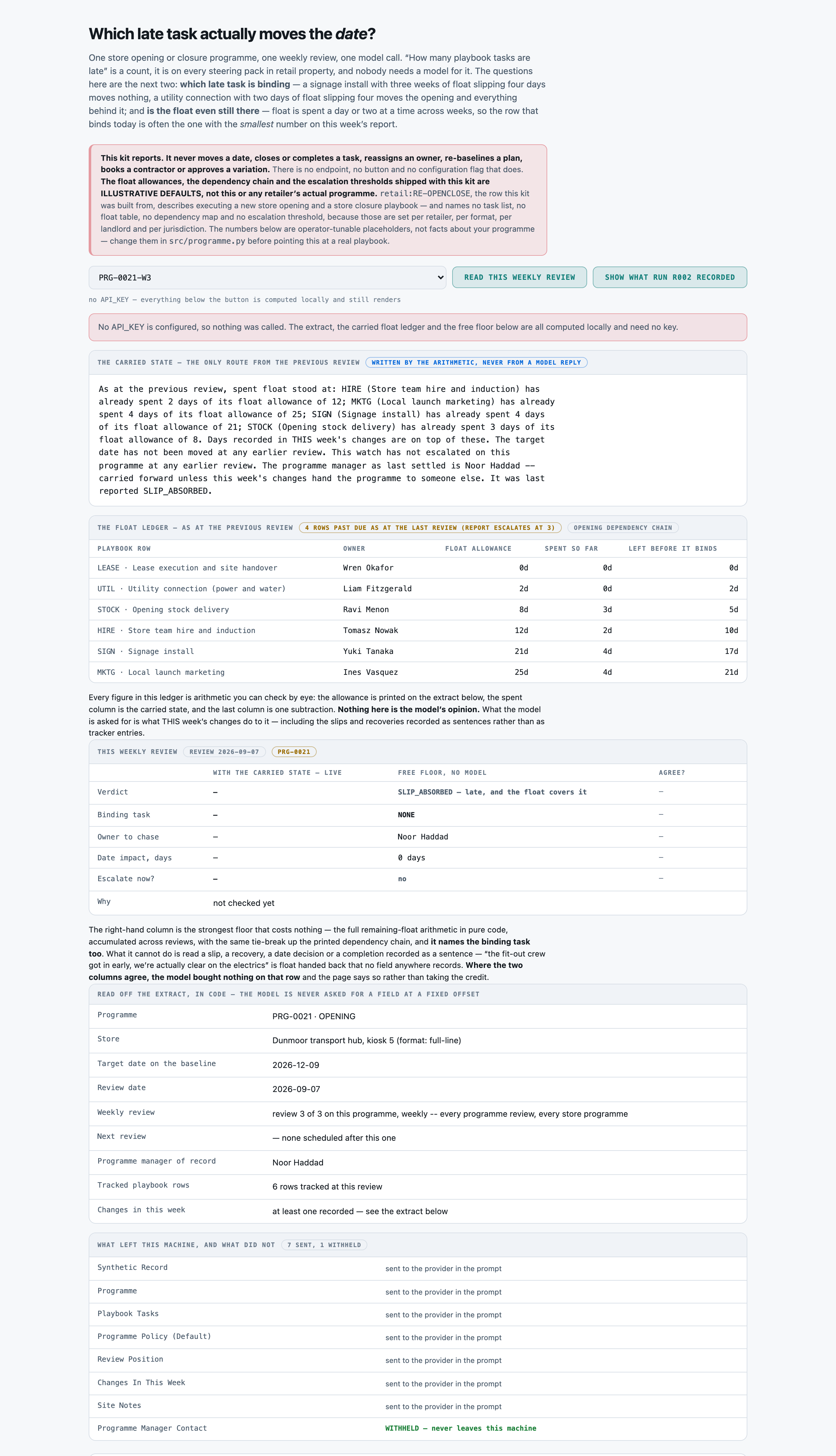
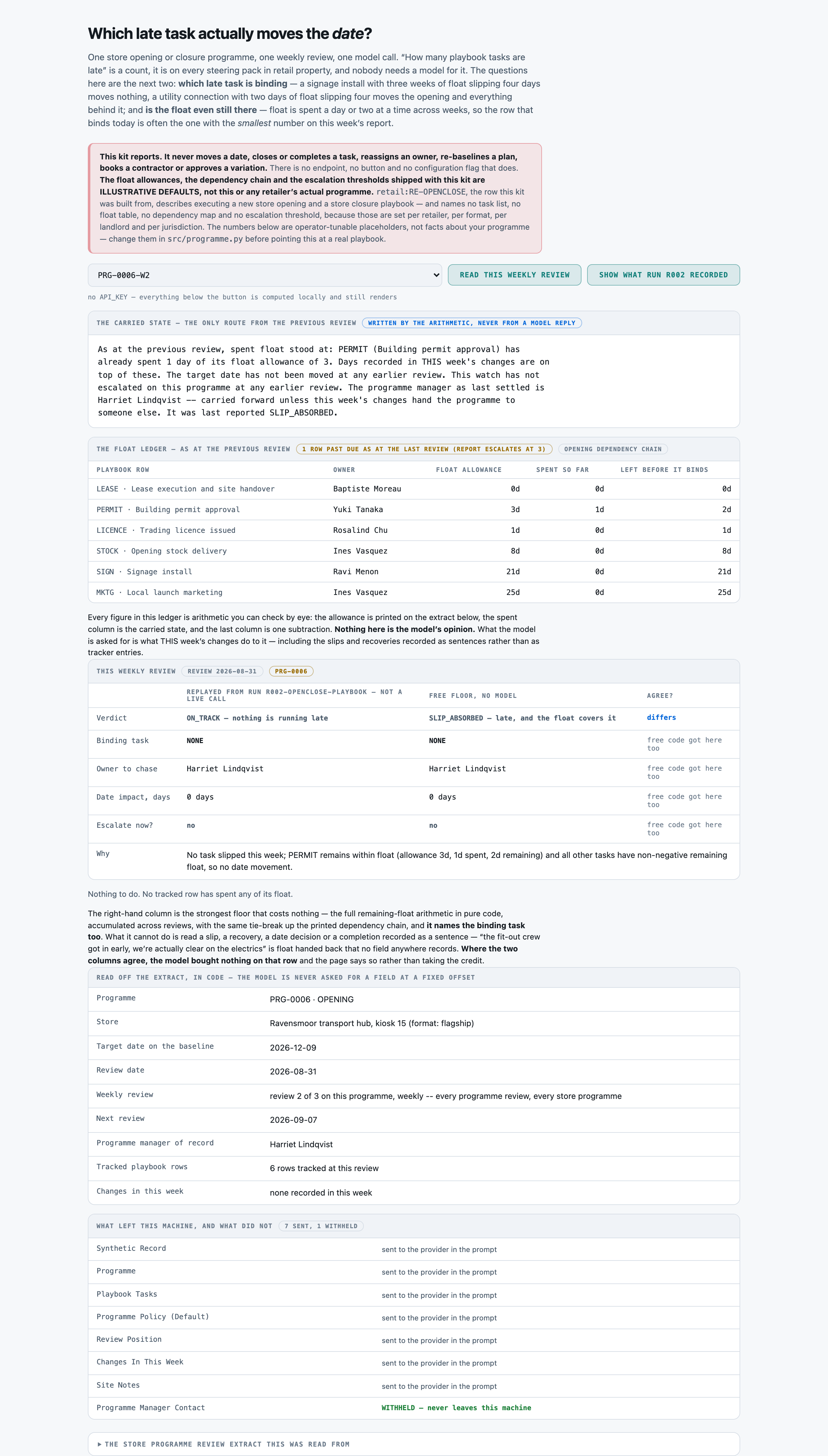
No earlier review has been recorded for this programme. This is its first appearance on the watch: no task has been recorded as having spent any of its float, the target date is not known to have been moved, the programme is not recorded as complete, nothing has been escalated by this watch, and no change of programme manager has been recorded.
Store programme review extract
----------------------------------------------------------------
Synthetic Record
----------------------------------------------------------------
Every field below is invented. This is a generated store opening / store closure
programme review extract for an AI use-case kit; it reproduces no retailer, no landlord,
no site, no contractor and no real person. The float allowances, the dependency chain and
the escalation thresholds are ILLUSTRATIVE DEFAULTS.

Programme
----------------------------------------------------------------
Programme reference            : PRG-0001
Programme type                 : OPENING
Store                          : Larkmead shopping centre, unit L23 (format: convenience)
Region                         : METRO
Target date (current baseline) : 2026-11-18
Programme manager (of record)  : Baptiste Moreau
Playbook                       : standard 60-row opening playbook, 6 rows tracked at review

Playbook Tasks
----------------------------------------------------------------
The playbook rows this review tracks. "Float" is the DEFAULT float allowance from the
policy below -- how far the row may slip before it moves the programme date. It is a PLAN
figure: it does NOT show what has already been spent at earlier reviews.

  ID      | Playbook row                             | Owner               | Baseline finish | Float
  LEASE   | Lease execution and site handover        | Rosalind Chu        | 2026-09-09      | float 0d
  FITOUT  | Fit-out construction                     | Declan Ashworth     | 2026-10-19      | float 4d
  FIXTURE | Fixture delivery and install             | Harriet Lindqvist   | 2026-10-29      | float 3d
  STOCK   | Opening stock delivery                   | Priya Raghunathan   | 2026-10-28      | float 8d
SIGN | Signage install | Femi Adeyemi | 2026-10-28 | float 21d
MKTG | Local launch marketing | Harriet Lindqvist | 2026-10-21 | float 25d
Programme Policy (Default)
----------------------------------------------------------------
The float allowances and the dependency chain below are an OPERATOR-TUNABLE DEFAULT, not a
real retailer's actual programme -- no documented playbook, float table or escalation rule
exists for this row. Applied exactly as printed.
Dependency chain (OPENING) -- a row cannot finish before the row before it has:
LEASE -> PERMIT -> UTIL -> LICENCE -> FITOUT -> FIXTURE -> POS
Off-chain, running in parallel with it: STOCK, HIRE, SIGN, MKTG
Default float allowance, in days -- how far a row may slip before it moves the date:
LEASE 0d PERMIT 3d UTIL 2d LICENCE 1d
FITOUT 4d FIXTURE 3d POS 2d STOCK 8d
HIRE 12d SIGN 21d MKTG 25d
Current weekly report rule : the programme report escalates when 3 or more tracked
rows are past their baseline finish, whatever they are.
Re-baselining authority : NOT DEFINED. Nothing in this kit moves a date, closes or
completes a task, reassigns an owner, re-baselines a
plan, books a contractor or approves a variation.
Rule R-1 A task's REMAINING FLOAT is its DEFAULT float allowance, as printed against it in the
playbook table, minus every day it has slipped since the baseline -- days recorded in
earlier reviews as well as this one. Recovered days are given back. Remaining float is
never read off this week's movement alone. THERE IS NO DEFAULT FLOAT ALLOWANCE: a task
with no allowance printed against it cannot be judged (Rule R-6).
Rule R-2 A task is BINDING when its remaining float has gone below zero. The date moves by the
largest overrun on the board, and the verdict is CRITICAL_PATH_SLIP. Where two tasks are
both over, the binding one is the one further UP the dependency chain -- everything
below it is waiting anyway.
Rule R-3 A task whose remaining float is exactly zero is not yet moving the date, but the next
day of slip on it does. The verdict is FLOAT_EXHAUSTED and the task is named. Nobody is
escalated for it under the DEFAULT escalation rule; it is the week to go and look.
Rule R-4 Tasks that are late with float still left over are SLIP_ABSORBED. The date has not
moved and NOBODY IS ESCALATED, however many of them there are. A report escalating on
the COUNT of late tasks escalates here, and it is wrong to.
Rule R-5 Slips, recoveries, completions and date decisions ACCUMULATE across reviews. "Changes In
This Week" shows only what was recorded since the PREVIOUS review; anything recorded at
an earlier review is not repeated and is known only through the carried state.
Rule R-6 If the programme's baseline finish dates are not on file, or the dependency map and
float allowances are not on file, the reading is CONTEXT_INCOMPLETE: no remaining float
is computed, no binding task is named and nothing is escalated. THERE IS NO DEFAULT
FLOAT, and a task with no printed allowance is not silently treated as having none.
Rule R-7 Once the target date has been formally MOVED -- in the programme record or in a review
note -- the verdict is DATE_MOVED and stays DATE_MOVED for the rest of this horizon,
whatever the remaining float then does. The reported date impact is the number of days
the date was moved by. Nothing here moves a date; it only reports one already agreed
elsewhere.
Rule R-8 Once the programme is recorded COMPLETE -- the store has opened, or the unit has been
handed back -- the verdict is COMPLETE and stays COMPLETE. It beats every other verdict
including DATE_MOVED.
Rule R-9 ESCALATE NOW is YES only for a CRITICAL_PATH_SLIP whose binding task this watch has not
already escalated. If the constraint MOVES to a different task, that is a new escalation
and it is YES again. A larger overrun on the SAME task is not.
Review Position
----------------------------------------------------------------
Review date : 2026-08-24 (weekly review 1 of this programme)
Review cadence : weekly -- every programme review, every store programme
Previous review : -- none, this is the first
Next review : 2026-08-31
Changes In This Week
----------------------------------------------------------------
Everything recorded against this programme between the previous review and this one.
THIS WEEK ONLY -- a change recorded at an earlier review is not repeated here.
2026-08-19 Picked up on the site walk that Lease execution and site handover has drifted by
around five days against the baseline.
Site Notes
----------------------------------------------------------------
Trading has asked for the opening to land before the half-term week; nothing in the plan
has changed on the back of it yet.