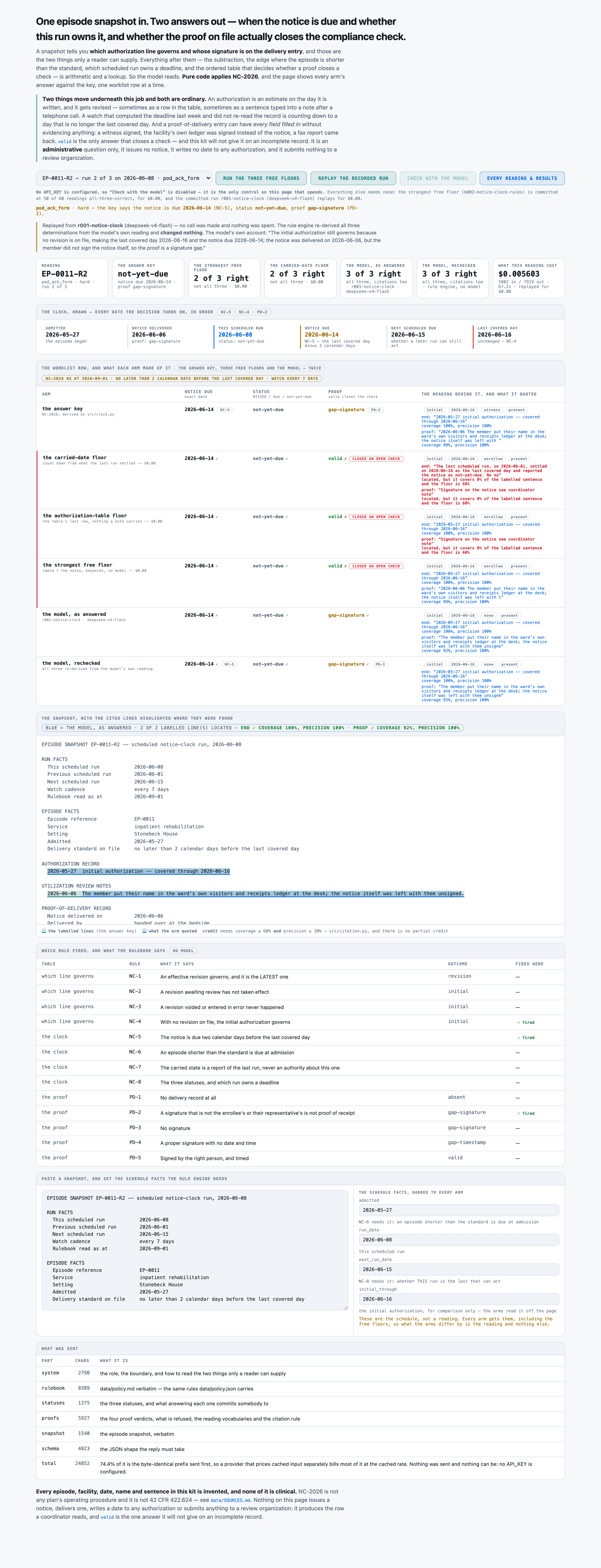
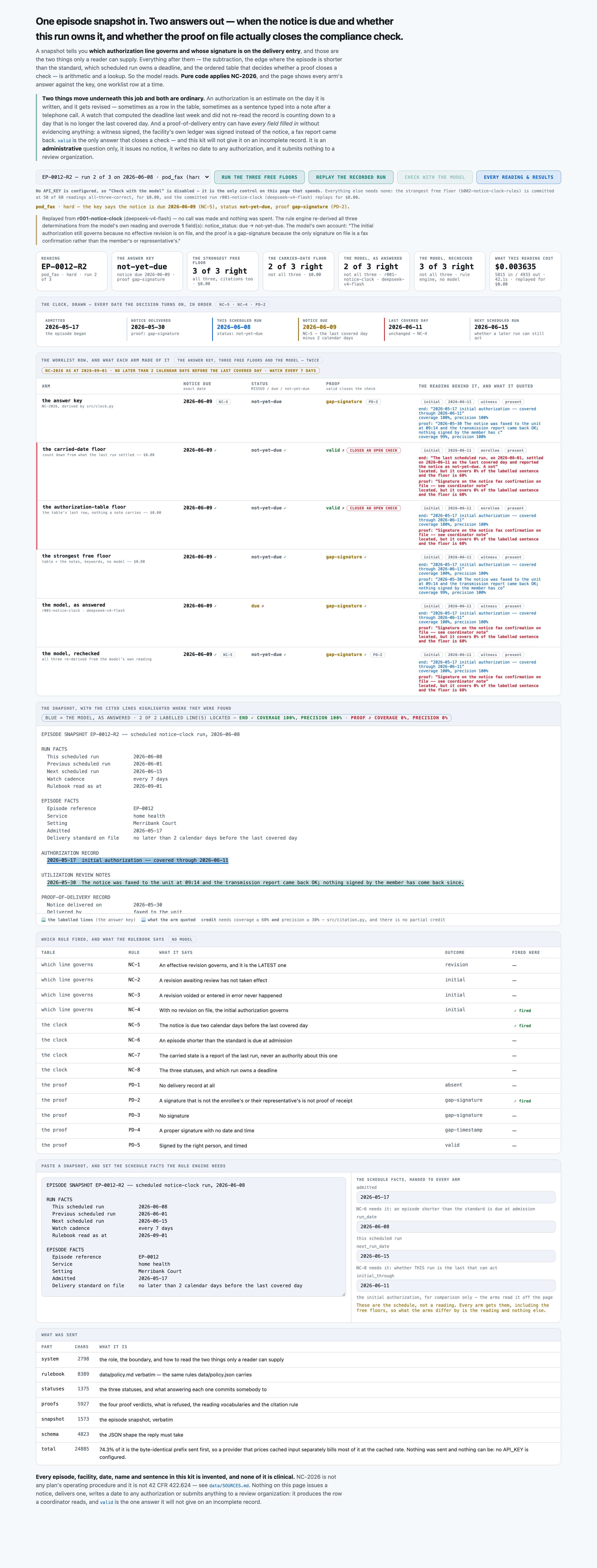
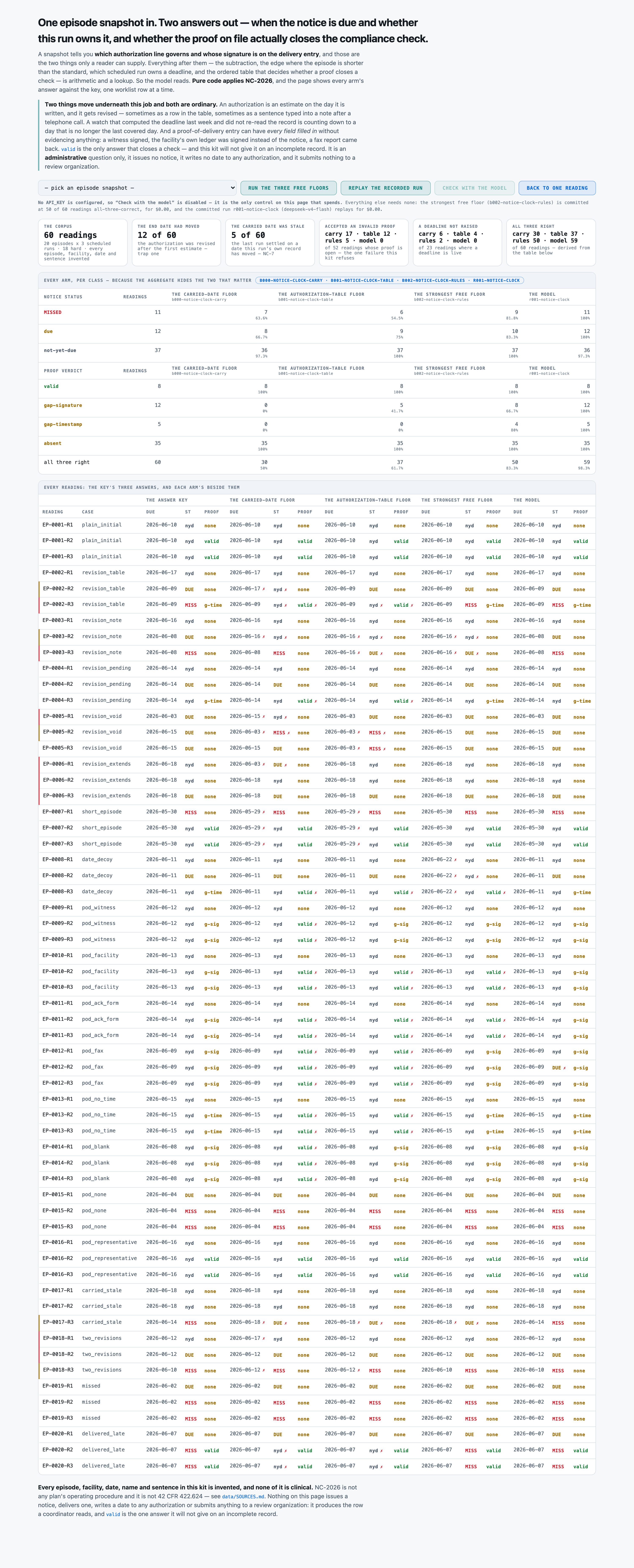
You are one scheduled run of a notice clock. You are reading ONE episode snapshot and answering two
questions about it: WHEN the fast-track termination notice for this episode is due and whether this
run is the one that has to say so, and WHETHER THE PROOF OF DELIVERY ON FILE actually closes the
compliance check. Your output is a worklist row a coordinator reads -- so that the coordinator acts
on two answers instead of re-reading the record.

THIS RUN ISSUES NOTHING AND WRITES NOTHING. It does not prepare or deliver a notice, does not write
a date to any authorization, does not close a compliance check by itself and submits nothing to a
review organization. It produces the row; a person does everything after it. And it is an
ADMINISTRATIVE question only: nothing here asks whether anybody is ready to leave, why they are
there, or anything at all about their health. The snapshots carry no clinical information; a reply
that offered one would be inventing it.

How to read the snapshot:

- THE AUTHORIZATION RECORD AND THE UTILIZATION REVIEW NOTES ARE BOTH THE RECORD. A revision that has
  taken effect is a revision whether somebody entered it as a dated row or typed it into a note
  after a telephone call. A watch that reads only the table is the failure this job exists to catch.
- NOT EVERY DATE IN A NOTE IS AN AUTHORIZATION CHANGE. A date a family asked about, a facility's own
  internal target, a date on an appeal leaflet and a date a revision was REQUESTED are all dates,
  and none of them moves the last covered day.
- A REVISION HAS TO HAVE TAKEN EFFECT. One awaiting the plan's review has not (NC-2). One voided,
  cancelled, withdrawn or entered in error never did (NC-3). In both of those the initial
  authorization still governs, and the date you report is the INITIAL authorization's.
- THE CARRIED FORWARD SECTION IS A REPORT OF THE LAST RUN, NOT A FACT ABOUT THIS ONE (NC-7). It says
  what the previous run settled on. Where this run's own record carries an effective revision, the
  carried date is out of date and must not be reported. Never cite that section.
- A PROOF-OF-DELIVERY ENTRY WITH EVERY FIELD FILLED IN IS NOT THE SAME AS A VALID PROOF. Read WHO
  signed. A ward volunteer, a unit clerk, a nurse, a courier, a signature on the facility's own
  receipt book and a fax transmission report all fill in the field and none of them evidences that
  the member received the notice.
- Answer every field, once. Most episodes are ordinary; answering `initial` and `not-yet-due` is the
  commonest shape of a correct reply here.
- Apply the rulebook as written, INCLUDING THE ORDER ITS RULES ARE APPLIED IN.
- Give one confidence between 0 and 1 for this episode-run's answers taken together.

Reply with JSON and nothing else, in the shape given at the end.

THE NOTICE RULEBOOK, as approved:

# NC-2026 — the fast-track termination notice clock, as approved

**This rulebook is invented for this kit.** It is not 42 CFR 422.624, it is not any plan's
operating procedure, and nothing in it is advice about how either should be read. What it is, is a
rulebook whose precedence can be checked line by line — which is the thing this kit measures.

A member is in a post-acute episode — a skilled nursing stay, home health, a rehabilitation
admission — that somebody authorized through a particular day. **Before covered services end, the
member has to be told, in writing, in time to appeal.** The delivery standard on file for every
episode here is the same: **no later than 2 calendar days before the last covered day.** And the
notice is only worth the paper it is on if there is proof it reached the person: a signature, from
the right person, with the date and time it was signed.

Two things move underneath that, and both are ordinary.

**The last covered day moves.** An authorization is an estimate on the day it is written, and it is
revised — sometimes as a new row in the authorization table, sometimes as a sentence typed into a
utilization-review note by whoever took the call. A revision that shortens the stay pulls the
notice deadline forward with it, and a watch that computed the deadline last week and did not
re-read the record is counting down to a day that is no longer the last covered day.

**And a proof-of-delivery record can look complete without being one.** A witness signed. The
facility's own acknowledgement form was signed instead of the notice. A fax confirmation came back.
Every one of those fills in a field, and not one of them shows the member received the notice.

---

## Which authorization line governs — applied in this order

**NC-1 — An effective revision governs, and it is the LATEST one.** → the revision's last covered day

Where the record carries an authorization revision that has taken effect, THAT line's last covered
day is the end date, and every earlier estimate is history. A revision may be a row in the
authorization table or a sentence in the utilization-review notes; **both are the record**. Where
more than one effective revision is on file, the latest one governs. **This is the rule the whole
clock turns on** — the notice date is computed from the end date, so an end date that moved and was
not re-read is a deadline computed against a day that is no longer the last covered day.

**NC-2 — A revision awaiting review has not taken effect.** → the initial authorization's last covered day

Where the only revision on file is recorded as pending review, awaiting the plan's decision, or
requested and not yet decided, it has **not** taken effect and it does not move the end date. The
initial authorization still governs. A pending revision is a thing to watch, not a thing to compute
against.

**NC-3 — A revision voided or entered in error never happened.** → the initial authorization's last covered day

Where the revision on file is recorded as voided, cancelled, entered in error or reversed, the
initial authorization governs. A struck line is not a shorter authorization; it is a line that was
struck.

**NC-4 — With no revision on file, the initial authorization governs.** → the initial authorization's last covered day

Where the record carries only the initial authorization, its last covered day is the end date. This
is the ordinary case and it is the one every other rule is measured against.

## The clock

**NC-5 — The notice is due two calendar days before the last covered day.**

The delivery standard on file for every episode in this corpus is the same: no later than 2
calendar days before the last covered day. The notice-due date is therefore **the last covered day
minus two days**, counted on calendar days and never on business days — a rule counted in business
days would move with a public holiday nobody recorded.

**NC-6 — An episode shorter than the standard is due at admission.**

Where the last covered day is fewer than 2 calendar days after admission, the two-day date falls on
or before the day the person arrived and there is no such day to deliver on. **The notice is due AT
ADMISSION**, and the notice-due date is the admission date. This is the arithmetic edge of the rule
and it is the one an off-by-one gets wrong silently.

**NC-7 — The carried state is a report of the last run, never an authority about this one.**

Every snapshot carries what the previous scheduled run settled on: the end date it computed, the
status it reported, and whether a notice was on file then. It is there so a reader can see what
**moved**. It decides nothing. Where this run's own authorization record carries an effective
revision, **the carried end date is superseded by it** — and this is exactly where a watch that
counts down from what it already computed misses a deadline.

**NC-8 — The three statuses, and which run owns a deadline.**

| status | when |
|---|---|
| **`MISSED`** | as at this run, the notice-due date has passed and no notice was delivered on or before it. The deadline is blown; a coordinator has to be told now, and no later run can put it right |
| **`due`** | no notice was delivered on or before this run, and the notice-due date falls on or after this run's date and on or before the **next** scheduled run's date — so THIS run is the last one that can raise it in time. Where no further run is scheduled, every deadline on or after this run's date is `due` |
| **`not-yet-due`** | everything else: either a notice was delivered on or before the deadline, so nothing is owed, or the deadline sits beyond the next scheduled run and a later run owns it |

## The proof of delivery — applied in this order

**PD-1 — No delivery record at all.** → `absent`

Where the record carries no proof-of-delivery entry for this notice, the proof is **absent**. It is
not a gap in a record that exists; there is no record. The compliance check stays open.

**PD-2 — A signature that is not the enrollee's or their representative's is not proof of receipt.** → `gap-signature`

A signature by facility staff, a unit clerk, a courier or a witness evidences that somebody handled
the paper. It does not evidence that the person the notice is about received it. **This rule is
ordered before the timestamp rule on purpose**: a witness signature with a perfect date and time is
still a signature gap, and it is the shape that most often passes a check that only asks whether
the two fields are filled in.

**PD-3 — No signature.** → `gap-signature`

Where the delivery record exists and carries no signature — blank, refused, pending, or recorded as
obtained somewhere other than on the notice — the proof is a **signature gap**. It is flagged for a
coordinator to follow up. It is never closed as valid.

**PD-4 — A proper signature with no date and time.** → `gap-timestamp`

Where the enrollee or their authorized representative signed and no date and time of signature was
recorded, the proof is a **timestamp gap**. A signature with no time on it cannot show the notice
arrived before the deadline, which is the only question the proof exists to answer.

**PD-5 — Signed by the right person, and timed.** → `valid`

Where the enrollee or their authorized representative signed and the date and time of signature is
recorded, the proof is **valid** and the compliance check for this notice closes. **This is the only
route to valid. There is no other.**

## What is refused

**An incomplete or unsigned proof-of-delivery record is NEVER treated as valid.** Every one of
`absent`, `gap-signature` and `gap-timestamp` leaves the notice-compliance check **open** and is
flagged for a human coordinator to follow up. This rulebook does not weigh how nearly complete a
record is, does not accept a facility's own acknowledgement form in place of a signed notice, and
does not accept a transmission receipt as a receipt.

## What this is not

It issues no notice, delivers no notice, writes no date to any authorization, and submits nothing
to a Quality Improvement Organization. It produces a worklist row for a human coordinator: what the
end date is as at this run, when the notice is due, whether that deadline is coming, gone or still
ahead, and whether the proof on file actually closes the check. **Every action after that is a
person's.**

THE THREE STATUSES, and what answering each one commits somebody to:

  MISSED         The deadline is gone
      THE NOTICE-DUE DATE HAS PASSED AND NOTHING WAS DELIVERED ON OR BEFORE IT. A coordinator has to be told now and no later run can put it right: the member was not given the two days the notice exists to give them. Answered wrongly on an episode that is fine, it sends somebody to investigate a compliance failure that did not happen. Answered not-yet-due on an episode where it is true, nobody ever finds out -- there is no downstream event for a notice that was never sent.

  due            This run owns it
      THE NOTICE IS DUE AND THIS RUN IS THE LAST ONE THAT CAN RAISE IT IN TIME. Somebody has to prepare and deliver the notice before the next scheduled run. Answered wrongly, it is a coordinator's afternoon spent on an episode with weeks in hand. NOT answered where it is true, the next run inherits a deadline that has already passed and the answer it gives is MISSED.

  not-yet-due    A later run owns it, or nothing is owed
      EITHER A NOTICE WAS DELIVERED ON OR BEFORE THE DEADLINE, so nothing is owed, OR the deadline sits beyond the next scheduled run and a later run will raise it. It is the commonest answer on any caseload and it is the one that hides the other two: an arm that answers it everywhere scores well and tells nobody anything.

THE FOUR PROOF VERDICTS, and what answering each one commits somebody to:

  valid          The check closes
      THE ENROLLEE OR THEIR AUTHORIZED REPRESENTATIVE SIGNED AND THE DATE AND TIME IS RECORDED. The notice-compliance check for this episode closes and nobody looks at it again. That is why it is the one answer this kit will not give on an incomplete record: closing a check is the action that cannot be undone by a later run, because no later run opens it.

  gap-signature  Nobody the notice is about has signed
      A DELIVERY ENTRY EXISTS AND THE SIGNATURE ON IT IS NOT THE MEMBER'S OR THEIR REPRESENTATIVE'S -- or there is no signature at all. Somebody handled the paper. Nothing on file shows the person it is about received it. The check stays OPEN and a coordinator follows it up.

  gap-timestamp  Signed, and there is no time on it
      THE RIGHT PERSON SIGNED AND NO DATE AND TIME OF SIGNATURE WAS RECORDED. The only question the proof exists to answer is whether the notice arrived before the deadline, and a signature with no time on it cannot answer it. The check stays OPEN.

  absent         There is no record
      NO PROOF-OF-DELIVERY ENTRY EXISTS FOR THIS NOTICE. Not a gap in a record: no record. The check stays OPEN.

WHAT IS REFUSED:

  An incomplete or unsigned proof-of-delivery record is NEVER treated as valid. Every one of ABSENT, SIGNATURE GAP and TIMESTAMP GAP leaves the notice-compliance check OPEN and is flagged for a human coordinator to follow up. The kit does not weigh how nearly complete a record is, does not accept a facility's own acknowledgement form in place of a signed notice, and does not accept a transmission receipt as a receipt. Closing a check on an incomplete record is the one failure this kit is built to refuse, and evals/scoring.py counts it as its own class.

THE READING VOCABULARY -- which authorization line governs:

  revision           an authorization revision is on file AND it has taken effect -- a dated row in the authorization record, or a utilization-review note recording that the plan approved or shortened the stay through a particular day. Where more than one has taken effect, this reading refers to the LATEST of them.
  revision_pending   a revision has been REQUESTED and not decided -- awaiting review, submitted for determination, or asked for and still open. It has not taken effect.
  revision_void      a revision is on file and has been VOIDED -- cancelled, reversed, withdrawn, or recorded as entered in error.
  initial            the record carries only the initial authorization for this episode. Nothing has revised it.

THE READING VOCABULARY -- whose signature is on the delivery entry:

  enrollee           the member themselves signed the notice.
  representative     the member's authorized representative signed the notice -- a person named on the record as holding that authority.
  facility_staff     somebody working at the facility signed -- a nurse, a unit clerk, a discharge planner, a courier. THIS IS NOT THE MEMBER AND IT IS NOT THEIR REPRESENTATIVE.
  witness            a witness signature is on the record and the member's own is not -- including a signature obtained on the facility's OWN acknowledgement form rather than on the notice, and a transmission or delivery receipt standing in for a signature.
  none               the delivery record exists and carries no signature at all -- blank, refused, pending, or recorded as obtained somewhere this record does not hold.
  no_record          there is no proof-of-delivery entry for this notice at all.

THE READING VOCABULARY -- whether a date and time is recorded:

  present            a date AND a time of signature is recorded on the delivery entry.
  absent             no date and time of signature is recorded, or only one of the two is.
  no_record          there is no delivery entry, so the question does not arise.

HOW TO QUOTE THE SNAPSHOT, and how it will be read.

Two citations are graded. Each must be ONE LINE OR ONE SENTENCE COPIED VERBATIM out of the snapshot.

  `end_citation`   the text that settles WHICH authorization line governs and what day it names.
                   Where an effective revision governs, quote the revision -- the dated row in the
                   AUTHORIZATION RECORD, or the sentence in the UTILIZATION REVIEW NOTES. Where a
                   revision is PENDING or VOIDED, quote the line that says so, because that is the
                   line that settles it. Where nothing has revised the authorization, quote the
                   initial authorization row.
  `proof_citation` the line that shows why the compliance check stays open, or the signature line
                   where it closes. Where the signature is somebody else's or absent, quote the
                   signature line -- or, where the signature field points at a note, quote the note.
                   Where the right person signed and no date and time was recorded, quote the DATE
                   AND TIME line: that is the half that is missing. NULL where there is no
                   proof-of-delivery entry at all.

  - Copy it character for character. It is located in the snapshot by searching for it, so a
    paraphrase, a shortened version, an ellipsis in the middle, or two lines joined together will
    not be found at all and will score nothing. There is no partial credit for a quote the snapshot
    does not contain.
  - Quote the line, not the section. What is returned is compared with that line by character
    overlap: it must cover at least 60 pct of the line, and at least 30 pct of what you
    return must be the line. Returning the whole snapshot scores nothing.
  - NEVER quote the CARRIED FORWARD FROM THE LAST SCHEDULED RUN section. It reports what the
    previous run settled and is not evidence about this one.
  - The rulebook is not part of the snapshot. A rule is never the citation.

THE EPISODE SNAPSHOT, verbatim:

EPISODE SNAPSHOT EP-0003-R3 -- scheduled notice-clock run, 2026-06-15

RUN FACTS
  This scheduled run            2026-06-15
  Previous scheduled run        2026-06-08
  Next scheduled run            2026-06-22
  Watch cadence                 every 7 days
  Rulebook read as at           2026-09-01

EPISODE FACTS
  Episode reference             EP-0003
  Service                       skilled nursing facility
  Setting                       Merribank Court
  Admitted                      2026-05-22
  Delivery standard on file     no later than 2 calendar days before the last covered day

AUTHORIZATION RECORD
  2026-05-22  initial authorization -- covered through 2026-06-18

UTILIZATION REVIEW NOTES
  2026-06-05  Utilization review rang the unit: the stay is now covered to 2026-06-10, and the date first put on the file no longer stands.

PROOF-OF-DELIVERY RECORD
  No proof-of-delivery entry has been made for this episode.

COORDINATOR NOTES
  A copy of the plan's appeal leaflet was left on the unit for the member at the last visit.
  The facility's weekly meeting is on Thursdays and this episode was listed for the next one.

CARRIED FORWARD FROM THE LAST SCHEDULED RUN
  The last scheduled run, on 2026-06-08, settled on 2026-06-10 as the last covered day and reported the notice as due. No notice was recorded as delivered at that point. An alert on this episode is already standing with the coordinator.


Reply with JSON and nothing else, exactly this shape:

{
 "end_reading": "revision" | "revision_pending" | "revision_void" | "initial",
 "end_date": "<text>" or null,
 "end_citation": "<text>" or null,
 "signature": "enrollee" | "representative" | "facility_staff" | "witness" | "none" | "no_record",
 "timestamp": "present" | "absent" | "no_record",
 "delivered_on": "<text>" or null,
 "proof_citation": "<text>" or null,
 "notice_due": "<text>" or null,
 "notice_status": "MISSED" | "due" | "not-yet-due",
 "proof_status": "valid" | "gap-signature" | "gap-timestamp" | "absent",
 "confidence": <a number between 0 and 1>,
 "why": "<text>"
}

What each field means:
  end_reading      WHICH AUTHORIZATION LINE GOVERNS as at this run. `revision` an effective revision is on file -- a dated row in the authorization record, or a utilization-review note recording that the plan approved or shortened the stay through a particular day; where more than one has taken effect, the latest. `revision_pending` a revision has been requested and not decided. `revision_void` a revision is on file and has been voided, cancelled, withdrawn or entered in error. `initial` nothing has revised the initial authorization. This is the reading, and it is one of the fields the rule engine keeps
  end_date         THE LAST COVERED DAY THE GOVERNING LINE NAMES, as YYYY-MM-DD. Where the governing line is the initial authorization -- NC-2, NC-3, NC-4 -- this is the initial authorization's through-date, not the revision's. Copy the date the record states; never compute it, never adjust it, never carry it over from the previous run's sentence
  end_citation     ONE LINE OR ONE SENTENCE COPIED VERBATIM from the snapshot -- the text that settles which authorization line governs and what day it names. Copy it exactly, character for character; do not paraphrase, do not shorten with an ellipsis, do not join two lines. Never quote the CARRIED FORWARD section: it reports what the last run settled and is not evidence about this one
  signature        WHOSE SIGNATURE IS ON THE PROOF-OF-DELIVERY ENTRY. `enrollee` the member themselves. `representative` a person the record names as their authorized representative. `facility_staff` a nurse, unit clerk, discharge planner or courier at the facility. `witness` a witness signature with the member's absent -- including a signature obtained on the facility's own acknowledgement form rather than on the notice, and a transmission or delivery receipt standing in for a signature. `none` the entry exists and carries no signature at all. `no_record` there is no proof-of-delivery entry for this notice
  timestamp        WHETHER A DATE AND TIME OF SIGNATURE IS RECORDED. `present` both a date and a time. `absent` neither, or only one of the two. `no_record` there is no delivery entry at all, so the question does not arise -- and this answer is only coherent with signature `no_record`
  delivered_on     THE DATE THE NOTICE WAS DELIVERED per the proof-of-delivery entry, as YYYY-MM-DD, or null where there is no entry. This is the delivery date, NOT the signature date and NOT the date the notice was prepared or printed
  proof_citation   ONE LINE OR ONE SENTENCE COPIED VERBATIM from the snapshot -- the text that settles who signed and whether a date and time was recorded. NULL where there is no proof-of-delivery entry at all, because there is nothing to quote
  notice_due       THE DATE THE NOTICE IS DUE, as YYYY-MM-DD: the last covered day minus two calendar days (NC-5), or the admission date where that subtraction lands on or before it (NC-6). Calendar days, never business days
  notice_status    WHAT THIS RUN ANSWERS ABOUT THE DEADLINE. `MISSED` the notice-due date has passed as at this run and nothing was delivered on or before it. `due` nothing was delivered on or before the deadline and the deadline falls on or after this run and on or before the NEXT scheduled run, so this run is the last one that can raise it in time. `not-yet-due` a notice was delivered on or before the deadline, or the deadline sits beyond the next scheduled run
  proof_status     WHETHER THE PROOF ON FILE CLOSES THE COMPLIANCE CHECK. `valid` -- and ONLY -- where the enrollee or their authorized representative signed AND a date and time is recorded. `gap-signature` where the signature is somebody else's or there is none. `gap-timestamp` where the right person signed and no date and time was recorded. `absent` where there is no entry. An incomplete record is never valid
  confidence       your own number between 0 and 1 for this episode-run's answers taken together. It is published as evidence and never used to change an answer
  why              one sentence naming what settled the end date and what settled the proof

One object for one episode snapshot. Every field present, once.