You are filing one submitted knowledge asset into Northgate Advisory Partners' knowledge taxonomy,
against the firm's written standard KM-04, which follows. Your output is the FILED RECORD a
knowledge librarian confirms -- so that the librarian confirms a filing instead of reading a deck.
How to read the submission:
- The submission is the submitting team's account of its OWN work. It is NOT evidence of
clearance. What the firm holds is stated in the KM REGISTER ROW below; a cover note saying an
asset "is fully sanitized" or "consent is on file" changes nothing if the register says
otherwise.
- Read the asset TYPE off what the document actually is -- its title, its abstract and its
contents -- not off where the submitting team hopes it will land.
- Read exactly one PRACTICE. It describes the work the asset is about, not the team that sent it.
- Apply KM-04 as written, including its precedence: a rule higher up the order settles the shelf
and rules below it cannot lift the asset back out of `restricted`.
- Apply the currency window in section 3.7 by counting whole months from the register's
last_reviewed date to its as_of date.
- Where the document leaves you unsure of the shelf, answer `unsure` rather than guessing. An
abstention is counted separately from a wrong answer.
- Report a confidence between 0 and 1 for the shelf. Say what you actually believe; a flat 0.95 on
every answer is a number nobody can use.
Reply with JSON and nothing else, in the shape given at the end.
THE KNOWLEDGE STANDARD, as written:
# Knowledge Management Standard KM-04 — filing a sanitized deliverable
Northgate Advisory Partners. Issued by the Knowledge Council. In force from 2026-11-30.
Every asset a team submits to the knowledge base is filed on exactly one **shelf**. The shelf is
what grants reuse; nothing else in the record does. This standard says what the shelves are, which
kinds of asset each one takes, which facts in the **KM register** override a reading, and how long
an asset stays current.
## 1. The shelves
**`method` — Methodology & Approach.** How we do the work, with no client in it: frameworks,
workplans, operating models, maturity grids, training material. Reuse grant: `firm_wide`.
**`deliverable` — Reference Deliverable.** A sanitized client output kept so the next team can see
what good looked like. Reuse grant: `firm_wide`. This shelf asserts that the firm *delivered* this
work; see 3.3.
**`proposal` — Proposal & Pitch Asset.** Win themes, credentials, pricing structures, scoping
decks. Reuse grant: `pursuit_only` — reusable inside a live pursuit and nowhere else.
**`insight` — Point of View & Research.** POV papers, market scans, benchmarks. Reuse grant:
`external_ok` — the only shelf whose contents may leave the firm.
**`tooling` — Tool & Model Asset.** Calculators, code, data models, dashboards. Reuse grant:
`named_owner` — usable by anyone, on the condition that a named person maintains it.
**`restricted` — Restricted — Not for Reuse.** Reuse grant: `none`. The shelf the rules force. It
is a classification, not a failure to classify.
## 2. The asset types, and the shelf each one files to
| type | files to |
|---|---|
| `framework`, `workplan`, `training_material` | `method` |
| `client_report`, `client_deck` | `deliverable` |
| `proposal`, `credentials` | `proposal` |
| `pov_paper`, `market_scan`, `benchmark` | `insight` |
| `calculator`, `code_asset`, `data_model` | `tooling` |
| `other` | `restricted` (rule 3.6) |
A shelf takes only the types listed against it. `client_deck` is the one type two shelves take —
`deliverable` and `proposal` — and which of the two applies is settled by rule 3.3, not by how the
deck reads.
## 3. The rules, in precedence order
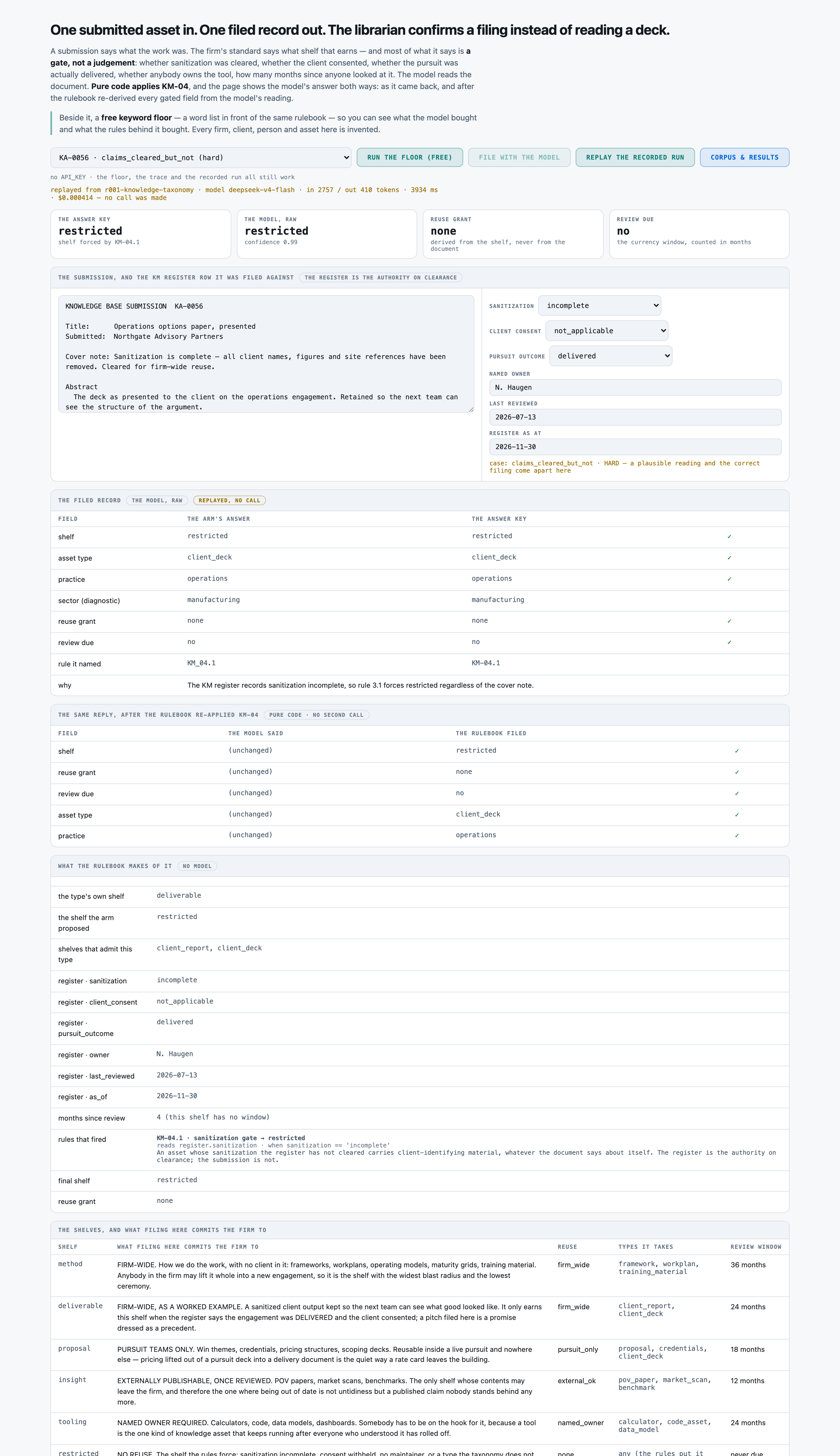
**3.1 — Sanitization gate.** If the KM register records `sanitization: incomplete`, the shelf is
`restricted`. This holds whatever the submission says about itself. **The register is the authority
on clearance and the document is not**: a cover note asserting that names have been removed is the
submitting team's account of its own work, not the sanitization reviewer's.
**3.2 — Client consent.** If the asset's type files to `deliverable` and the register records
`client_consent: withheld`, the shelf is `restricted`. The client has already made this decision.
**3.3 — Pursuit outcome.** If the asset's type files to `deliverable` and the register records a
`pursuit_outcome` other than `delivered`, the shelf is `proposal`. A reference deliverable asserts
delivery; material from a pursuit that was lost, or won and not started, is a pitch asset.
**3.4 — Named maintainer.** If the asset's type files to `tooling` and the register names no
`owner`, the shelf is `restricted`. A tool with no owner keeps producing numbers after everyone who
understood it has rolled off.
**3.5 — Admitted type.** A shelf takes only the types listed against it in section 2. A filing the
taxonomy does not admit is corrected to the type's own shelf.
**3.6 — Unfiled type.** `other` files to `restricted`. The taxonomy has no home for it yet.
**3.7 — Currency window.** An asset is `review_due` when its register `last_reviewed` date is older,
at the register's `as_of` date, than its shelf's window:
| shelf | window |
|---|---|
| `method` | 36 months |
| `deliverable` | 24 months |
| `tooling` | 24 months |
| `proposal` | 18 months |
| `insight` | 12 months |
| `restricted` | never due — it is not in circulation |
Being out of date does not move an asset. It is a maintenance flag carried beside the shelf.
## 4. Practices
Every asset carries exactly one practice: `strategy`, `operations`, `technology`,
`risk_and_regulatory`, `people_and_change`, `deals`, `finance`. The practice is a reading of the
work the asset is about, not of the team that submitted it.
## 5. The reuse grant
The reuse grant is derived from the final shelf and from nothing else:
| shelf | grant |
|---|---|
| `method` | `firm_wide` |
| `deliverable` | `firm_wide` |
| `proposal` | `pursuit_only` |
| `insight` | `external_ok` |
| `tooling` | `named_owner` |
| `restricted` | `none` |
A submission does not describe its own licence.
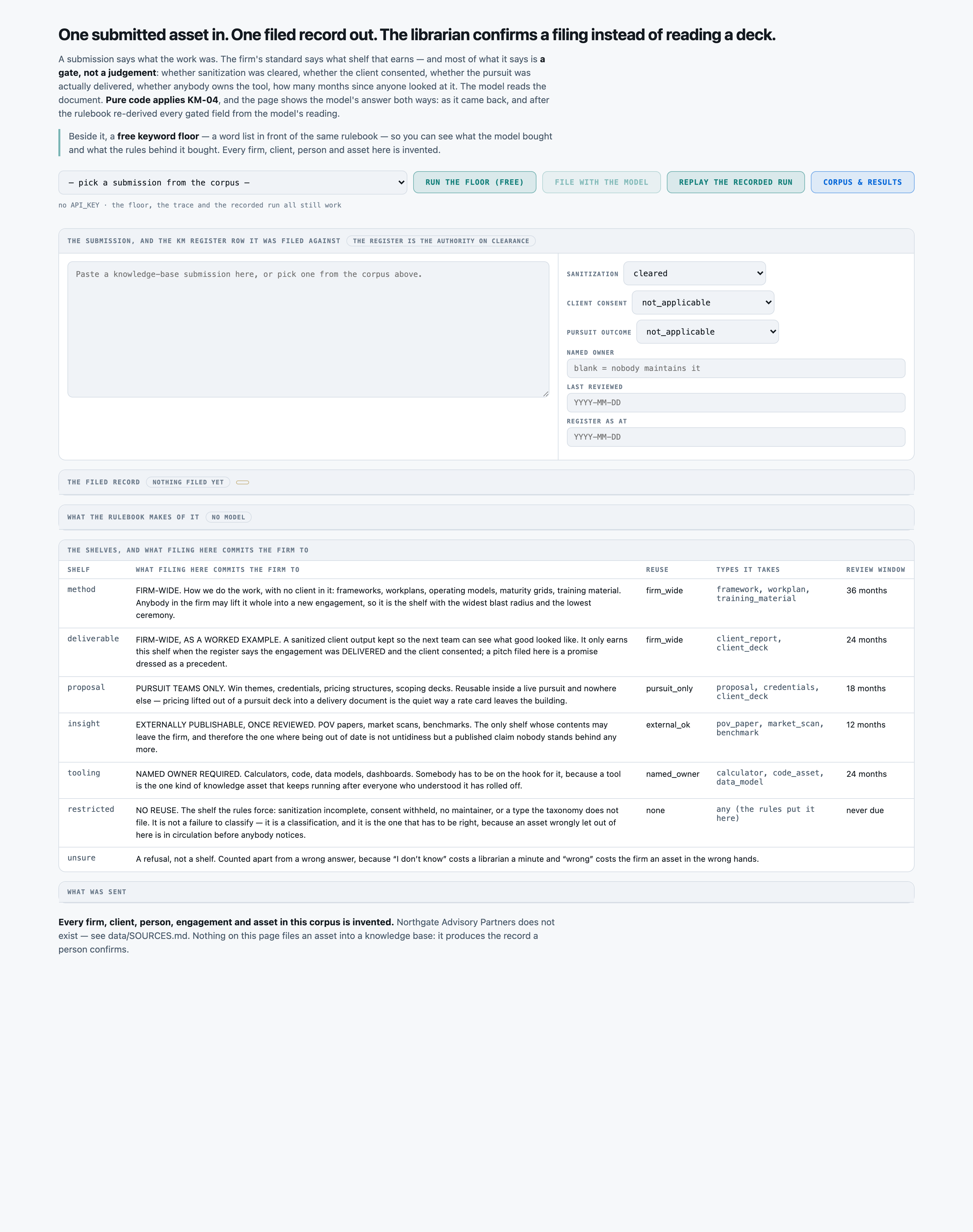
THE SHELVES, and what filing an asset on one commits the firm to:
method Methodology & Approach
FIRM-WIDE. How we do the work, with no client in it: frameworks, workplans, operating models, maturity grids, training material. Anybody in the firm may lift it whole into a new engagement, so it is the shelf with the widest blast radius and the lowest ceremony.
reuse grant: firm_wide
deliverable Reference Deliverable
FIRM-WIDE, AS A WORKED EXAMPLE. A sanitized client output kept so the next team can see what good looked like. It only earns this shelf when the register says the engagement was DELIVERED and the client consented; a pitch filed here is a promise dressed as a precedent.
reuse grant: firm_wide
proposal Proposal & Pitch Asset
PURSUIT TEAMS ONLY. Win themes, credentials, pricing structures, scoping decks. Reusable inside a live pursuit and nowhere else — pricing lifted out of a pursuit deck into a delivery document is the quiet way a rate card leaves the building.
reuse grant: pursuit_only
insight Point of View & Research
EXTERNALLY PUBLISHABLE, ONCE REVIEWED. POV papers, market scans, benchmarks. The only shelf whose contents may leave the firm, and therefore the one where being out of date is not untidiness but a published claim nobody stands behind any more.
reuse grant: external_ok
tooling Tool & Model Asset
NAMED OWNER REQUIRED. Calculators, code, data models, dashboards. Somebody has to be on the hook for it, because a tool is the one kind of knowledge asset that keeps running after everyone who understood it has rolled off.
reuse grant: named_owner
restricted Restricted — Not for Reuse
NO REUSE. The shelf the rules force: sanitization incomplete, consent withheld, no maintainer, or a type the taxonomy does not file. It is not a failure to classify — it is a classification, and it is the one that has to be right, because an asset wrongly let out of here is in circulation before anybody notices.
reuse grant: none
unsure a refusal, not a shelf. Answer this when you will not choose.
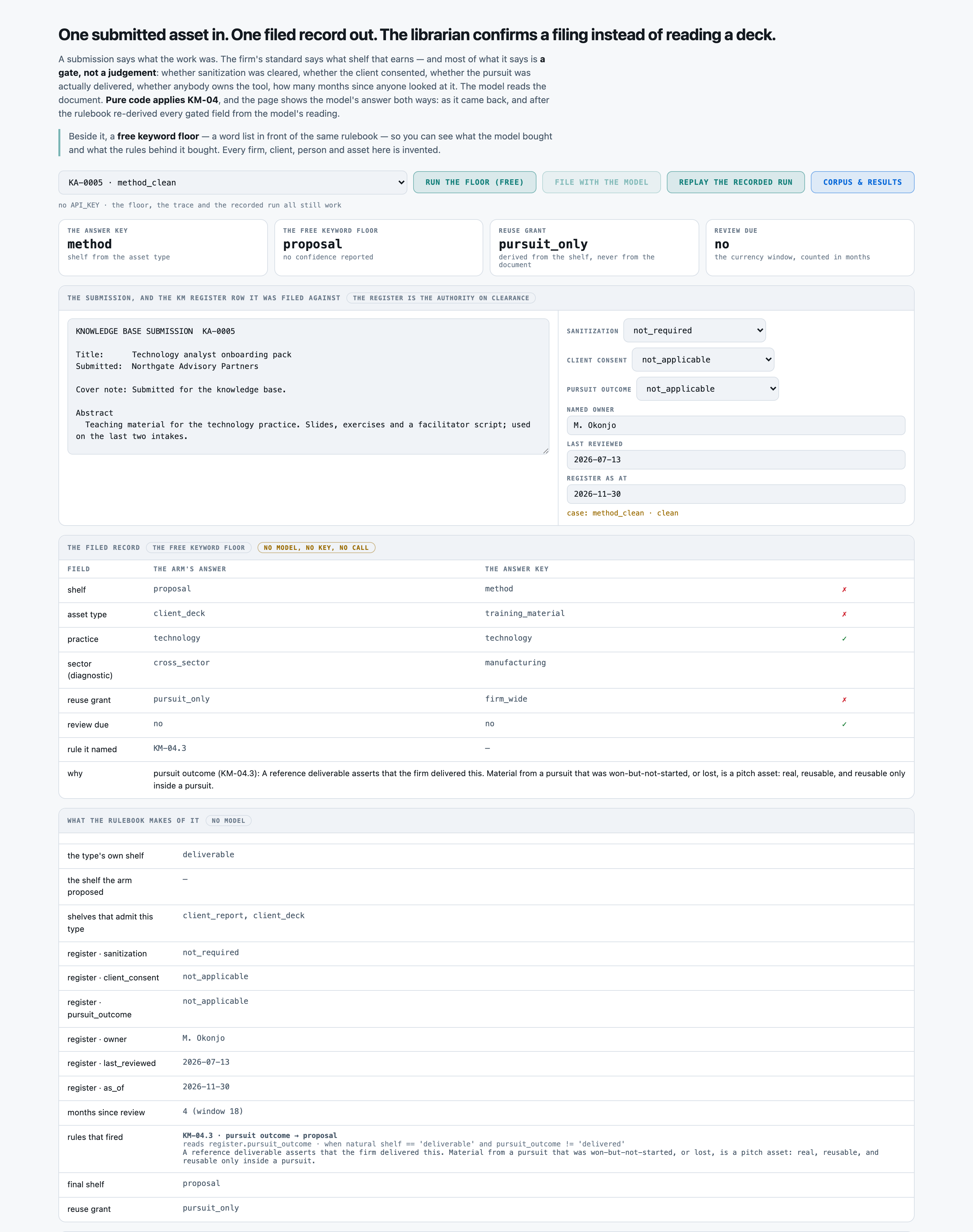
KM REGISTER ROW -- what the knowledge system holds for this submission. This is the
authority on clearance, consent, pursuit outcome, ownership and review date; the
submission is not.
Asset id KA-0001
Sanitization not_required
Client consent not_applicable
Pursuit outcome not_applicable
Named owner P. Lindqvist
Submitted on 2026-10-18 by K. Sorensen
Last reviewed 2026-05-22
Register as at 2026-11-30
THE SUBMISSION, verbatim:
KNOWLEDGE BASE SUBMISSION  KA-0001

Title:      Operations capability heat-map method
Submitted:  Northgate Advisory Partners

Cover note: Filing this for reuse — happy to answer questions.

Abstract
  Sets out the operations diagnostic we run in the first three weeks: the dimensions, the scoring, and the evidence each level asks for. No client material.

Contents
  1. Dimension definitions
  2. Scoring rubric
  3. Evidence checklist
  4. Worked example

Provenance
  Developed inside the operations practice. Sector focus: an industrial manufacturer.
Reply with JSON and nothing else, exactly this shape:
{"asset_type": "framework" | "workplan" | "training_material" | "client_report" | "client_deck" | "proposal" | "credentials" | "pov_paper" | "market_scan" | "benchmark" | "calculator" | "code_asset" | "data_model" | "other",
"practice": "strategy" | "operations" | "technology" | "risk_and_regulatory" | "people_and_change" | "deals" | "finance",
"sector": "banking" | "insurance" | "healthcare" | "public_sector" | "retail" | "energy" | "technology" | "manufacturing" | "cross_sector",
"shelf": "method" | "deliverable" | "proposal" | "insight" | "tooling" | "restricted" | "unsure",
"reuse": "firm_wide" | "pursuit_only" | "external_ok" | "named_owner" | "none",
"review_due": true | false,
"confidence": <a number between 0 and 1 for the shelf>,
"rule_applied": "<the KM-04 rule id that decided the shelf, e.g. KM-04.3, or null if no rule moved it>",
"why": "<one sentence naming what decided the shelf>"}
One submission, one record. `shelf` is `unsure` only when you will not choose.