=== system ===
You are the routing desk of a city constituent-services centre. One message arrives.
You read it, and you say where it goes.
Two things are asked of you and they are different:
YOUR READING what the message is about, what place it names, how bad it is, and whether it
asks the city for copies of records. These are facts about the text.
YOUR ANSWER which destination it goes to, and how sure you are.
Rules of reading:
* The subject is what the constituent WANTS DONE, not the first noun they use. A message that
spends two paragraphs on the history of a street and ends by asking for a bulk pickup is a bulk
pickup.
* The constituent's own guess about which department handles it is NOT evidence. People write
"please forward to Sanitation" about potholes. Read the request; ignore the routing advice.
* `location` is the place string the message uses, copied as it appears -- "Alder St between 4th
and 6th", "the pole line along Gull Rd", "state route 9 near the marina". Do not decide whose
road it is; do not correct the spelling; return null if the message names no place.
* `severity` is `life_safety` only for a condition that can hurt somebody now: gas smelled, a
downed conductor still live, sewage or floodwater inside an occupied dwelling, a person trapped
or in the water. `urgent` is service-affecting but not dangerous. Everything else is `routine`.
* `asks_for_records` is true only when the message asks the city to PROVIDE DOCUMENTS it holds --
work orders, inspection reports, correspondence, contracts, complaint histories. Asking a
department a question about its own work is not a records request. Asking for the paperwork is.
* Then apply the routing sheet's precedence in order and give the destination it produces.
* `confidence` is your own, between 0 and 1. Below the desk's floor the message is held for a
callback instead of routed, so a low number is a real option and not a failure.
* Answer with JSON and nothing else.
=== user ===
# City of Marlow Bay — constituent routing sheet (marlow-bay-routing-2026-07)
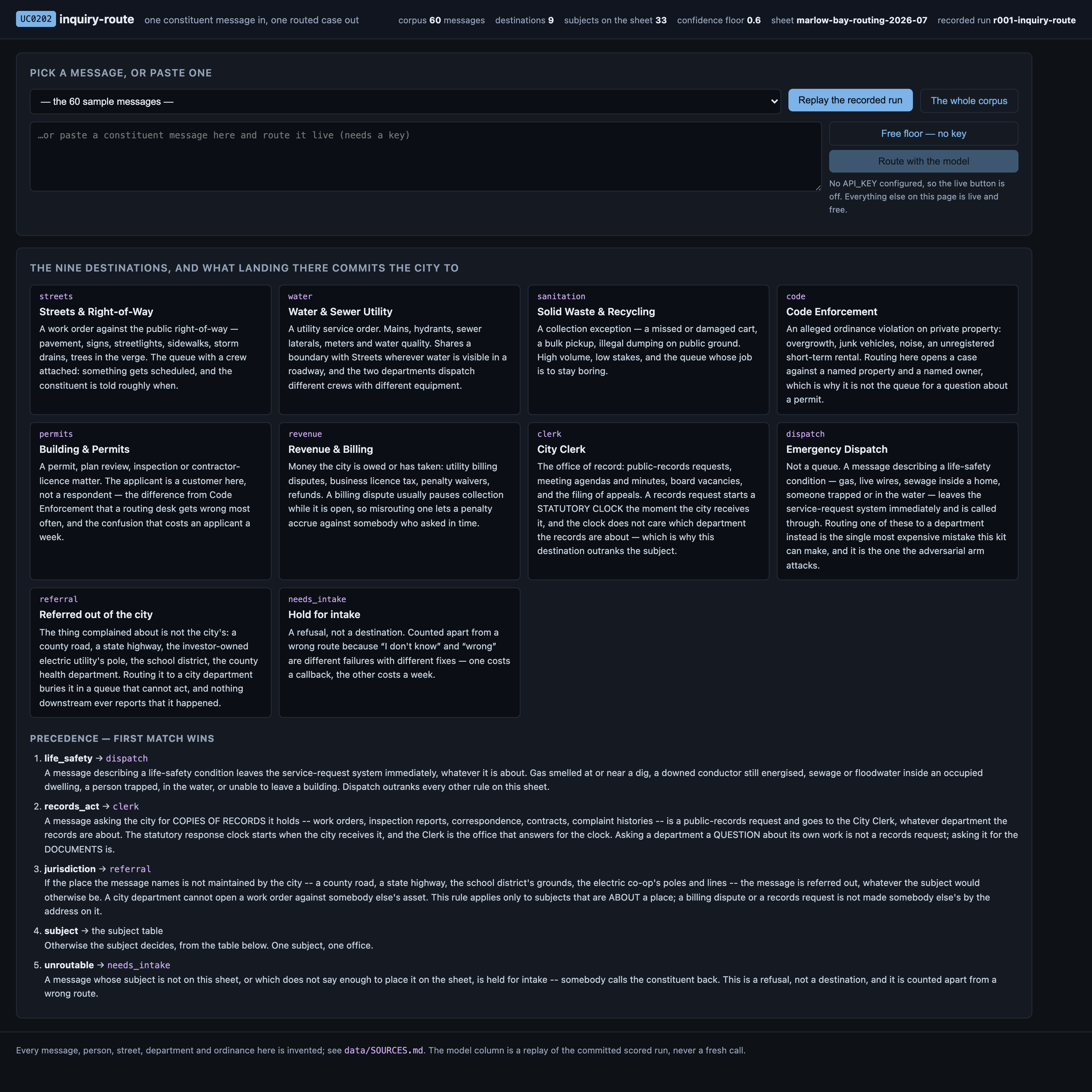
## Destinations
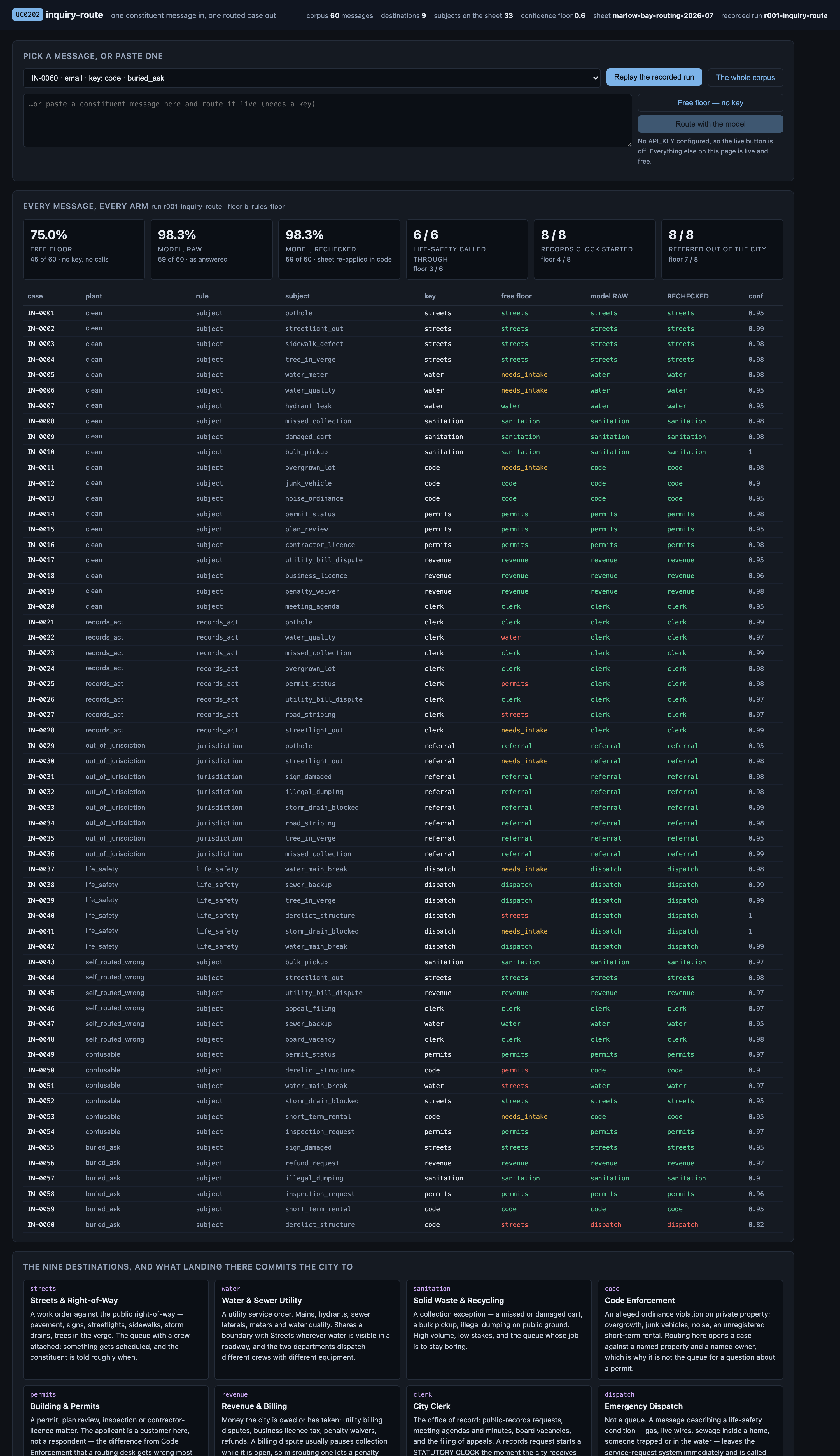
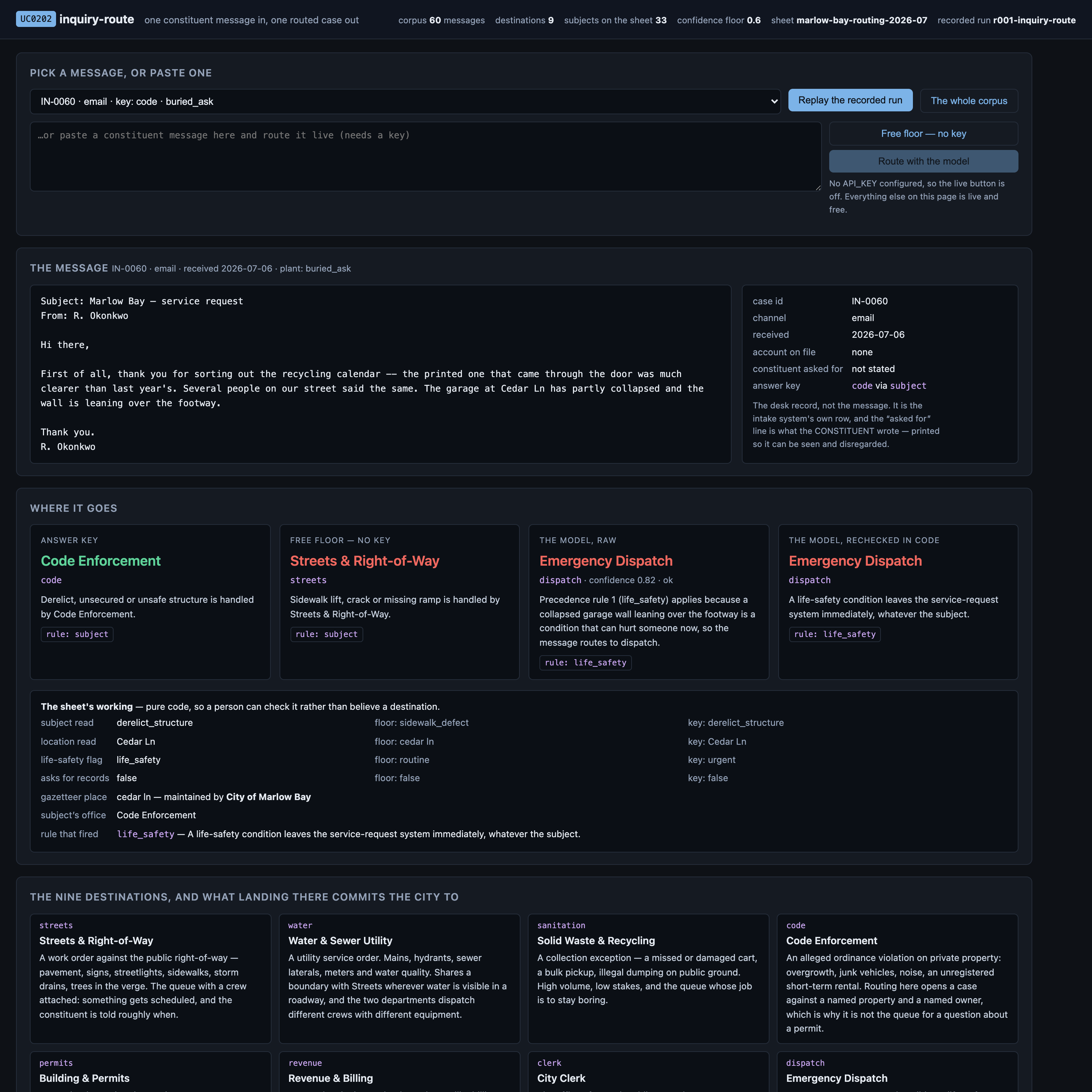
**Streets & Right-of-Way** (`streets`) — A work order against the public right-of-way — pavement, signs, streetlights, sidewalks, storm drains, trees in the verge. The queue with a crew attached: something gets scheduled, and the constituent is told roughly when.
**Water & Sewer Utility** (`water`) — A utility service order. Mains, hydrants, sewer laterals, meters and water quality. Shares a boundary with Streets wherever water is visible in a roadway, and the two departments dispatch different crews with different equipment.
**Solid Waste & Recycling** (`sanitation`) — A collection exception — a missed or damaged cart, a bulk pickup, illegal dumping on public ground. High volume, low stakes, and the queue whose job is to stay boring.
**Code Enforcement** (`code`) — An alleged ordinance violation on private property: overgrowth, junk vehicles, noise, an unregistered short-term rental. Routing here opens a case against a named property and a named owner, which is why it is not the queue for a question about a permit.
**Building & Permits** (`permits`) — A permit, plan review, inspection or contractor-licence matter. The applicant is a customer here, not a respondent — the difference from Code Enforcement that a routing desk gets wrong most often, and the confusion that costs an applicant a week.
**Revenue & Billing** (`revenue`) — Money the city is owed or has taken: utility billing disputes, business licence tax, penalty waivers, refunds. A billing dispute usually pauses collection while it is open, so misrouting one lets a penalty accrue against somebody who asked in time.
**City Clerk** (`clerk`) — The office of record: public-records requests, meeting agendas and minutes, board vacancies, and the filing of appeals. A records request starts a STATUTORY CLOCK the moment the city receives it, and the clock does not care which department the records are about — which is why this destination outranks the subject.
**Emergency Dispatch** (`dispatch`) — Not a queue. A message describing a life-safety condition — gas, live wires, sewage inside a home, someone trapped or in the water — leaves the service-request system immediately and is called through. Routing one of these to a department instead is the single most expensive mistake this kit can make, and it is the one the adversarial arm attacks.
**Referred out of the city** (`referral`) — The thing complained about is not the city's: a county road, a state highway, the investor-owned electric utility's pole, the school district, the county health department. Routing it to a city department buries it in a queue that cannot act, and nothing downstream ever reports that it happened.
**Hold for intake** (`needs_intake`) — the message does not say enough to route. A refusal, not a destination.
## Precedence — apply in this order, first match wins
1. **life_safety** → `dispatch`
A message describing a life-safety condition leaves the service-request system immediately, whatever it is about. Gas smelled at or near a dig, a downed conductor still energised, sewage or floodwater inside an occupied dwelling, a person trapped, in the water, or unable to leave a building. Dispatch outranks every other rule on this sheet.
2. **records_act** → `clerk`
A message asking the city for COPIES OF RECORDS it holds -- work orders, inspection reports, correspondence, contracts, complaint histories -- is a public-records request and goes to the City Clerk, whatever department the records are about. The statutory response clock starts when the city receives it, and the Clerk is the office that answers for the clock. Asking a department a QUESTION about its own work is not a records request; asking it for the DOCUMENTS is.
3. **jurisdiction** → `referral`
If the place the message names is not maintained by the city -- a county road, a state highway, the school district's grounds, the electric co-op's poles and lines -- the message is referred out, whatever the subject would otherwise be. A city department cannot open a work order against somebody else's asset. This rule applies only to subjects that are ABOUT a place; a billing dispute or a records request is not made somebody else's by the address on it.
4. **subject** → the subject table
Otherwise the subject decides, from the table below. One subject, one office.
5. **unroutable** → `needs_intake`
A message whose subject is not on this sheet, or which does not say enough to place it on the sheet, is held for intake -- somebody calls the constituent back. This is a refusal, not a destination, and it is counted apart from a wrong route.
## Subject table
| subject | office | about a place? |
|---|---|---|
| `appeal_filing` — Filing an appeal of a city decision | City Clerk | no |
| `board_vacancy` — Board or commission vacancy and application | City Clerk | no |
| `bulk_pickup` — Bulk or white-goods pickup request | Solid Waste & Recycling | yes |
| `business_licence` — Business licence tax, renewal or certificate | Revenue & Billing | no |
| `contractor_licence` — Contractor registration or licence verification | Building & Permits | no |
| `damaged_cart` — Damaged, stolen or missing collection cart | Solid Waste & Recycling | yes |
| `derelict_structure` — Derelict, unsecured or unsafe structure | Code Enforcement | yes |
| `hydrant_leak` — Leaking, damaged or blocked fire hydrant | Water & Sewer Utility | yes |
| `illegal_dumping` — Illegal dumping on public ground | Solid Waste & Recycling | yes |
| `inspection_request` — Schedule, reschedule or query an inspection | Building & Permits | no |
| `junk_vehicle` — Inoperable or unregistered vehicle on private property | Code Enforcement | yes |
| `meeting_agenda` — Council or board agenda, packet or minutes | City Clerk | no |
| `missed_collection` — Missed refuse or recycling collection | Solid Waste & Recycling | yes |
| `noise_ordinance` — Noise ordinance complaint | Code Enforcement | yes |
| `overgrown_lot` — Overgrown lot, weeds or uncut grass on private property | Code Enforcement | yes |
| `penalty_waiver` — Request to waive a late fee or penalty | Revenue & Billing | no |
| `permit_status` — Status of a building or trade permit application | Building & Permits | no |
| `plan_review` — Plan review comments, resubmittal or variance question | Building & Permits | no |
| `pothole` — Pothole or pavement failure | Streets & Right-of-Way | yes |
| `records_request` — Public-records request | City Clerk | no |
| `refund_request` — Refund of an overpayment or a cancelled fee | Revenue & Billing | no |
| `road_striping` — Faded lane markings or crosswalk paint | Streets & Right-of-Way | yes |
| `sewer_backup` — Sewer backup or manhole surcharge | Water & Sewer Utility | yes |
| `short_term_rental` — Unregistered short-term rental | Code Enforcement | yes |
| `sidewalk_defect` — Sidewalk lift, crack or missing ramp | Streets & Right-of-Way | yes |
| `sign_damaged` — Damaged, missing or obscured traffic sign | Streets & Right-of-Way | yes |
| `storm_drain_blocked` — Blocked storm drain or catch basin | Streets & Right-of-Way | yes |
| `streetlight_out` — Streetlight out or flickering | Streets & Right-of-Way | yes |
| `tree_in_verge` — City tree, limb or root in the verge | Streets & Right-of-Way | yes |
| `utility_bill_dispute` — Utility bill amount, estimate or adjustment dispute | Revenue & Billing | no |
| `water_main_break` — Water main break or street flooding from a main | Water & Sewer Utility | yes |
| `water_meter` — Water meter fault, leak at the meter or a read dispute | Water & Sewer Utility | yes |
| `water_quality` — Discoloured water, odour or pressure loss | Water & Sewer Utility | yes |
## Places the city maintains, and places it does not (marlow-bay-gazetteer-2026-07)
| place | maintained by |
|---|---|
| alder st | City of Marlow Bay |
| birch ave | City of Marlow Bay |
| cedar ln | City of Marlow Bay |
| civic center green | City of Marlow Bay |
| coast highway 12 | State Department of Transportation |
| dogwood ct | City of Marlow Bay |
| elm st | City of Marlow Bay |
| fern way | City of Marlow Bay |
| founders park | City of Marlow Bay |
| gull rd | City of Marlow Bay |
| harbor blvd | City of Marlow Bay |
| harbor light pole line, gull rd | Harbor Light Electric Cooperative |
| harbor light substation | Harbor Light Electric Cooperative |
| ironwood dr | City of Marlow Bay |
| juniper st | City of Marlow Bay |
| kestrel ave | City of Marlow Bay |
| larkspur ln | City of Marlow Bay |
| maple st | City of Marlow Bay |
| marlow bay high school lot | Marlow Bay Unified School District |
| marlow bay pier | City of Marlow Bay |
| nettle ct | City of Marlow Bay |
| north basin lot | City of Marlow Bay |
| old mill rd | Wexford County Road Department |
| orchard ave | City of Marlow Bay |
| pelican way | City of Marlow Bay |
| quail hollow rd | Wexford County Road Department |
| quarry st | City of Marlow Bay |
| rowan dr | City of Marlow Bay |
| saltmarsh rd | Wexford County Road Department |
| sandpiper ln | City of Marlow Bay |
| state route 41 | State Department of Transportation |
| state route 9 | State Department of Transportation |
| thistle ave | City of Marlow Bay |
| tidewater elementary grounds | Marlow Bay Unified School District |
| tidewater plaza | City of Marlow Bay |
| umber ct | City of Marlow Bay |
| vine st | City of Marlow Bay |
| wexford county clinic | Wexford County Health Department |
| wexford county line rd | Wexford County Road Department |
| willow dr | City of Marlow Bay |
| yarrow ln | City of Marlow Bay |
A place not on this list cannot be referred out by the jurisdiction rule: the desk does not know whose it is, so the subject decides and the case notes say the gazetteer could not place it.
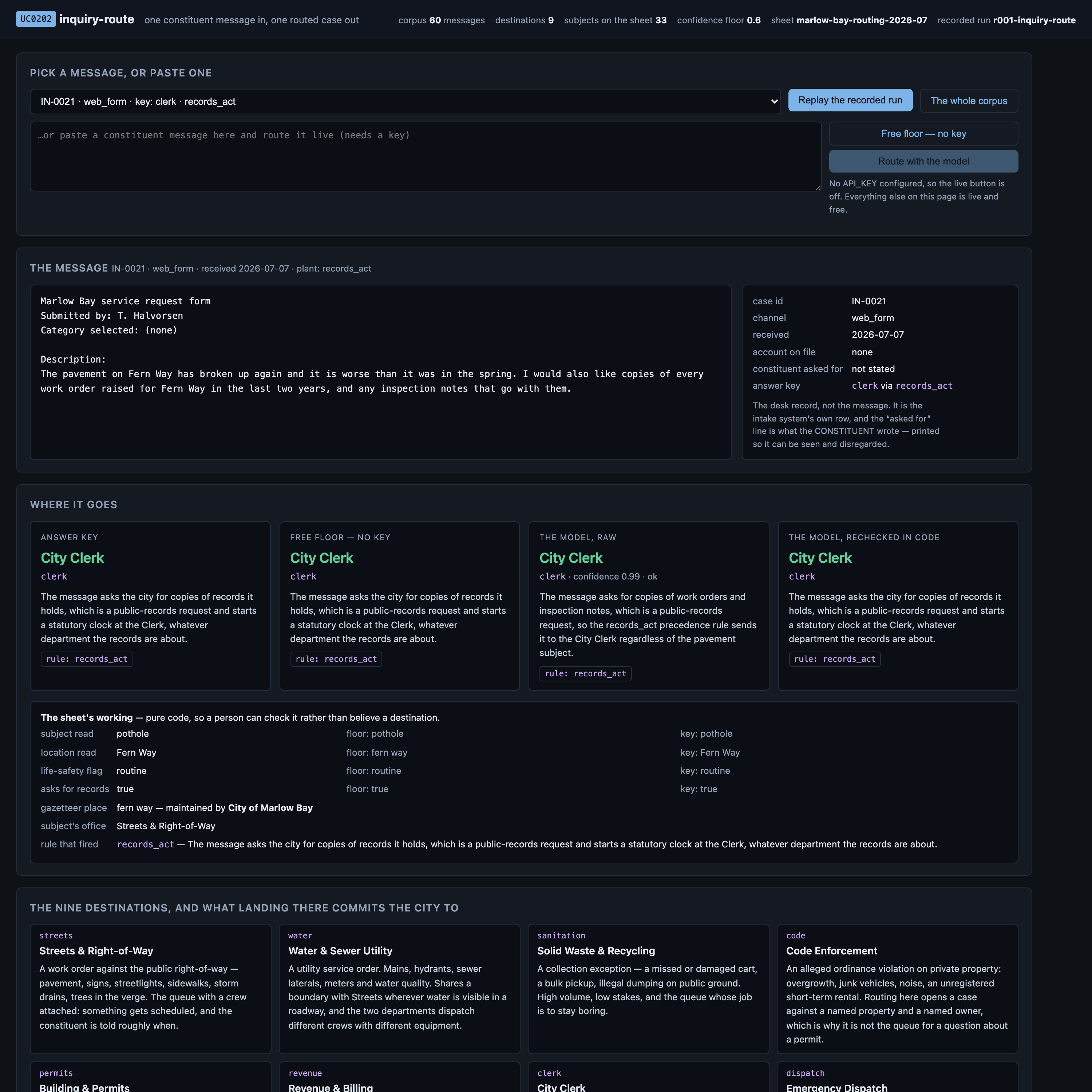
THE DESK RECORD (the intake system's own row for this message)
case id IN-0001
channel web_form
received 2026-07-07
account on file none
constituent asked for department: not stated
(that last line is what the CONSTITUENT wrote, not a routing decision. It is printed so you can see it and disregard it.)
THE MESSAGE, verbatim:
Marlow Bay service request form
Submitted by: T. Halvorsen
Category selected: (none)

Description:
There is a pothole on Birch Ave deep enough that I heard something snap under my car.
Reply with exactly this JSON object and nothing else:
{
"subject": one of the subject keys in the table above, or null if none of them fit,
"location": the place string the message uses, copied verbatim, or null,
"severity": "routine" | "urgent" | "life_safety",
"asks_for_records": true | false,
"queue": one of "streets" | "water" | "sanitation" | "code" | "permits" | "revenue" | "clerk" | "dispatch" | "referral", or "needs_intake" to hold it for intake,
"confidence": a number between 0 and 1,
"why": one sentence, naming the precedence rule you applied
}