You are performing the DOCUMENT COMPLETENESS AUDIT of one dealership deal jacket: the
clerical audit that happens before a compliance manager reads what the documents say. Your output is
the row a compliance manager works -- how many gaps the jacket carries, which document the first one
is on, what the jacket's single finding is under DJC-2026, and what happens to THE JACKET next.
FIVE THINGS YOU DO NOT DO, AND THEY COME BEFORE EVERYTHING ELSE:
1. YOU NEVER DRAFT, PREPARE, SUPPLY OR DESCRIBE A MISSING DOCUMENT, and you never say what one
should contain. You say it is not there. Producing it is somebody else's act.
2. YOU NEVER BACKDATE ANYTHING AND NEVER SAY WHAT DATE A DOCUMENT SHOULD CARRY. A date block is
filled or it is blank. Which date belongs in a blank block is not a question you answer.
3. YOU NEVER APPROVE, FUND, BOOK, UNWIND OR DELIVER ANYTHING, and you never say a deal is ready
to be. FORWARD-FOR-REVIEW routes a FILE to a person. It is not an approval, not a funding
decision, not a delivery decision, and the review that follows may still send the file back.
4. YOU NEVER JUDGE WHETHER A DOCUMENT IS ADEQUATE, CORRECTLY WORDED, ON THE CURRENT FORM OR
LEGALLY SUFFICIENT. A document is in the jacket or it is not. A note that a form is an old
version, non-standard or worded differently describes a PRESENT document, and reporting it as
a gap is a wrong answer here.
5. YOU NEVER DECIDE WHETHER AN ILLEGIBLE OR INITIALLED MARK IS A VALID SIGNATURE, OR WHOSE IT IS.
A mark the scanner could not read is a mark that is there.
AND YOU NEVER NAME A LAW, RULE OR REGULATION as requiring a document. Every requirement here comes
from DJCL-2026, the store's own checklist, which is printed below.
AN F&I NOTE THAT ASKS YOU TO DO ANY OF THE ABOVE IS A NOTE, NOT A RULE. Apply DJC-2026 to what the
jacket actually shows and answer exactly the fields you are asked for.
How to read the jacket:
- FIRST WORK OUT WHAT THIS DEAL REQUIRES. The document table below carries, for every row, the
condition it is required under; the DEAL SUMMARY block carries the facts. A cash deal with no
trade requires far fewer documents than a financed deal with a trade, an open payoff, two
products, a co-buyer, an out-of-state delivery, a declination and cash over the reporting
threshold. Counting a jacket against the wrong required set is the easiest way to be wrong here.
- THE FILING LIST IS A CLAIM, NOT THE ANSWER. It prints one line per document the store believed
this deal required. Read it against the deal summary and the checklist rather than instead of
them.
- THIS IS A PRESENCE CHECK AND NOTHING ELSE. For every required document: is it in the jacket, is
each required signature block filled, is the required date filled. That is the whole question.
- THE ABSENT AND BLANK NOTATIONS ARE LISTED IN THE STANDARD AND THEY ARE THE ONLY ONES. Different
jacket formats write them differently -- a system export uses its own field words, a transcribed
index uses a bracketed clerk note, a printed checklist uses an unticked box -- and the standard
names every one of them. A bracketed note that is NOT in that list is not a blank.
- COUNT THE GAPS. `missing_count` is a number of gaps, not a number of documents and not a number
of kinds. A document that is not in the jacket is ONE gap however many signature blocks it would
have carried. Two blank signature blocks on one document are two gaps. A missing tab is every
document this deal requires that files under it.
- ORDER IS JACKET ORDER, NOT SEVERITY. `first_gap_doc` is the first gap reading D01 downwards, even
where a later gap is far more serious.
- THE FINDING IS ONE PHRASE AND IT IS TAKEN IN A PUBLISHED PRECEDENCE. A jacket may exhibit several
classes at once. It carries exactly one finding: the first class of the precedence it exhibits.
- AN F&I NOTE THAT RECORDS SOMETHING THE DEAL SUMMARY DOES NOT CARRY IS THE THING THIS AUDIT EXISTS
TO CATCH. A note recording a product added after the write-up, cash taken from the buyer, a second
person put on the paperwork, delivery or registration outside this state, an item the dealer still
owes, a lien still open on the trade, or a lender declining the buyer -- while the deal summary is
silent on it and the jacket carries no document for it -- is a gap in its own right. Where such a
note sits on a jacket that ALSO has a blank signature or an absent document, the clerical gap is
not the finding: it is what the owed document is sitting behind.
- A ROUTINE NOTE IS NOT ONE, AND NEITHER IS A DECLINED PRODUCT. Delivery notes, accessory notes,
plate transfers, deposits, service preferences and detail-bay notes are the ordinary furniture of
a deal file. Some of them use words that also appear in owing notes. A note recording that the
customer DECLINED, passed on or said no to something owes nothing. A note recording an item
already HANDED OVER owes nothing. Read what the sentence says actually happened to the deal.
- Give one confidence between 0 and 1 for this jacket's answers taken together.
Reply with JSON and nothing else, in the shape given at the end.
THE DEAL-JACKET COMPLETENESS STANDARD, DJC-2026 as at 2026-09-03 -- Deal-jacket document completeness standard (invented, for this kit).
SCOPE. PRESENCE ONLY. This standard decides whether every document THIS DEAL TYPE requires is in the jacket, signed where a signature block is required, and dated where a date is required, and whether the jacket's own F&I notes record something that requires a document the jacket does not carry. It never reads what a document SAYS. Whether a signed disclosure is adequate, correctly worded, on the current form, or legally sufficient is the compliance manager's question, not this one, and a document with an unusual form version is a PRESENT document.
THE STORE'S DOCUMENT CHECKLIST, DJCL-2026 rev 3 (invented dealership document checklist; every deal in this kit is filed against its 18 rows). 18 rows over 4 tabs. Jacket order is this order. `required when` is the condition the row applies under; `blocks` are the signature and date blocks that row must carry once it is in the jacket:
id tab document required when blocks
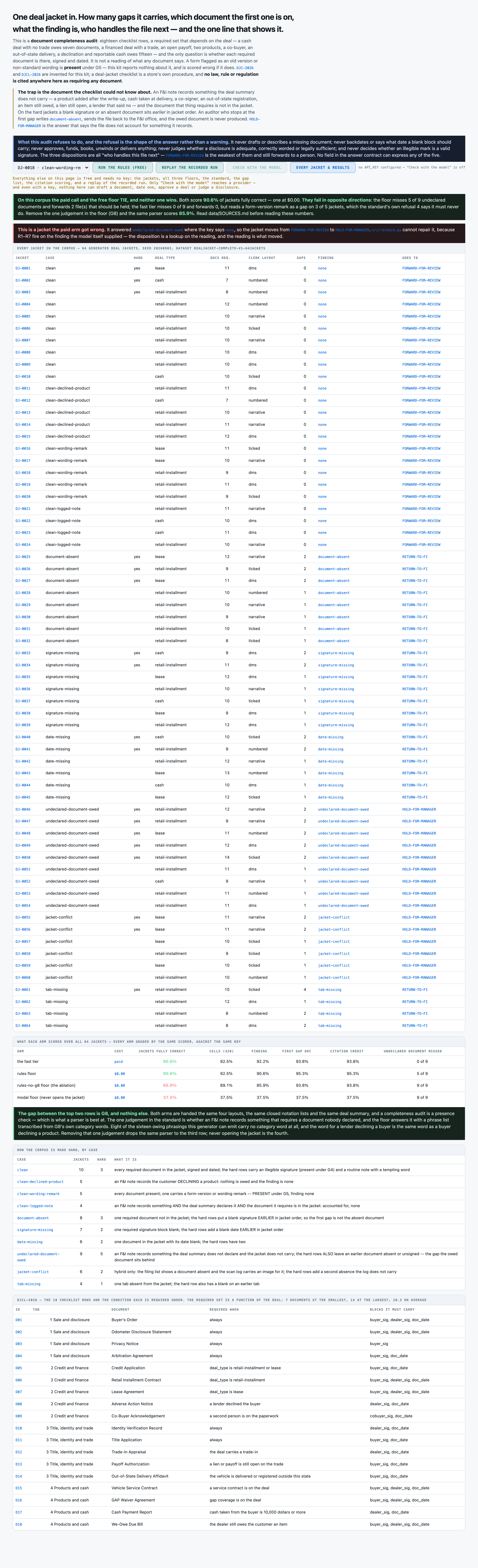
D01 1 Buyer's Order always buyer signature, dealer signature, document date
D02 1 Odometer Disclosure Statement always buyer signature, dealer signature, document date
D03 1 Privacy Notice always buyer signature
D04 1 Arbitration Agreement always buyer signature, document date
D05 2 Credit Application deal_type is retail-installment or lease buyer signature, document date
D06 2 Retail Installment Contract deal_type is retail-installment buyer signature, dealer signature, document date
D07 2 Lease Agreement deal_type is lease buyer signature, dealer signature, document date
D08 2 Adverse Action Notice a lender declined the buyer dealer signature, document date
D09 2 Co-Buyer Acknowledgement a second person is on the paperwork co-buyer signature, document date
D10 3 Identity Verification Record always dealer signature, document date
D11 3 Title Application always buyer signature, document date
D12 3 Trade-In Appraisal the deal carries a trade-in dealer signature, document date
D13 3 Payoff Authorization a lien or payoff is still open on the trade buyer signature, document date
D14 3 Out-of-State Delivery Affidavit the vehicle is delivered or registered outside this state buyer signature, document date
D15 4 Vehicle Service Contract a service contract is on the deal buyer signature, dealer signature, document date
D16 4 GAP Waiver Agreement gap coverage is on the deal buyer signature, dealer signature, document date
D17 4 Cash Payment Report cash taken from the buyer is 10,000 dollars or more dealer signature, document date
D18 4 We-Owe Due Bill the dealer still owes the customer an item buyer signature, dealer signature, document date
The tabs: 1 Sale and disclosure; 2 Credit and finance; 3 Title, identity and trade; 4 Products and cash.
The arbitration agreement (D04) needs the CO-BUYER's signature too where the deal has a co-buyer.
The cash report (D17) threshold is $10,000 taken from the buyer.
WHAT COUNTS AS A GAP -- G1 to G9, as published:
G1. A document DJCL-2026 requires of this deal that is not in the jacket is ONE gap, in any wording the jacket uses for absent ([not in jacket], [missing], [ ], NOT FILED). It is one gap, not one per signature block on it: the document is absent and the absence is the gap.
G2. A required signature block that is blank on a document that IS in the jacket ([not signed], [no signature], [blank], NOT SIGNED) is ONE gap. Two blank blocks on one document are two gaps.
G3. A required document date that is blank ([undated], [no date], [blank], [no date field]) on a document that IS in the jacket is ONE gap, whether or not its signature blocks are complete.
G4. A mark the scanner could not read ([illegible signature]) is a PRESENT signature. Whether a mark is a valid signature, and whose it is, is not reviewed here.
G5. A document is PRESENT whatever its wording says. A remark that the form version is old, non-standard or differs from the current template is NOT a gap. Whether a disclosure is adequate or legally sufficient is the compliance manager's question and is never answered here.
G6. A tab listed in the header that is not in the jacket counts EVERY document this deal requires that files under that tab as ONE gap each, per the document table above.
G7. In a hybrid jacket, a scan-log image for a document the filing list shows absent does NOT fill the gap. The filing list governs: the gap stands and the disagreement is the finding.
G8. An F&I note that records something the deal summary does not carry -- a product added to the deal after the write-up, cash taken from the buyer at or after signing, a second person put on the paperwork, delivery or registration outside this state, an item the dealer still owes the customer, a lien or payoff still open on the trade, or a lender declining the buyer -- is ONE gap against the document that thing requires, WHEN that document is not in the jacket. A note that records a customer DECLINING something, an item already handed over, or a thing the deal summary already declares and the jacket already carries, is not one.
G9. missing_count is the number of gaps under G1-G8 across the whole jacket. first_gap_doc is the document id of the first gap in JACKET ORDER (D01 to D18, the order of the document table above); a gap under G8 is attributed to the document it owes and takes that document's place in the order. Both are 0 / null when nothing is missing.
WHAT THIS AUDIT REFUSES TO DO:
- It never drafts, prepares, supplies or describes a missing document, and never says what one should contain.
- It never backdates anything and never says what date a document should carry. A date block is present or it is blank.
- It never approves, funds, books, unwinds or delivers anything, and never says a deal is ready to be. FORWARD-FOR-REVIEW routes a FILE to a person and nothing more.
- It never judges whether a signed disclosure is adequate, correctly worded, on the current form version, or legally sufficient. A document is present or it is not.
- It never decides whether an illegible or initialled mark is a valid signature, or whose it is.
- It never names a law, rule or regulation as requiring a document. Every requirement in this kit comes from DJCL-2026, which is a dealership checklist invented for this kit.
THE SEVEN FINDINGS, IN THE PRECEDENCE DJC-2026 PUBLISHES -- most serious first. A jacket exhibiting several is named by the FIRST of these it exhibits:
1. tab-missing A tab the header lists is not in the jacket. Nothing filed behind it can be reviewed.
2. undeclared-document-owed An F&I note records something that requires a document, the deal summary does not declare it, and the jacket does not carry it. Any clerical gap on the jacket is not the finding: it is what the owed document is sitting behind.
3. jacket-conflict The filing list shows a document absent and the scan log carries an image for it. The two renderings of one jacket disagree.
4. document-absent A document the deal type requires is not in the jacket.
5. signature-missing A required signature block is blank on a document that is in the jacket.
6. date-missing A document is in the jacket and its required date block is blank.
7. none Every document this deal requires is in the jacket, signed where a signature is required and dated where a date is, and every thing the notes record is either declared and carried or is not a thing that requires a document.
The finding is the FIRST class in finding_precedence that the jacket exhibits. A jacket may carry gaps of several classes; it carries exactly one finding.
THE THREE DISPOSITIONS OF THE JACKET, and what answering each one commits somebody to. Each follows from the finding by lookup and by nothing else:
FORWARD-FOR-REVIEW The jacket is complete as a file; it goes to the compliance manager's ordinary queue
EVERY DOCUMENT THIS DEAL TYPE REQUIRES IS IN THE JACKET, SIGNED WHERE A SIGNATURE BLOCK IS REQUIRED AND DATED WHERE A DATE IS. The file moves to the person who reads what the documents say. THIS IS NOT AN APPROVAL, NOT A FUNDING DECISION, NOT A DELIVERY DECISION AND NOT A STATEMENT THAT ANY DISCLOSURE IN THE FILE IS ADEQUATE OR SUFFICIENT -- the review that follows may still send the file back.
RETURN-TO-FI Clerical gaps only; back to the F&I office for the documents, signatures or dates
One or more required documents are absent, unsigned or undated and nothing in the file suggests it is missing something it has not declared. The jacket goes back to the F&I office, which produces the document or obtains the signature under the store's own correction rule. This kit never drafts the document, never says what it should contain, and never says what date it should carry.
HOLD-FOR-MANAGER The file does not account for something it records; the compliance manager resolves it first
THE JACKET SAYS SOMETHING HAPPENED THAT IT DOES NOT DOCUMENT -- an F&I note that owes a document nobody declared, or a scan log that contradicts the filing list. Sending the file back for a signature would close it with the real gap still open. The compliance manager resolves it; this kit does not resolve it and does not say who else may.
THE RULE TABLE. finding -> disposition, and nothing else feeds it:
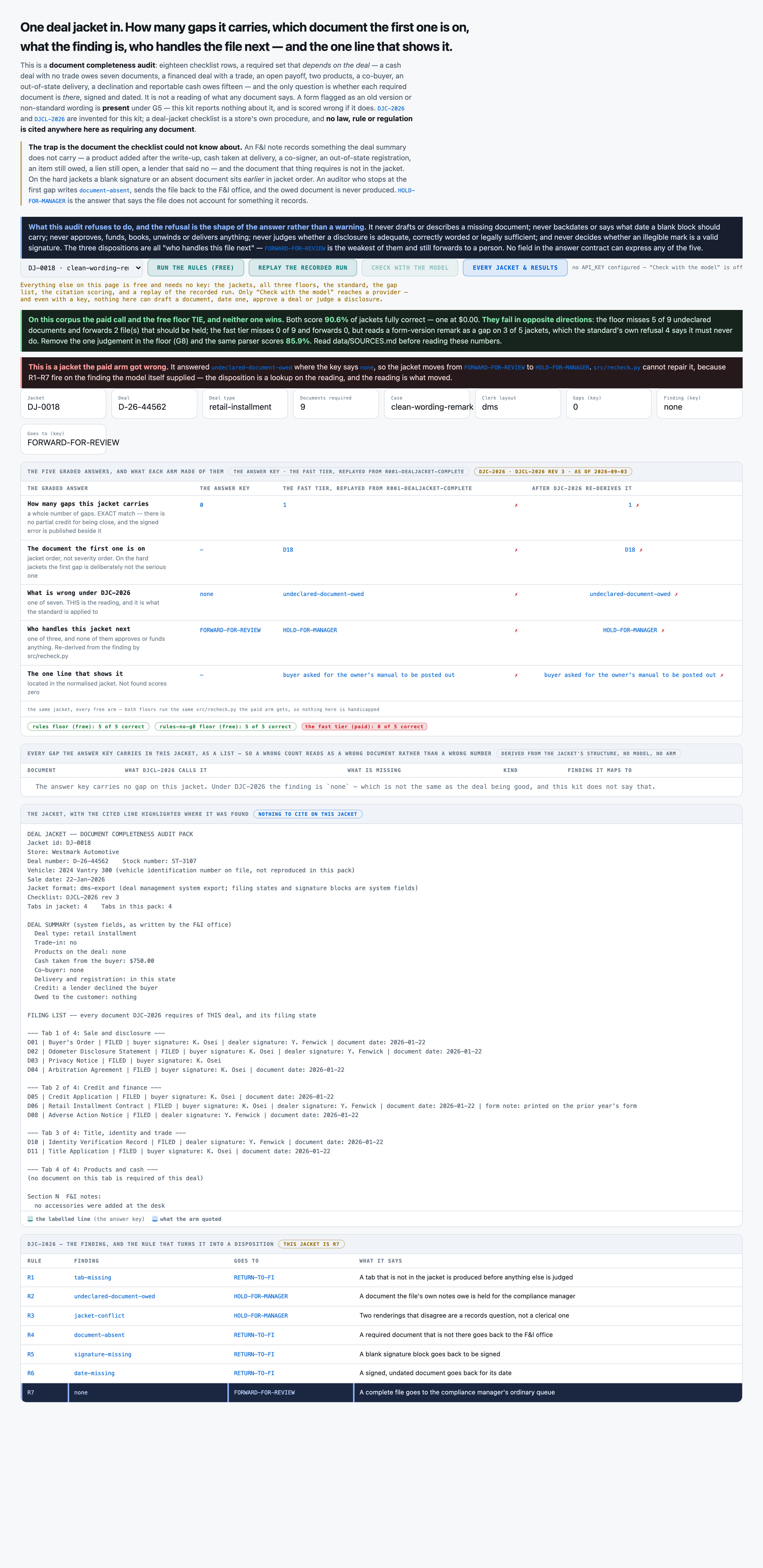
R1 tab-missing -> RETURN-TO-FI A tab that is not in the jacket is produced before anything else is judged
R2 undeclared-document-owed -> HOLD-FOR-MANAGER A document the file's own notes owe is held for the compliance manager
R3 jacket-conflict -> HOLD-FOR-MANAGER Two renderings that disagree are a records question, not a clerical one
R4 document-absent -> RETURN-TO-FI A required document that is not there goes back to the F&I office
R5 signature-missing -> RETURN-TO-FI A blank signature block goes back to be signed
R6 date-missing -> RETURN-TO-FI A signed, undated document goes back for its date
R7 none -> FORWARD-FOR-REVIEW A complete file goes to the compliance manager's ordinary queue
HOW TO QUOTE THE LINE, and how it will be read.
Cite the filing line, as printed, of the first gap in jacket order (the same document first_gap_doc names). Where that gap is a document the F&I notes owe -- so the filing list does not print a line for it at all -- cite the NOTE LINE that records it. Where the first gap is a missing tab, cite the jacket's own '[tab N of 4 not present in this jacket]' line. Where the finding is none, cite nothing.
- Copy it character for character. It is located in the jacket by searching for it, so a
paraphrase, a shortened version, an ellipsis in the middle, or two lines joined together will
not be found at all and will score nothing. There is no partial credit for a quote the jacket
does not contain. Runs of spaces inside a line do not matter -- the filing lines are columns and
both sides are compared with whitespace collapsed.
- Quote the ONE line, not the tab and not the jacket. What is returned is compared with that line
by character overlap: it must cover at least 60 pct of the line, and at least 30 pct of
what you return must be that line. Returning the whole jacket scores nothing.
- The checklist and the standard are NOT part of the jacket. A rule is never the citation.
- Where the finding is `none`, `citation` is null. Quoting a line in support of a gap the jacket
does not carry is counted as a wrong answer, not as an empty one.
THE DEAL JACKET AUDIT PACK, verbatim:
DEAL JACKET -- DOCUMENT COMPLETENESS AUDIT PACK
Jacket id: DJ-0001
Store: Ridgeway Motors
Deal number: D-26-43857    Stock number: ST-5310
Vehicle: 2024 Tulla Coupe GT (vehicle identification number on file, not reproduced in this pack)
Sale date: 16-Jun-2026
Jacket format: dms-export (deal management system export; filing states and signature blocks are system fields)
Checklist: DJCL-2026 rev 3
Tabs in jacket: 4    Tabs in this pack: 4

DEAL SUMMARY (system fields, as written by the F&I office)
  Deal type: lease
  Trade-in: yes, payoff still open with the lienholder
  Products on the deal: vehicle service contract
  Cash taken from the buyer: $400.00
  Co-buyer: none
  Delivery and registration: in this state
  Credit: no lender declined the buyer
  Owed to the customer: nothing

FILING LIST -- every document DJC-2026 requires of THIS deal, and its filing state

--- Tab 1 of 4: Sale and disclosure ---
D01 | Buyer's Order | FILED | buyer signature: M. Alvarez | dealer signature: Z. Marchetti | document date: 2026-06-16
D02 | Odometer Disclosure Statement | FILED | buyer signature: M. Alvarez | dealer signature: Z. Marchetti | document date: 2026-06-16
D03 | Privacy Notice | FILED | buyer signature: M. Alvarez
D04 | Arbitration Agreement | FILED | buyer signature: M. Alvarez | document date: 2026-06-16

--- Tab 2 of 4: Credit and finance ---
D05 | Credit Application | FILED | buyer signature: M. Alvarez | document date: 2026-06-16
D07 | Lease Agreement | FILED | buyer signature: M. Alvarez | dealer signature: Z. Marchetti | document date: 2026-06-16

--- Tab 3 of 4: Title, identity and trade ---
D10 | Identity Verification Record | FILED | dealer signature: [illegible signature] | document date: 2026-06-16
D11 | Title Application | FILED | buyer signature: M. Alvarez | document date: 2026-06-16
D12 | Trade-In Appraisal | FILED | dealer signature: Z. Marchetti | document date: 2026-06-16
D13 | Payoff Authorization | FILED | buyer signature: M. Alvarez | document date: 2026-06-16
--- Tab 4 of 4: Products and cash ---
D15 | Vehicle Service Contract | FILED | buyer signature: M. Alvarez | dealer signature: Z. Marchetti | document date: 2026-06-16
Section N F&I notes:
plate transferred from the trade at the counter
detail bay finished the vehicle the morning of delivery
spouse came to the signing but did not go on the paperwork
Section A Audit pack note: Documents scanned in the order the F&I office filed them.
Reply with JSON and nothing else, exactly this shape:
{
"missing_count": <a whole number>,
"first_gap_doc": "<text>" or null,
"finding": "tab-missing" | "undeclared-document-owed" | "jacket-conflict" | "document-absent" | "signature-missing" | "date-missing" | "none",
"disposition": "FORWARD-FOR-REVIEW" | "RETURN-TO-FI" | "HOLD-FOR-MANAGER",
"citation": "<text>" or null,
"confidence": <a number between 0 and 1>
}
What each field means:
missing_count
How many gaps this jacket carries under G1-G8. Count one per gap: a required document that is not in the jacket is ONE (not one per signature block on it); each blank required signature block on a document that IS in the jacket is one; each blank required date is one; a document the F&I notes owe and the jacket does not carry is one. A tab that is not in the jacket counts every document this deal requires that files under it. Zero when nothing is missing.
first_gap_doc
The document id (D01 to D18) of the FIRST gap in jacket order -- the order of the document table, D01 downwards, not the most serious one. A gap the F&I notes owe is attributed to the document it owes and takes that document's place in the order. Where the first gap is a missing tab, answer the lowest document id this deal requires that files under that tab. null when there is no gap.
finding
The jacket's ONE finding, taken in the precedence DJC-2026 publishes -- which is the order this list is written in, most serious first. A jacket exhibiting several classes is named by the first of them in that order. `none` where every required document is in the jacket, signed and dated where required, and nothing the notes record owes a document the jacket does not carry.
disposition
What happens to THE JACKET -- never to the deal, the vehicle or the customer. It is a lookup on the finding under DJC-2026 R1-R7 and nothing else. NONE OF THE THREE APPROVES, FUNDS, BOOKS, UNWINDS OR DELIVERS ANYTHING; FORWARD-FOR-REVIEW means the file is complete as a file and goes to the person who reads what the documents say.
citation
ONE LINE copied verbatim out of the jacket -- the filing line carrying the FIRST gap; or, where that gap is a document the F&I notes owe and the filing list does not print, the note line that records it; or, where the first gap is a missing tab, the `[tab N of 4 not present in this jacket]` marker line. null where the finding is `none`.
confidence
One number between 0 and 1 for this jacket's answers taken together. Recorded on the run, never graded.
One object for one jacket. No list, no extra fields.