The business caseThe problem this solves
A retail centre is about to sign a new lease. Two things have to be checked first and NEITHER can be answered from the lease in front of you: does the use this tenant is asking for cut across an exclusive the landlord already granted a sitting tenant, and is the co-tenancy condition this tenant is relying on already unsatisfied on the day it signs. The conflicting words are in a THIRD PARTY'S lease — a covenant given years ago to a tenant three units away, or an anchor that went dark in the spring. On a centre with 16 units that is a portfolio read, not a document read, and it is the one nobody has time for. the provision-by-provision read an asset manager does by eye against a rent roll, on the deals there is time for
Audience
The asset or leasing manager who signs the lease, and the solicitor who inherits whatever was granted. The decision is whether one model call per centre is worth more than the code you would write instead — and on three of the five bands measured here it is not. Every number on these pages came from one real run of this code, not from a vendor page.
The inputThe actual centre packets
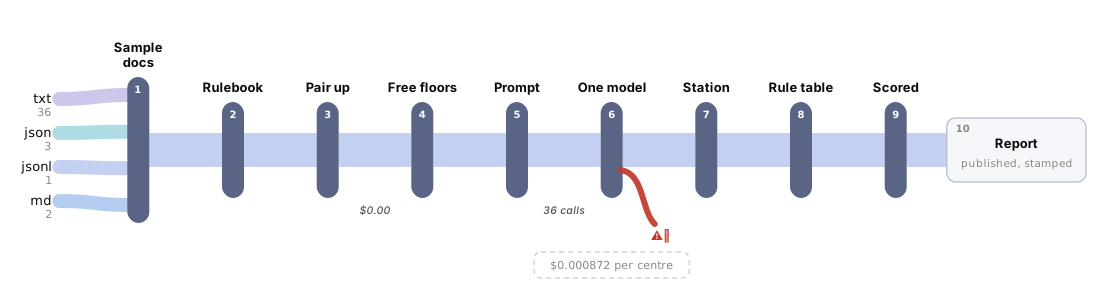
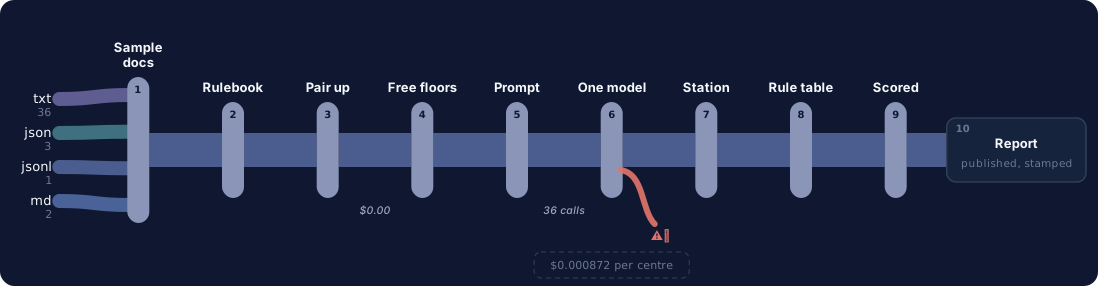
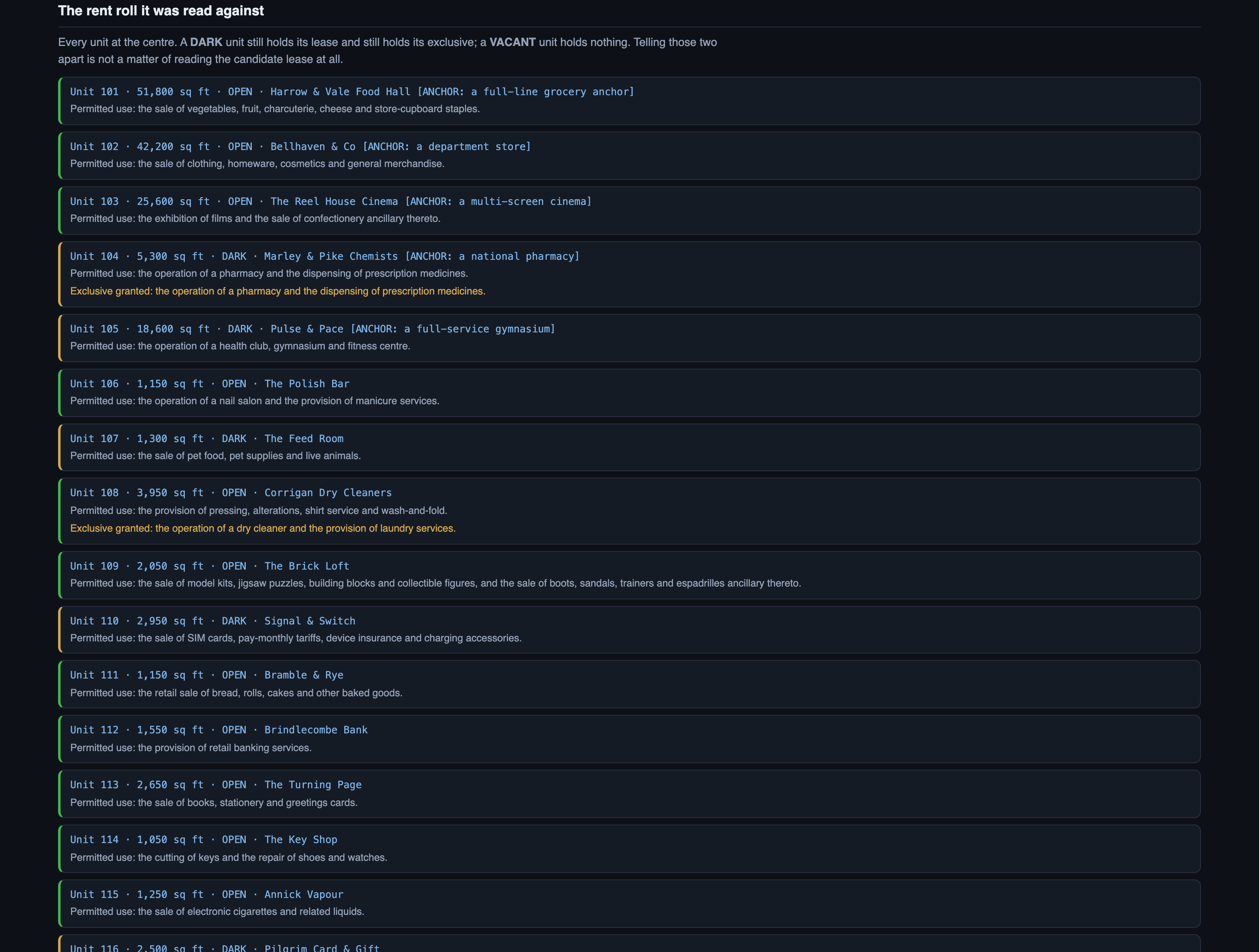
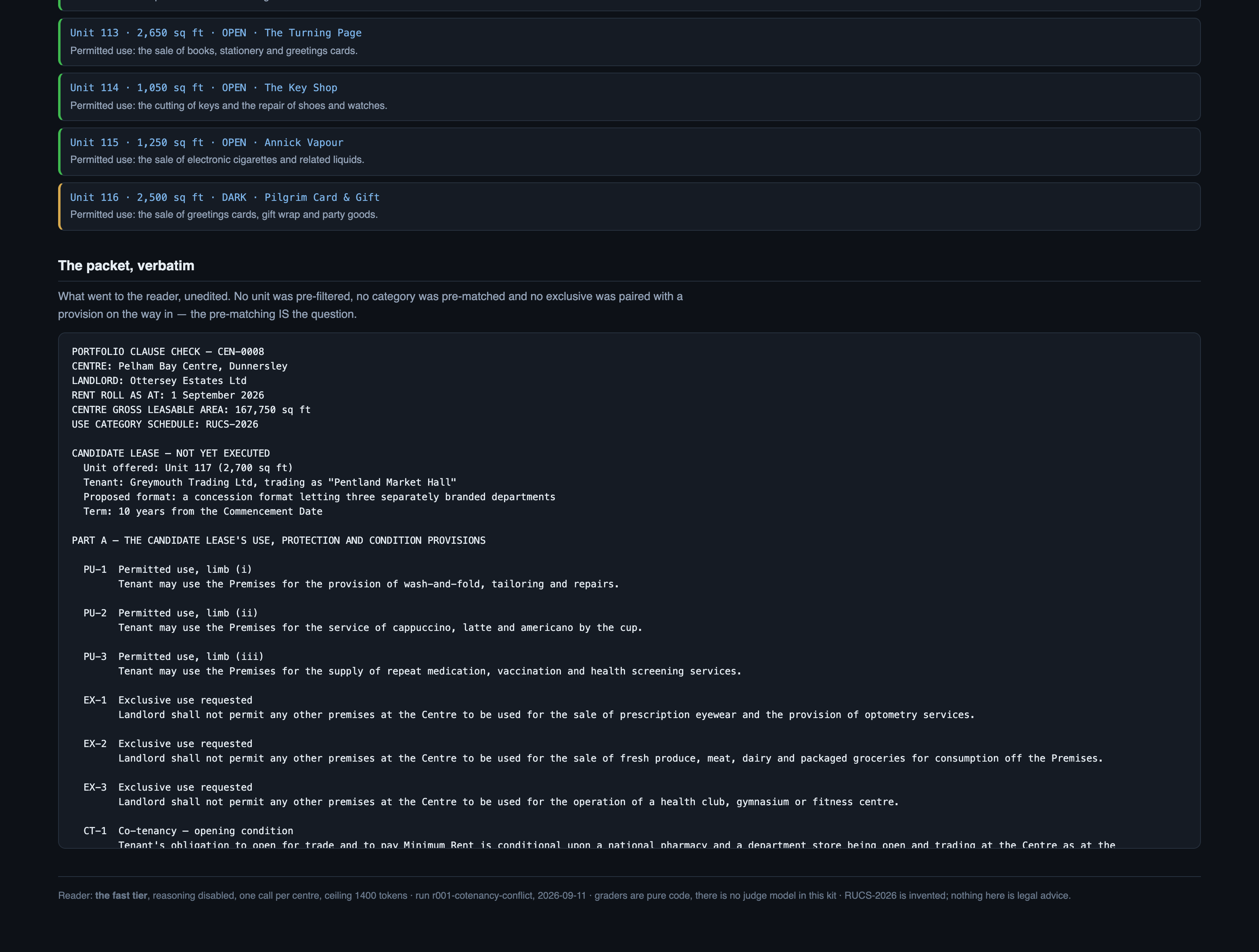
The corpus is 36 centre packets, 0.22 MB (json 3 · jsonl 1 · md 2 · txt 36). ⚠︎ EVERY BYTE OF IT IS INVENTED, AND THAT IS STATED BEFORE ANY NUMBER. RUCS-2026 — the Retail Use Category Schedule — is a fictional use-category framework written for this kit. It is not ICSC, not RICS, not NAICS and not any planning use-class order. Every centre, landlord, unit, trade name, tenant entity, square footage and word of clause text is generated from one seed. THE SHAPE IS THE POINT: one packet is a candidate lease beside the WHOLE rent roll, 16 units on average, because the conflicting words live in a third party's lease and a two-document differ cannot reach them. The corpus is built to punish the shortcuts — 82 units are DARK and still hold their leases (18 of them holding an exclusive), 45 are VACANT and hold nothing, 30 leases carry an ancillary trade their headline use does not mention, and 64 of the 169 conflicts are worded so that the two sides share no content word at all.
The corpus
- The 36 centre packetsgenerated from a fixed seed, so no real record, person or institution appears in it.
- Where each came fromwritten for this kit rather than collected — the corpus is generated in the kit's own repository, so there is no third-party data in it.
Swap this folder for your own material and the kit is pointed at your centre packets. That is the whole change — there is no database to migrate.
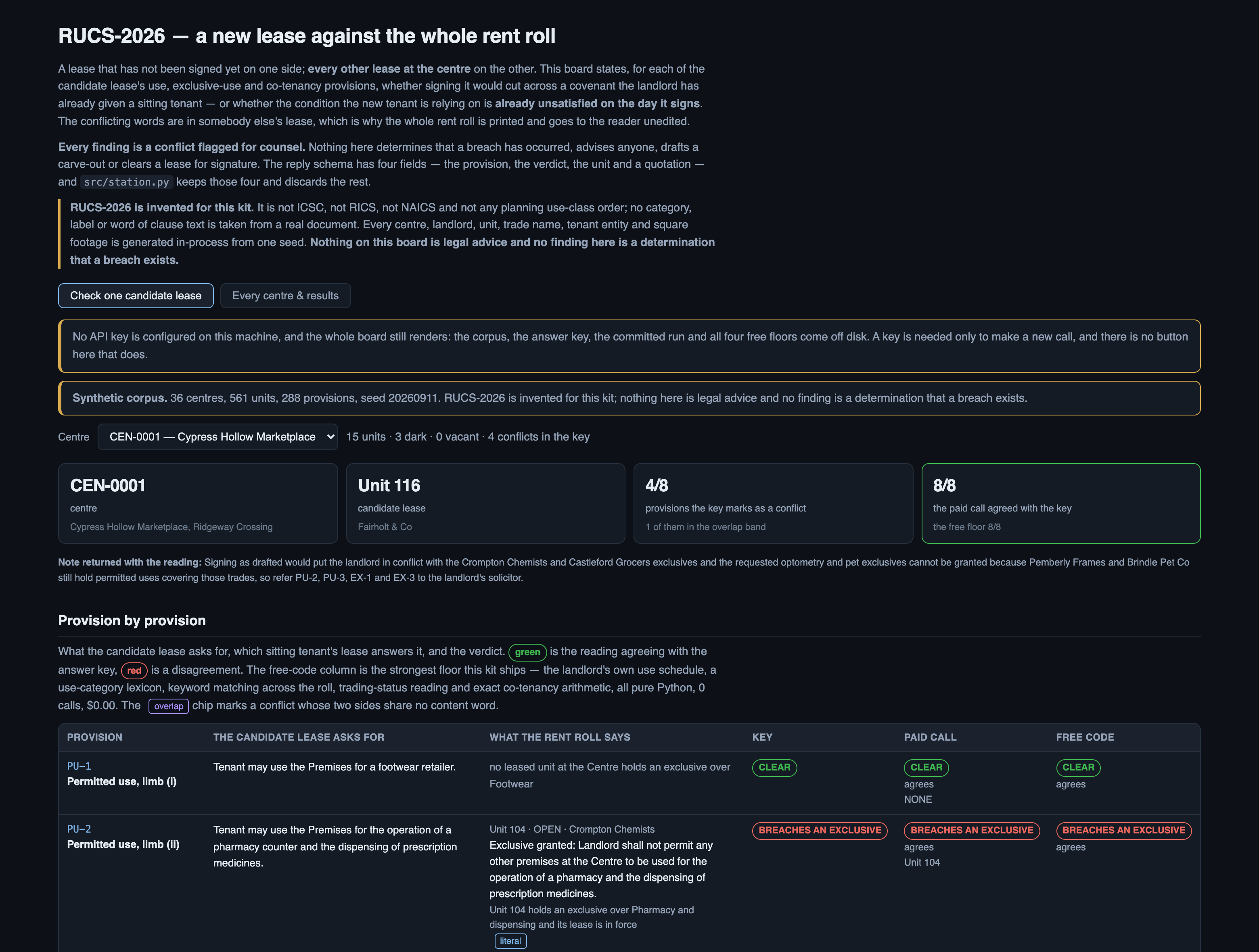
PORTFOLIO CLAUSE CHECK — CEN-0001
CENTRE: Cypress Hollow Marketplace, Ridgeway Crossing
LANDLORD: Callowfield Property Group
RENT ROLL AS AT: 1 September 2026
CENTRE GROSS LEASABLE AREA: 179,250 sq ft
USE CATEGORY SCHEDULE: RUCS-2026

CANDIDATE LEASE — NOT YET EXECUTED
  Unit offered: Unit 116 (4,650 sq ft)
  Tenant: Mercer & Tyne Trading Ltd, trading as "Fairholt & Co"
  Proposed format: a mixed-format store operating three distinct trading limbs
  Term: 10 years from the Commencement Date

PART A — THE CANDIDATE LEASE'S USE, PROTECTION AND CONDITION PROVISIONS

  PU-1  Permitted use, limb (i)
        Tenant may use the Premises for a footwear retailer.

  PU-2  Permitted use, limb (ii)
        Tenant may use the Premises for the operation of a pharmacy counter and the dispensing of prescription medicines.

  PU-3  Permitted use, limb (iii)
        Tenant may use the Premises for a supermarket selling fresh produce, meat, dairy and packaged groceries.

  EX-1  Exclusive use requested
        Landlord shall not permit any other premises at the Centre to be used for the sale of prescription eyewear and the provision of optometry services.

  EX-2  Exclusive use requested
        Landlord shall not permit any other premises at the Centre to be used for the sale of bread, rolls, cakes and other baked goods for consumption off the Premises.

  EX-3  Exclusive use requested
        Landlord shall not permit any other premises at the Centre to be used for the sale of pet food, pet supplies and live animals.

  CT-1  Co-tenancy — opening condition
        Tenant's obligation to open for trade and to pay Minimum Rent is conditional upon a multi-screen cinema and a full-service gymnasium being open and trading at the Centre as at the Commencement Date.
Abridged — the file continues.
The outcomeWhat a good result looks like
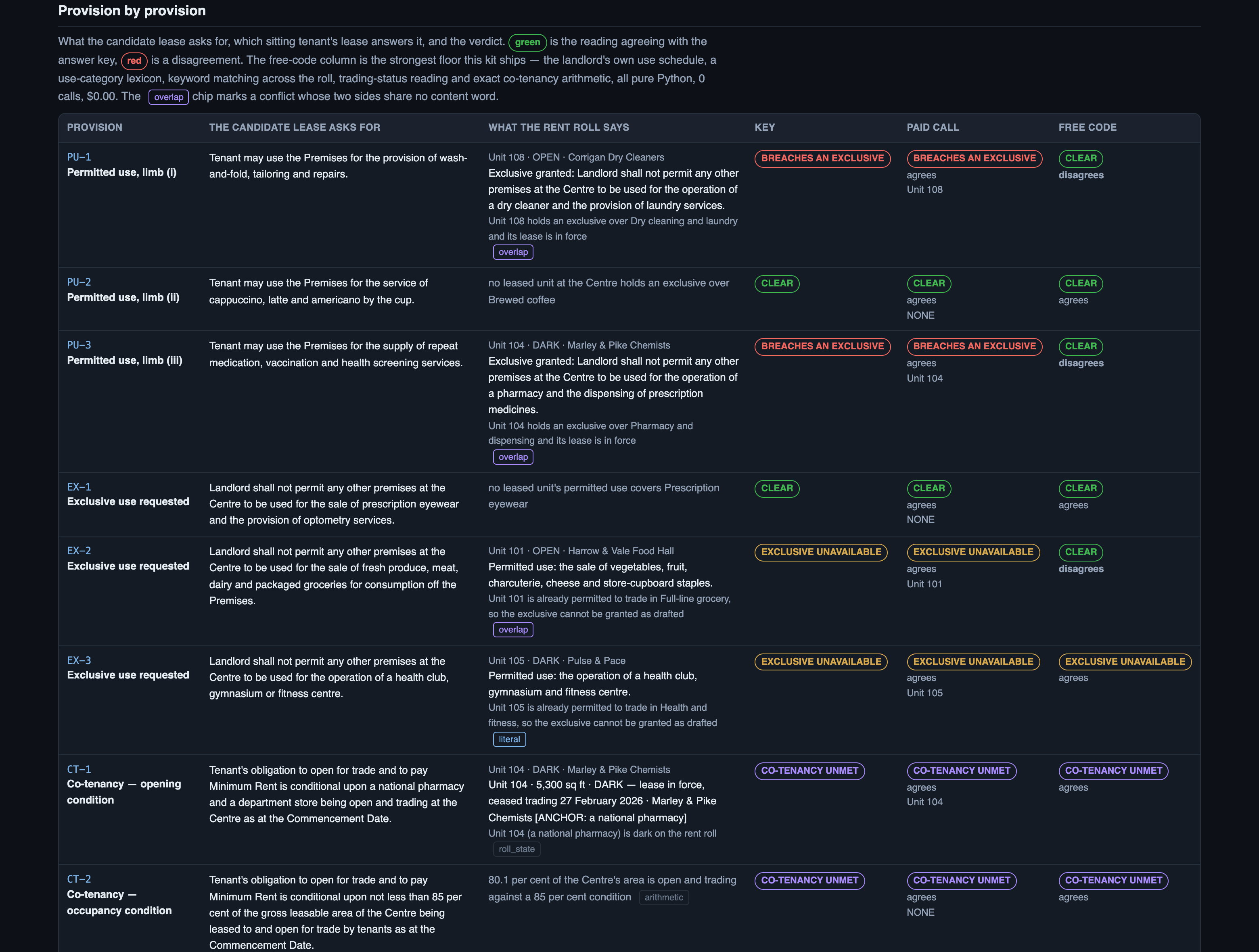
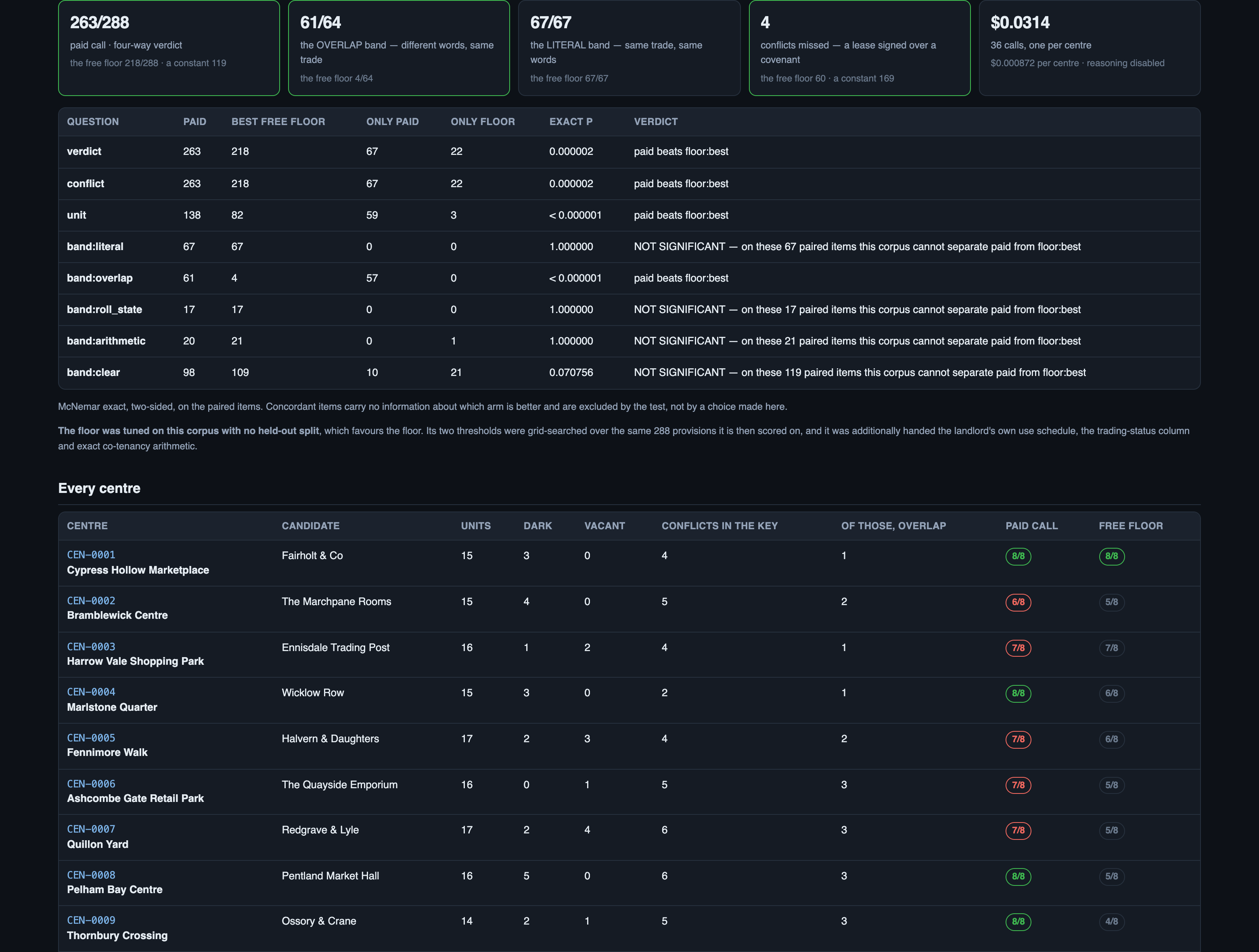
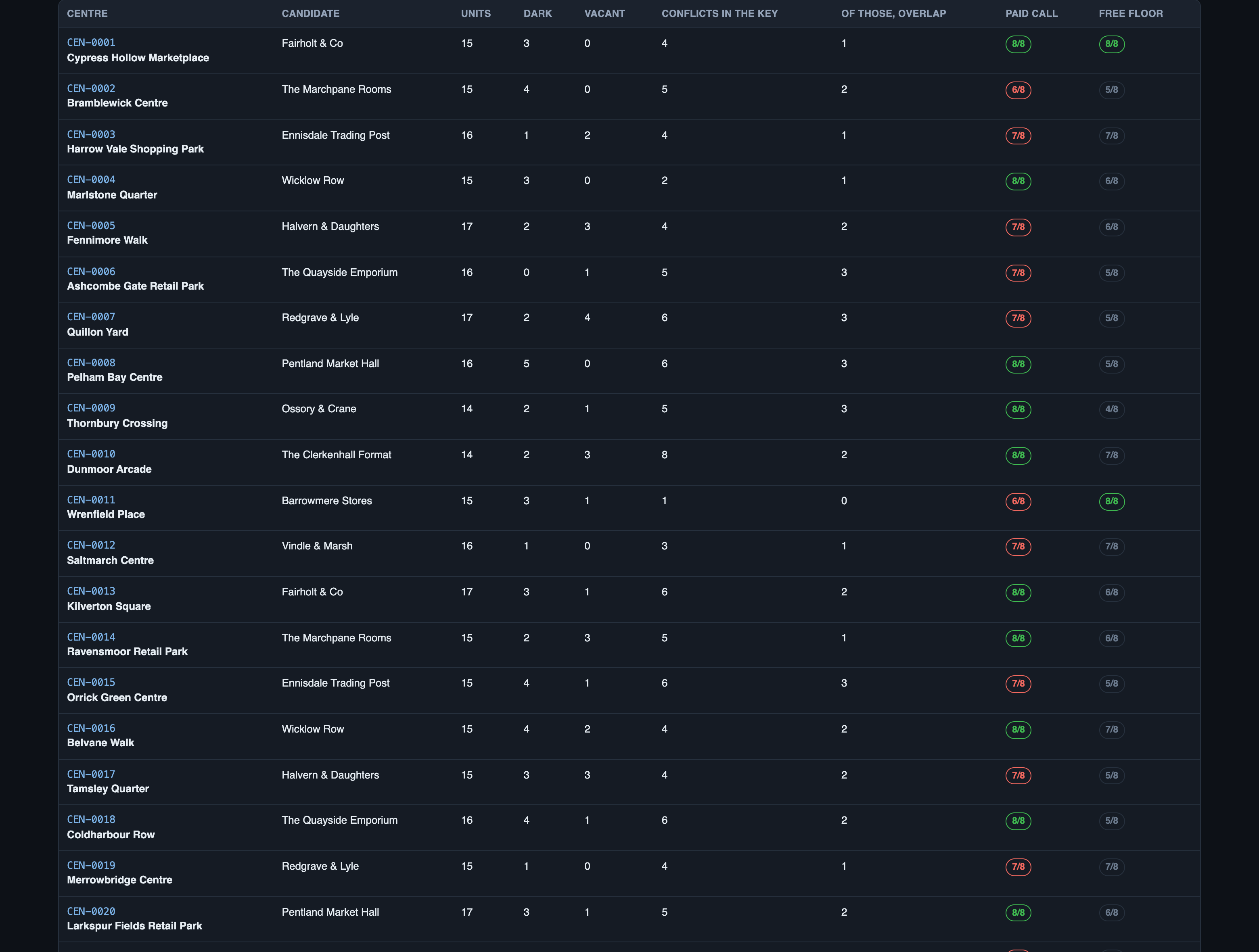
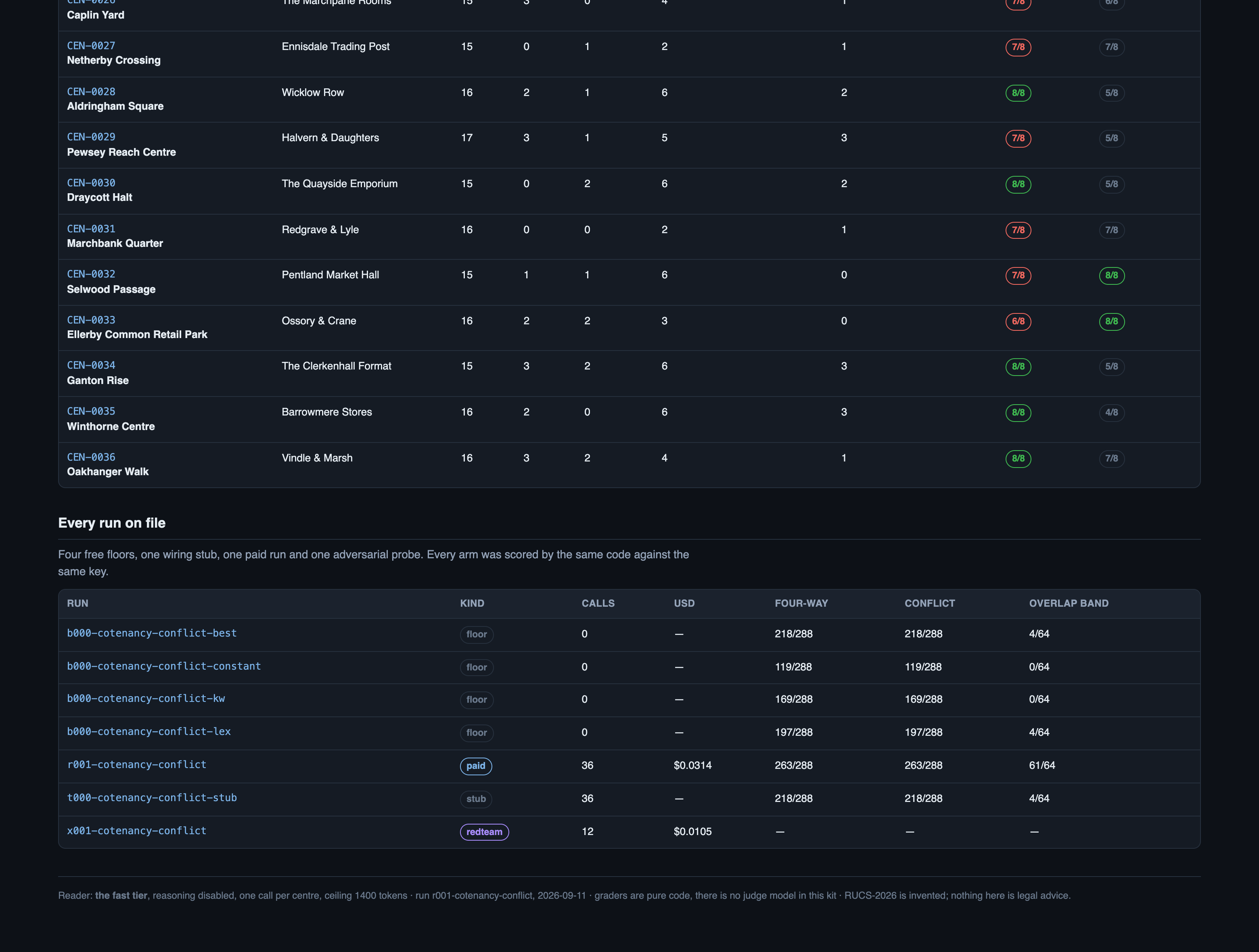
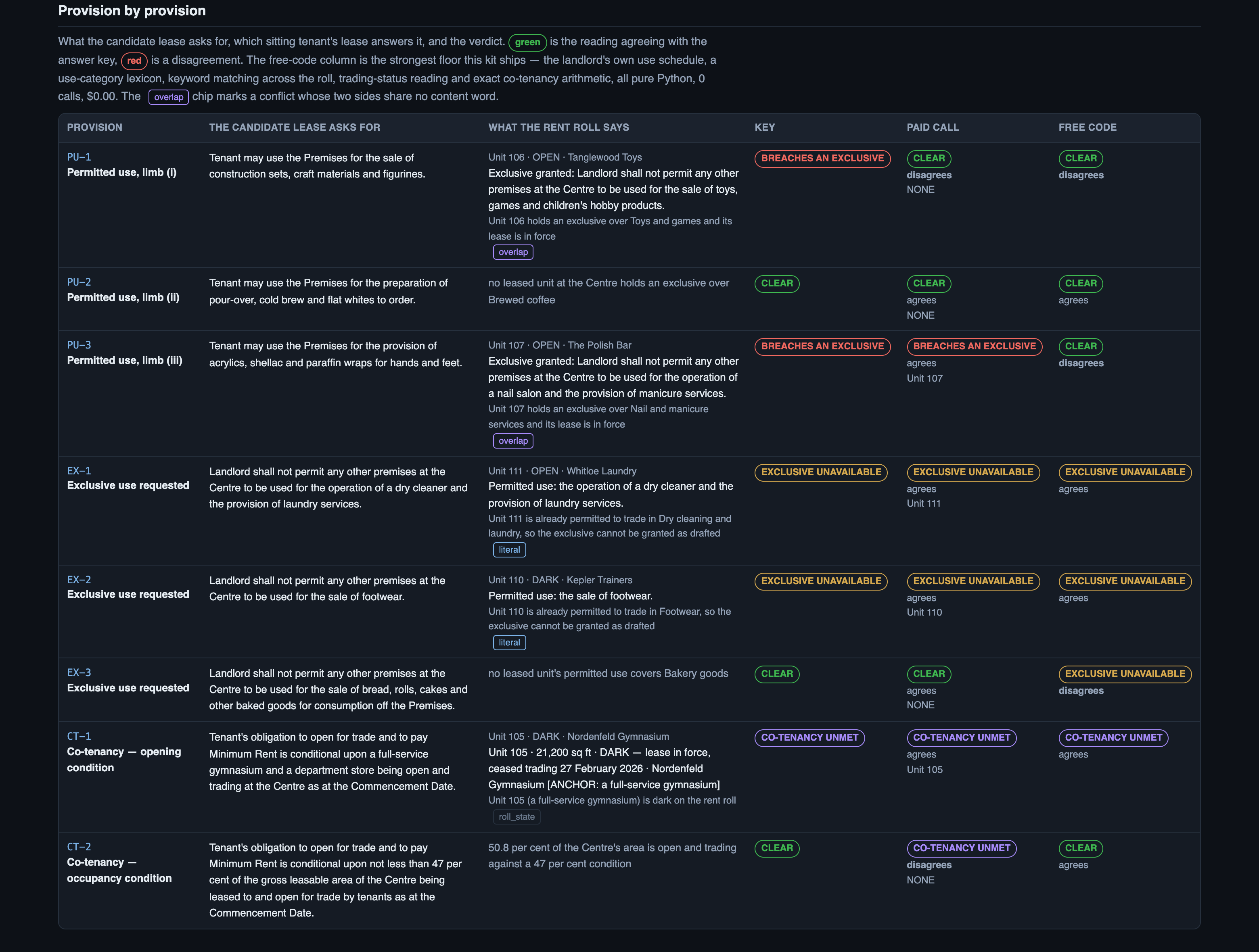
Every provision gets one of four verdicts and, where there is a counterparty, the unit and the words of that tenant's own rent-roll entry — so the conflict is read rather than asserted. 263 of 288 verdicts against the key; 138 of 148 counterparty units named correctly.
And when it cannot
IT OVER-FLAGS CO-TENANCY AND THAT IS 21 OF ITS 25 ERRORS. Nineteen times it reported a co-tenancy condition as unsatisfied when the roll actually satisfies it — six occupancy percentages, four anchor counts and nine named-anchor conditions where every named anchor was in fact open. Those errors cost a leasing manager a conversation; they do not sign anything away. The other direction is rarer and worse: 4 conflicts were missed outright, three of them overlap-band exclusives and one an occupancy condition that failed by a single percentage point — 73.0 per cent open against a 74 per cent condition.
Where it fitsWhat did work
Every line below is a measured result from this kit's own runs, with the figure that supports it. The headline above is not softened by any of them.
- your exclusives and your permitted uses are drafted from the same use schedule, in the same words — the free
bestfloor — 0 calls, $0.00
it scores 67 of 67 on the literal band, exactly what the paid call scores, p = 1.000000. There is no margin to buy - your permitted uses are free prose that lists what a tenant sells — the paid call
61 of 64 on the overlap band against the floor's 4, 57 discordant to 0, p < 0.000001. This is the only band where the money buys anything - co-tenancy conditions — occupancy percentages, anchor counts, named anchors — pure code, every time
the free floor is 17 of 17 on roll-state and 21 of 21 on arithmetic, both at or above the call. Summing square footage and reading a status column is what code is for - a first pass over a deal pipeline where a solicitor reads every flag — the paid call at $0.000872 a centre, with the co-tenancy conditions computed in code
it misses 4 conflicts against the floor's 60, and every finding it makes carries a verbatim quotation from the counterparty's own entry
And where nothing here is good enough:
- you want a number you can quote about your own portfolio — neither, until you re-run the eval on your own labelled centres
RUCS-2026 is invented and every exclusive here is rendered in one canonical form. Real covenants are negotiated one at a time
At a glanceHow the whole thing runs
Run once, for real, on 2026-09-11. Every figure on these pages was captured from that run — nothing is written from intent.
14 steps, grouped by the question that sends you to them rather than by build order. Each tile carries the one figure that step is about, and opens the page behind it.
Should you use this?What you bring, where it stops, and when not to use it
Before you commit an afternoon to this, these are the answers that decide it. Each one is rendered from the record it lives in — and links the page that holds it in full.
| What do I have to bring? | Replace data/framework.json with your own landlord's use schedule — category ids, labels, the wording your exclusives actually use, and the permitted-use wordings you consider equivalent — and drop your own centres into data/corpus/ in the same two-part shape, with a gold row per provision. THE MEASURED ACCURACY DOES NOT TRAVEL WITH YOUR ROLL. Corpus lens → |
| When is this the wrong choice? | Avoid: Quoting its overall rate — it misses 60 of 64 overlap-band conflicts. That is the case against the best-fitting scenario (“your exclusives and your permitted uses are drafted from the same use schedule, in the same words”). 5 scenarios scored in all, each with its own. Eval lens → |
| Where does it stop working? | a centre where TWO sitting tenants could both be the counterparty. This corpus guarantees one by construction so the key can name a unit; a real roll does not, and the honest answer is then 'these two, read them together'. 5 recorded failure modes, each from a run rather than a guess. Corpus lens → |
| What was never verified? | whether any of these rates survives on a REAL rent roll. RUCS-2026 is invented, every exclusive is rendered in the schedule's own wording, and each category is held by at most one leased unit per centre so the key can name a single counterparty. 6 items this kit says it could not check. Eval lens → |
| Can I run this on a model I control? | The shipped adapter is the runtime provider is not named on this page; the Prompt lens states what swapping it costs. The published figures come from 1 model on the fast tier. Prompt lens → |
| And if it fits — what do I stand up? | 5 artifacts with a stated home and a stated egress, and 3 decisions each with what you provision past its ceiling — plus what was not measured. That is the next page, not this one. step 14 — Run it in your environment → |
Not asked of this kit — 2 questions: clone (a fresh clone of this kit runs with nothing fetched); judge (nothing here is graded by a model).
Last verified 2026-09-11 — r001-cotenancy-conflict. Every figure on these pages was captured from that run.
Run itHow this reaches your data
Every result on this page was produced by pure code over checked-in files, with no API key — which is why you can read the numbers before anyone spends anything.
Run this on your own data
- The pipeline, its eval harness and the runs behind every numberdeployed inside your environment, on your own model endpoints, against your own documents.
- The corpus above is the shape, not the limitit is a folder swap, and there is no database to migrate.
Checked before this shipped — A clean checkout with no key configured renders the whole board — the corpus, the answer key, the committed run and all four free floors — and scores every floor offline in pure Python. Shot as kits/UC0388-cotenancy-conflict/docs/shots/cotenancy-conflict-empty.png, against a second server started with API_KEY blanked in its own environment.