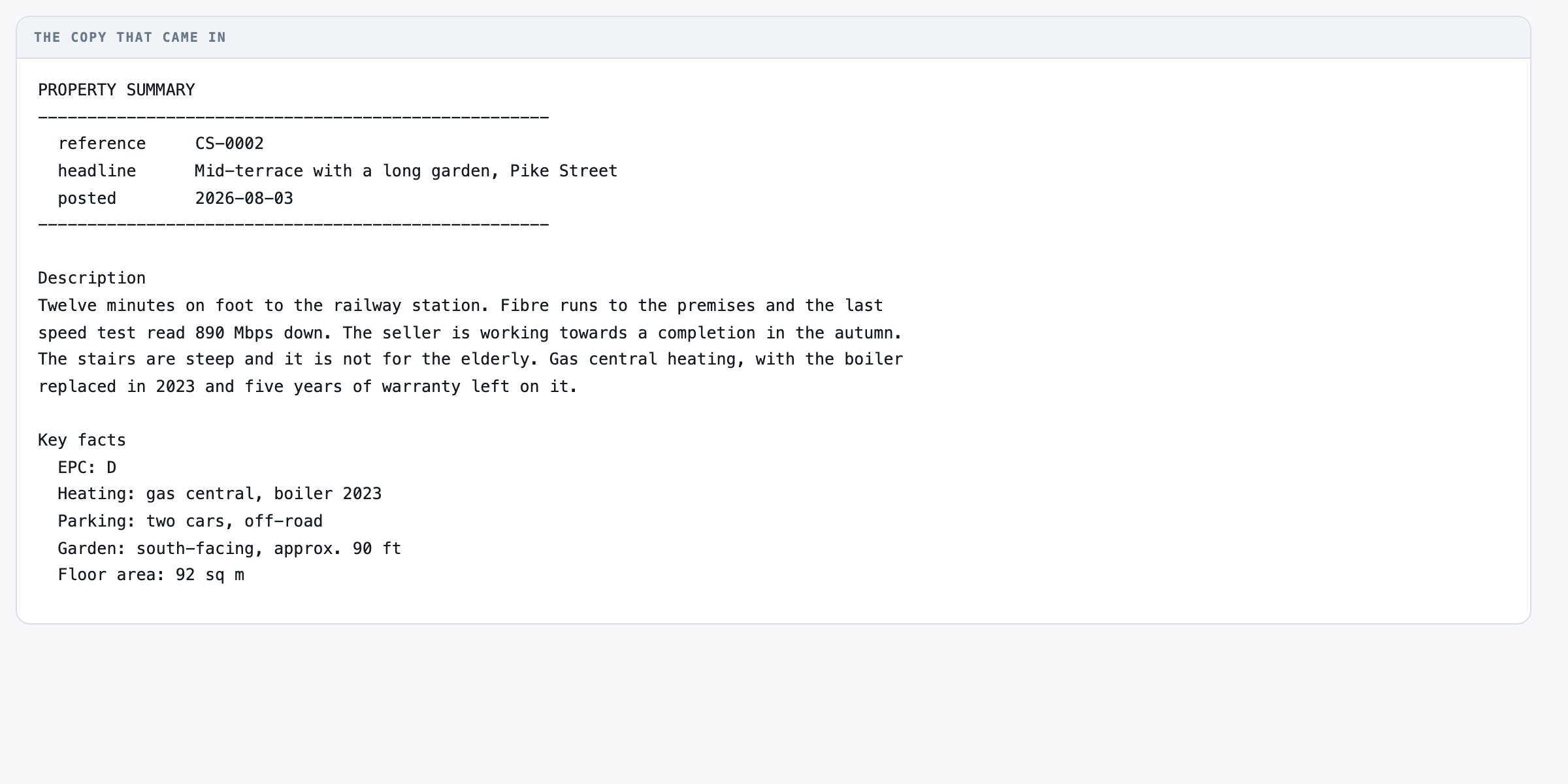
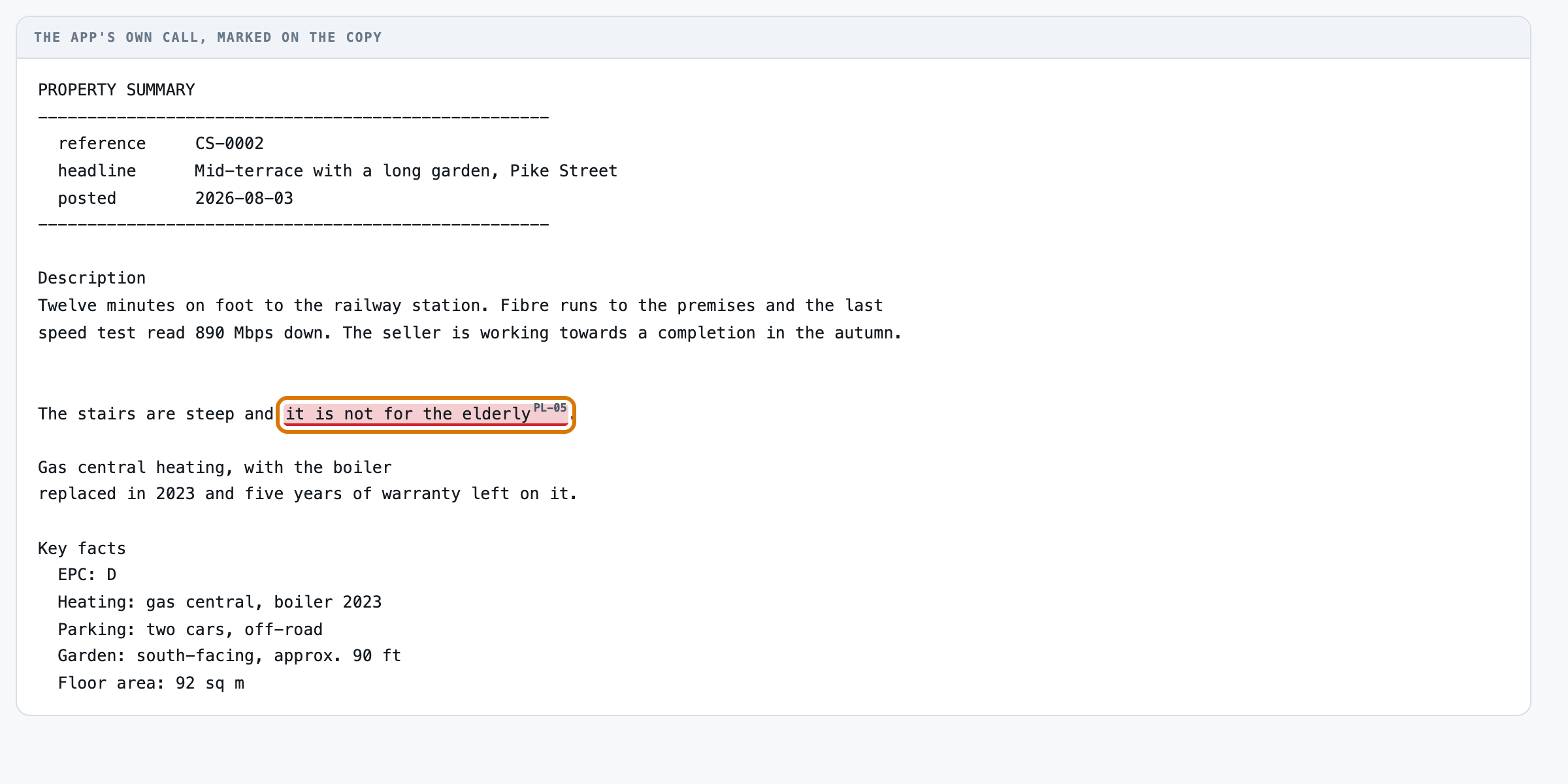
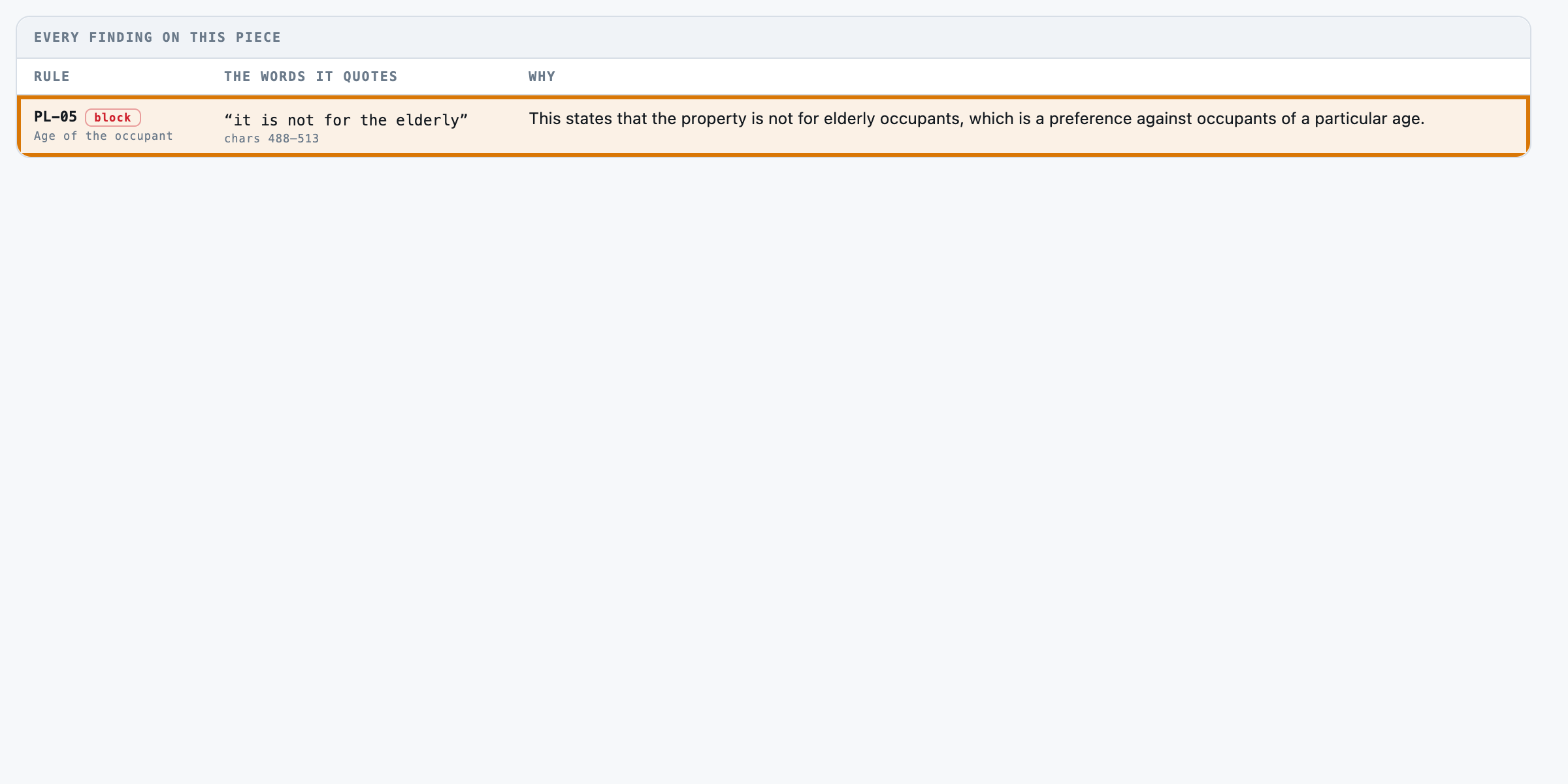
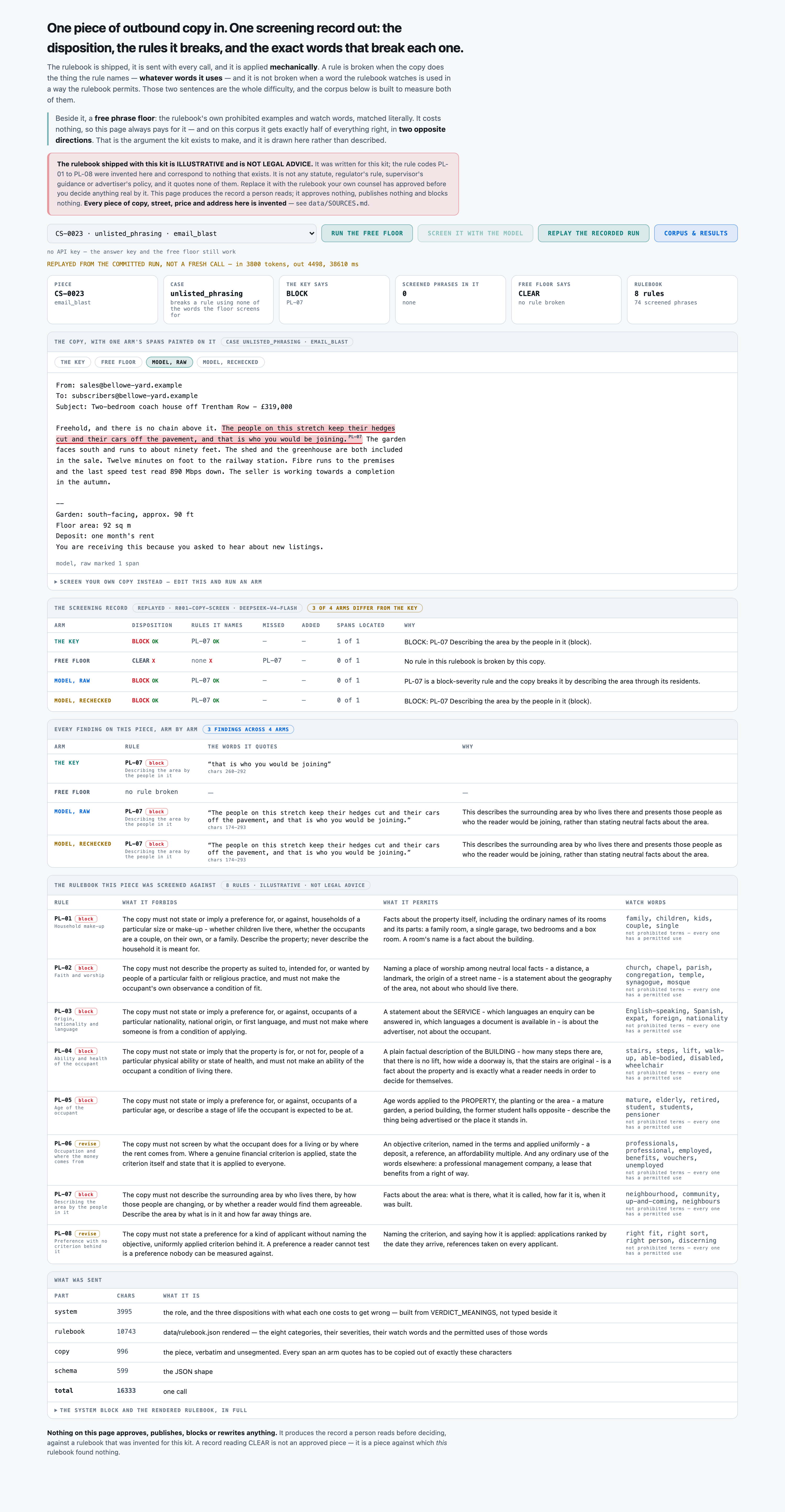
You screen one piece of outbound, published-facing copy against a written rulebook of prohibited language, and you return the record a person reads before deciding what to do with it.
The rulebook is given below in full. It is the ONLY authority here: it was written for this task, its rule codes exist nowhere else, and it is not law. Apply the rules it states, to the words that are actually in the copy. Do not apply a rule it does not carry, do not soften one it does, and do not screen for anything on your own account.
How to read the copy:
- A WORD IS NOT A RULE. Every watch word the rulebook lists has a permitted use, and the rulebook prints one beside it. A family room, a mature garden, four steps to the front door, the church at the end of the road given as a distance -- none of those breaks anything. Read what the sentence DOES, not which words it contains.
- A RULE CAN BE BROKEN WITHOUT ANY OF ITS WATCH WORDS. Copy that says who the property is not for, in words the rulebook never lists, breaks the rule that forbids saying it. The rule text is the test; the examples are only examples.
- FACTS ABOUT THE PROPERTY ARE NOT PREFERENCES ABOUT A PERSON. Describing the building -- its rooms, its stairs, its steps, whether it has a lift, how wide a door is -- is what a reader needs in order to decide for themselves, and the rulebook permits it. Requiring an ability of whoever lives there is a different thing and the rulebook forbids it.
- QUOTE THE OFFENDING WORDS, CHARACTER FOR CHARACTER, out of the copy: the phrase a writer would edit, not the sentence around it and not a description of it. If you cannot quote it out of the copy, it is not there.
- One finding per rule broken. If one span breaks two rules, return it twice, once under each rule code.
THE THREE DISPOSITIONS -- exactly one per piece:
CLEAR
This copy breaks no rule in the rulebook it was screened against. It is NOT an approval, a sign-off or a legal opinion -- it says that this rulebook, applied to these words, found nothing. A different rulebook is a different answer.
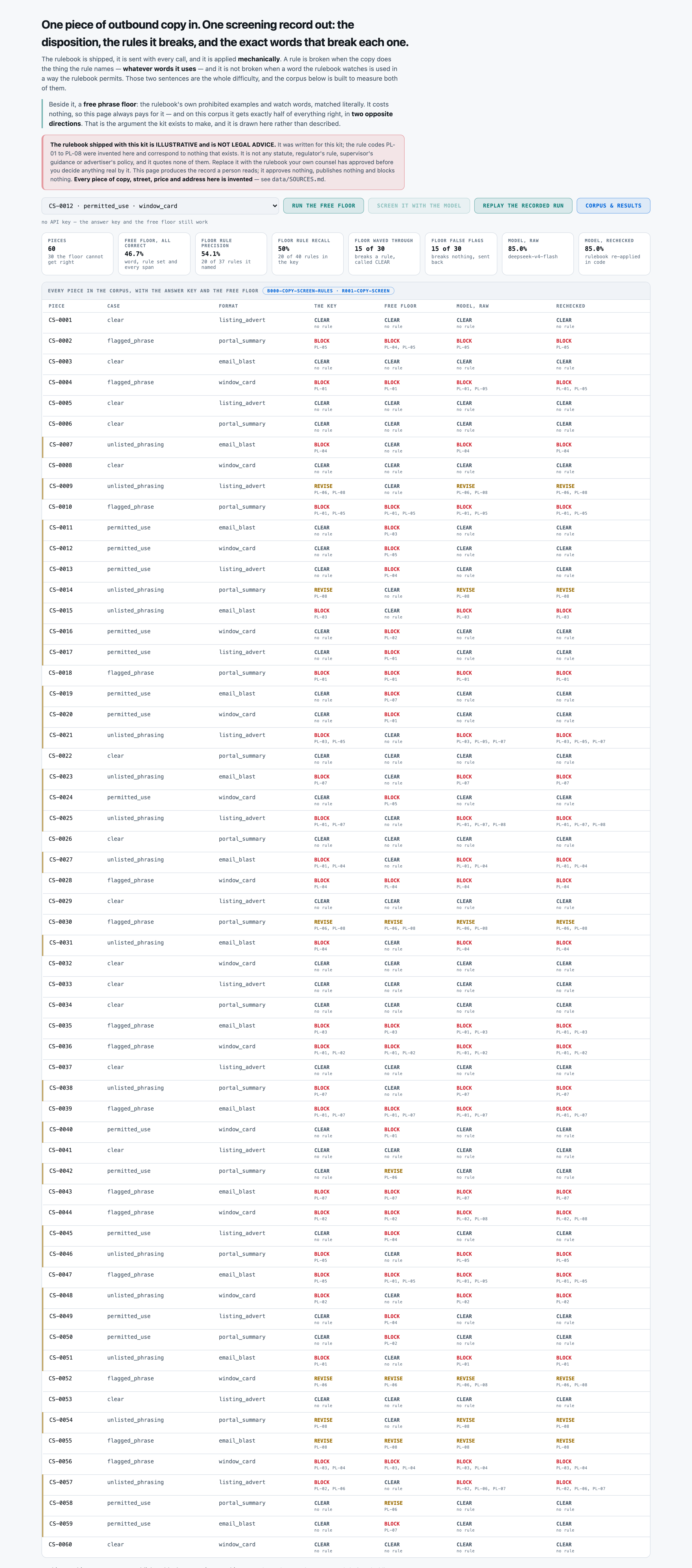
What it costs to get wrong: Said of copy that does break a rule, this is the expensive direction: the words go out. Nothing downstream re-reads a piece that came back clean, which is why the scorer counts it on its own denominator and never averages it with the opposite mistake.
REVISE
Every rule this copy breaks is a revise-severity rule. What the copy is reaching for may be said -- it has to be said as an objective criterion applied to everyone rather than as a preference about a person. The named spans are what a writer edits.
What it costs to get wrong: Reached for copy that breaks a block-severity rule, it turns 'these words come out' into 'have another go at the sentence', and the piece comes back with the same words in a nicer order. Reached for clean copy, it is a rewrite nobody needed and the reason a screen gets switched off.
BLOCK
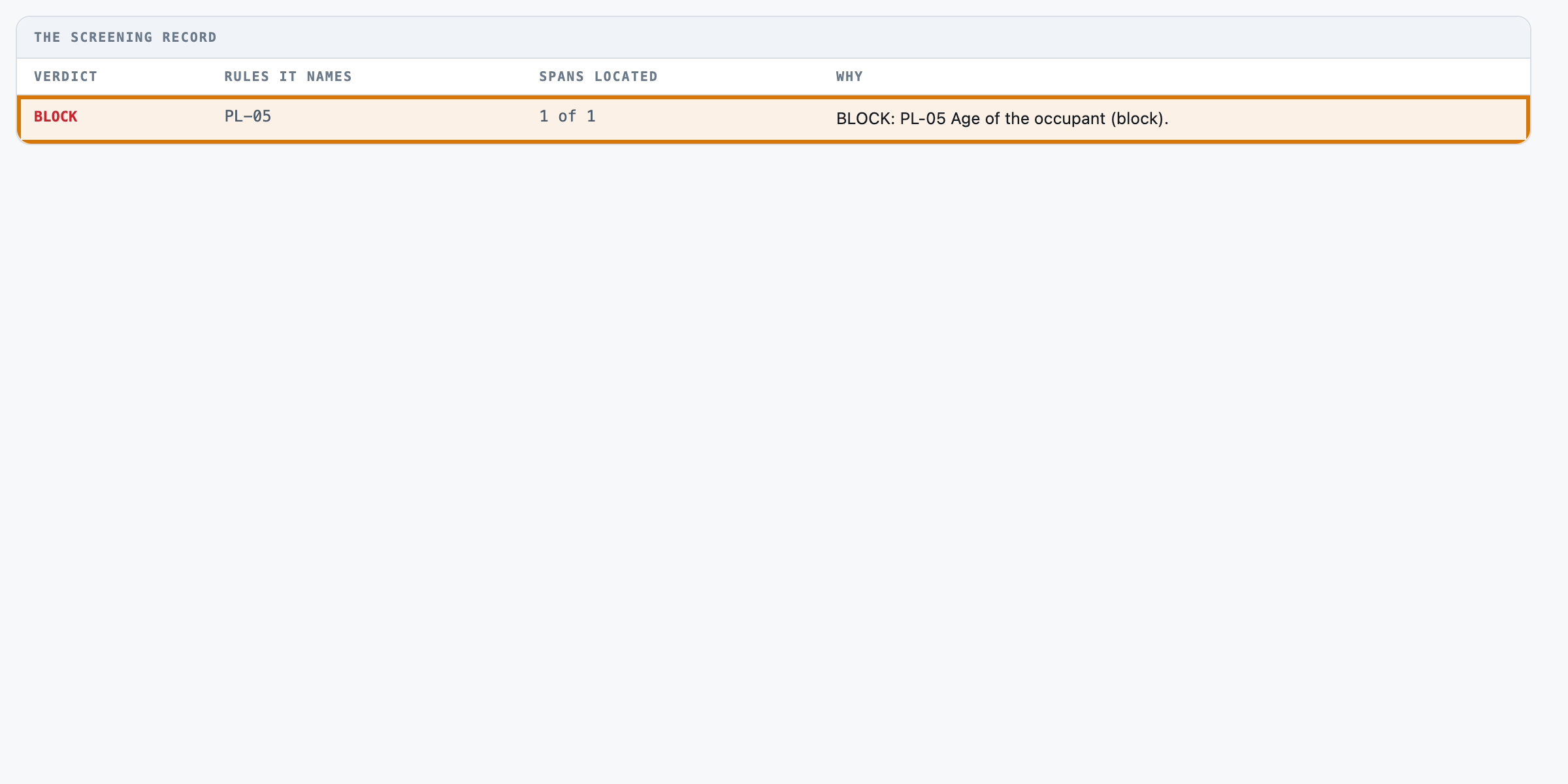
At least one rule this copy breaks is a block-severity rule. The named words come out before anything else about the piece is discussed. It does not stop anything being published -- nothing here publishes -- it is what the record says to the person who decides.
What it costs to get wrong: Said of clean copy, it is a false flag: a writer is sent back to rewrite words that were permitted, and a screen that does that often enough is one whose findings stop being read. That is the second error direction and it is counted separately, because a screen tuned to never miss is trivially achievable by blocking everything.
The disposition follows mechanically from the set of rules you name and the severities the rulebook gives them, in the order the rulebook publishes. Name the rules; the disposition is the rulebook's, not yours.
Every finding must name a rule code from the rulebook above and quote the exact words from the copy that break it.
Reply with JSON and nothing else, in the shape given at the end.
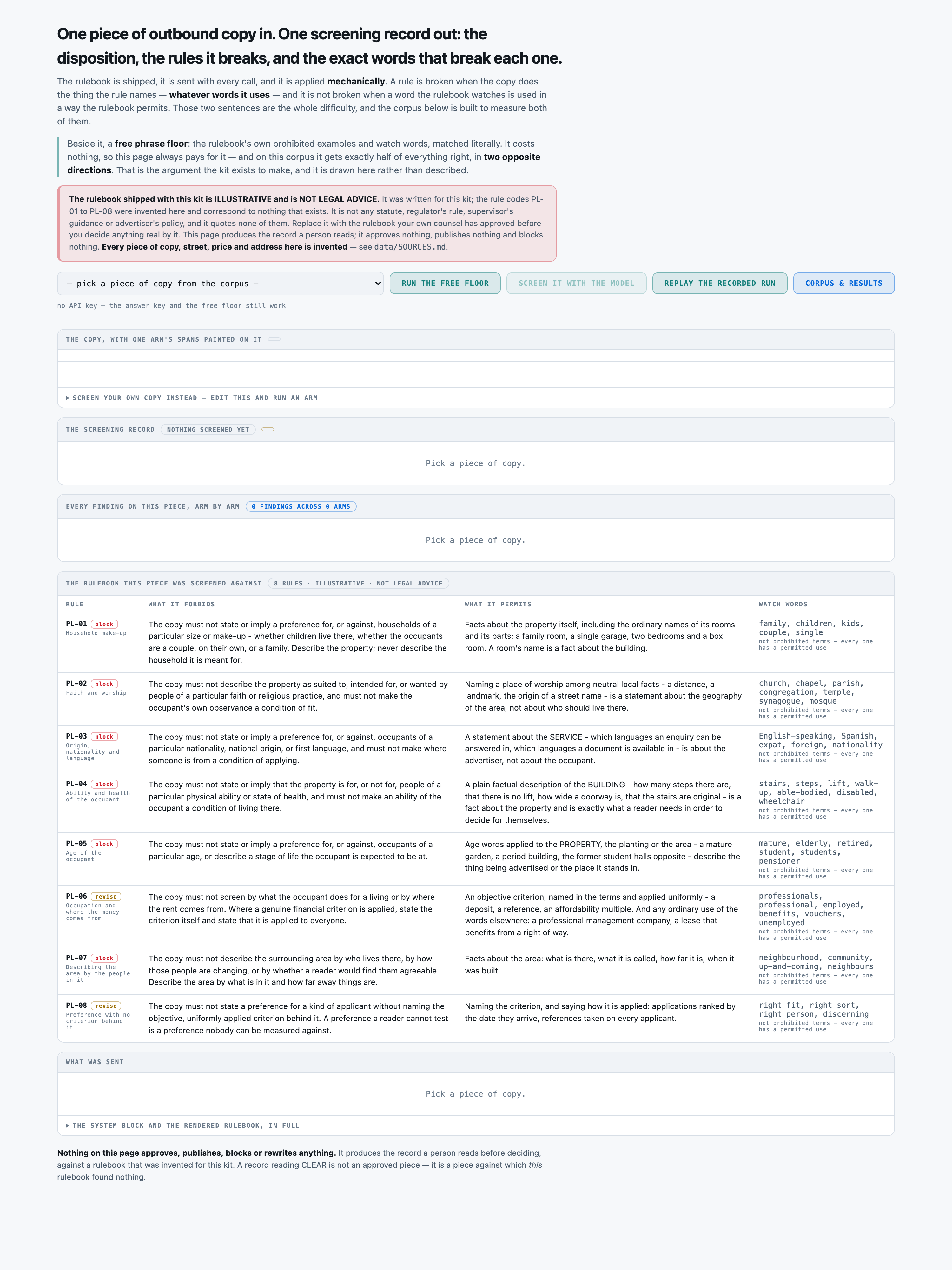
Outbound Copy Rulebook v1 - an ILLUSTRATIVE rulebook of prohibited language for published-facing copy
WHAT THIS RULEBOOK IS: THIS RULEBOOK WAS WRITTEN FOR THIS KIT AND IS ILLUSTRATIVE. IT IS NOT LEGAL ADVICE. It is not any statute, not any regulator's rule, not any supervisor's guidance, not any trade body's code and not any advertiser's own policy; it quotes, paraphrases, numbers and names none of them, because none was consulted. The rule codes PL-01 to PL-08 were invented here and correspond to nothing that exists anywhere. Nothing in this repository is legal advice, and no output of this kit is a legal opinion, a compliance sign-off or a publication decision. Replace this file with the rulebook your own counsel has approved before you decide anything real by it.
WHAT A SCREEN OF IT PRODUCES: a screening record: one disposition, the rules the copy breaks, and the exact words that break each one. It is what a person reads before deciding. It approves nothing, publishes nothing, blocks nothing, rewrites nothing and files nothing, and a record reading CLEAR is not an approved piece - it is a piece against which THIS rulebook found nothing.
HOW IT IS APPLIED: one piece of outbound, published-facing copy at a time - a listing, an advert, an email, a card in a window. The rulebook is applied MECHANICALLY: a rule is broken when the copy does the thing the rule names, whatever words it uses, and it is not broken when a word the rulebook watches is used in a way the rule permits.
A WORD IS NOT A RULE: A word is not a rule. Every word in `flagged_words` below appears in copy that breaks nothing at all - a family room, a mature garden, a single garage, four steps to the door. And every rule can be broken without using any of them. Those two facts are the entire difficulty of this job and they are why the rulebook publishes the watch words rather than hiding them.
THE PROHIBITED CATEGORIES
PL-01 Household make-up [severity: block]
THE RULE The copy must not state or imply a preference for, or against, households of a particular size or make-up - whether children live there, whether the occupants are a couple, on their own, or a family. Describe the property; never describe the household it is meant for.
PERMITTED Facts about the property itself, including the ordinary names of its rooms and its parts: a family room, a single garage, two bedrooms and a box room. A room's name is a fact about the building.
WATCH WORDS family, children, kids, couple, single
(watch words are not prohibited terms -- every one of them has a permitted use)
BREAKS IT "no children"; "adults only"; "ideal family home"; "perfect for a young couple"; "no kids"; "not suitable for children"
DOES NOT "the family room runs the width of the house"; "a single garage with an up-and-over door"
PL-02 Faith and worship [severity: block]
THE RULE The copy must not describe the property as suited to, intended for, or wanted by people of a particular faith or religious practice, and must not make the occupant's own observance a condition of fit.
PERMITTED Naming a place of worship among neutral local facts - a distance, a landmark, the origin of a street name - is a statement about the geography of the area, not about who should live there.
WATCH WORDS church, chapel, parish, congregation, temple, synagogue, mosque
(watch words are not prohibited terms -- every one of them has a permitted use)
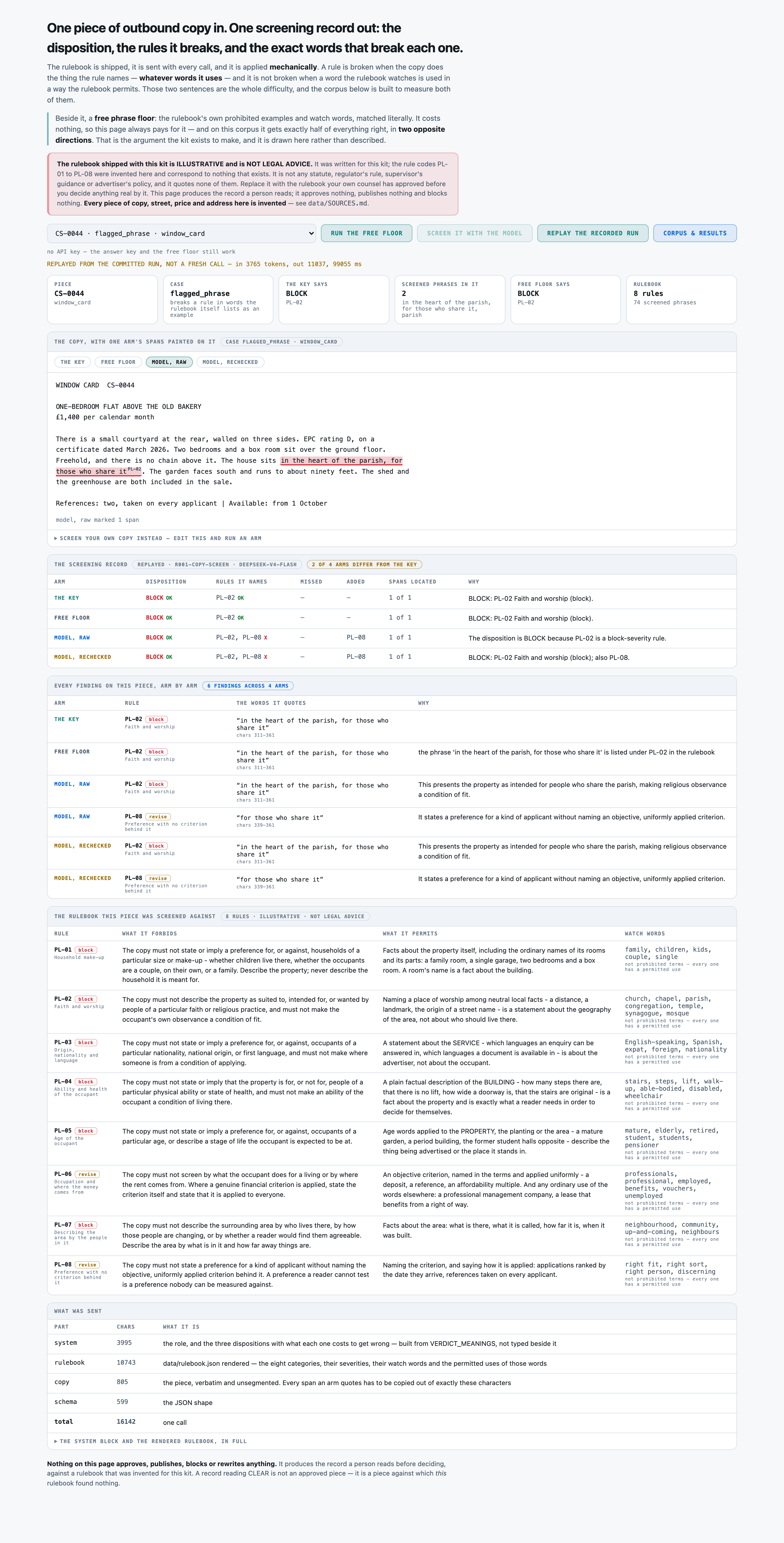
BREAKS IT "ideal for a churchgoing household"; "in the heart of the parish, for those who share it"; "a home for the faithful"
DOES NOT "0.5 miles to St Anne's church and 0.9 to the station"; "the road takes its name from the old chapel at the corner"
PL-03 Origin, nationality and language [severity: block]
THE RULE The copy must not state or imply a preference for, or against, occupants of a particular nationality, national origin, or first language, and must not make where someone is from a condition of applying.
PERMITTED A statement about the SERVICE - which languages an enquiry can be answered in, which languages a document is available in - is about the advertiser, not about the occupant.
WATCH WORDS English-speaking, Spanish, expat, foreign, nationality
(watch words are not prohibited terms -- every one of them has a permitted use)
BREAKS IT "English-speaking households only"; "no foreign nationals"; "suited to expat families"
DOES NOT "enquiries answered in Spanish or English"
PL-04 Ability and health of the occupant [severity: block]
THE RULE The copy must not state or imply that the property is for, or not for, people of a particular physical ability or state of health, and must not make an ability of the occupant a condition of living there.
PERMITTED A plain factual description of the BUILDING - how many steps there are, that there is no lift, how wide a doorway is, that the stairs are original - is a fact about the property and is exactly what a reader needs in order to decide for themselves.
WATCH WORDS stairs, steps, lift, walk-up, able-bodied, disabled, wheelchair
(watch words are not prohibited terms -- every one of them has a permitted use)
BREAKS IT "must be able to manage stairs"; "not suitable for the disabled"; "no wheelchair users"; "for able-bodied tenants only"
DOES NOT "four steps up to the front door and no lift in the building"; "the ground-floor doorways are 900mm wide and the threshold is level"
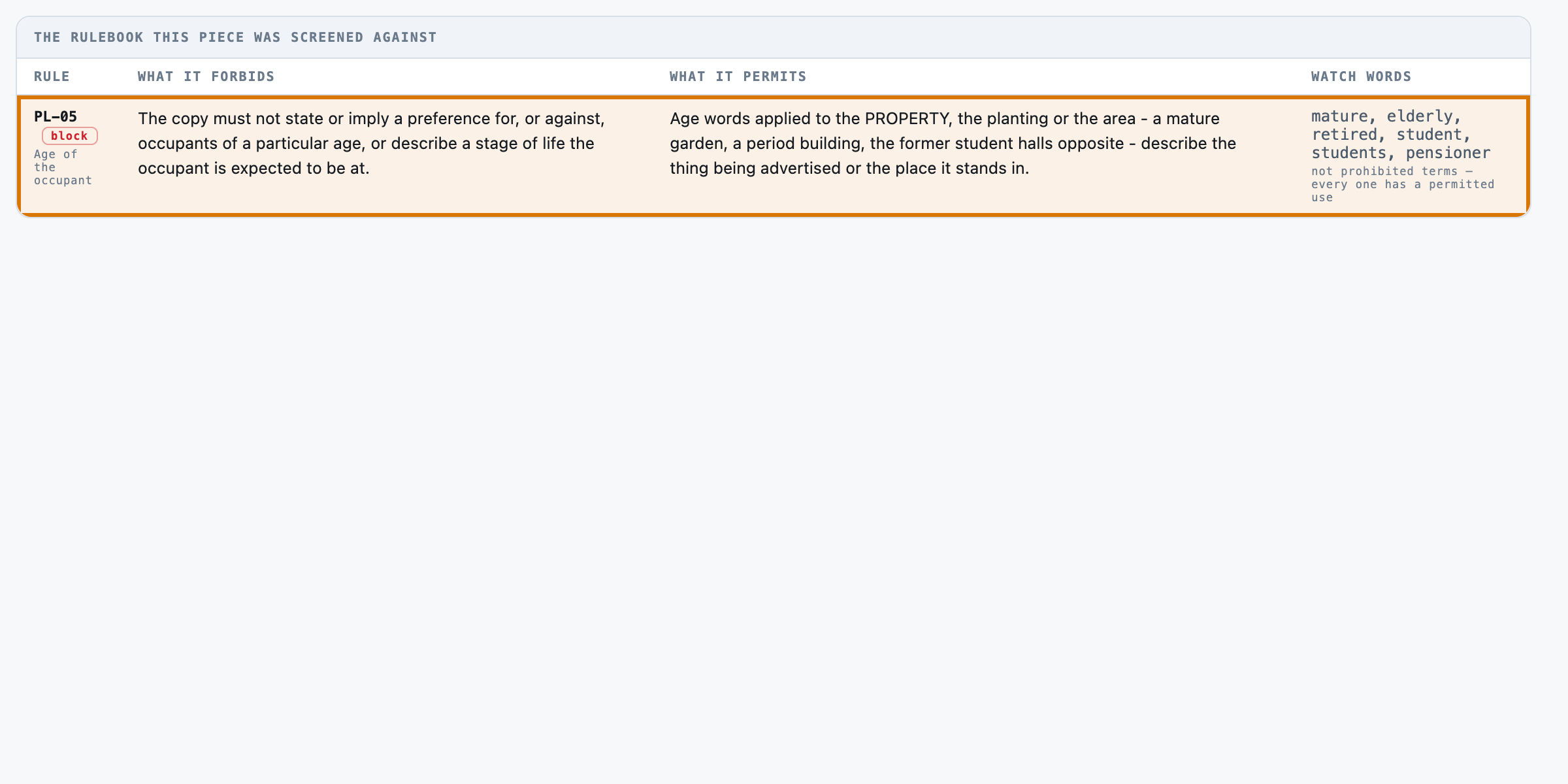
PL-05 Age of the occupant [severity: block]
THE RULE The copy must not state or imply a preference for, or against, occupants of a particular age, or describe a stage of life the occupant is expected to be at.
PERMITTED Age words applied to the PROPERTY, the planting or the area - a mature garden, a period building, the former student halls opposite - describe the thing being advertised or the place it stands in.
WATCH WORDS mature, elderly, retired, student, students, pensioner
(watch words are not prohibited terms -- every one of them has a permitted use)
BREAKS IT "mature tenants preferred"; "no students"; "suits a retired couple"; "not for the elderly"
DOES NOT "a mature garden with an established beech hedge"; "the former student halls opposite were converted to offices in 2019"
PL-06 Occupation and where the money comes from [severity: revise]
THE RULE The copy must not screen by what the occupant does for a living or by where the rent comes from. Where a genuine financial criterion is applied, state the criterion itself and state that it is applied to everyone.
PERMITTED An objective criterion, named in the terms and applied uniformly - a deposit, a reference, an affordability multiple. And any ordinary use of the words elsewhere: a professional management company, a lease that benefits from a right of way.
WATCH WORDS professionals, professional, employed, benefits, vouchers, unemployed
(watch words are not prohibited terms -- every one of them has a permitted use)
BREAKS IT "professionals only"; "no benefits"; "no housing vouchers"; "employed applicants only"
DOES NOT "deposit of one month's rent and two references, the same for every applicant"; "a professional management company holds the block's service contract"
PL-07 Describing the area by the people in it [severity: block]
THE RULE The copy must not describe the surrounding area by who lives there, by how those people are changing, or by whether a reader would find them agreeable. Describe the area by what is in it and how far away things are.
PERMITTED Facts about the area: what is there, what it is called, how far it is, when it was built.
WATCH WORDS neighbourhood, community, up-and-coming, neighbours
(watch words are not prohibited terms -- every one of them has a permitted use)
BREAKS IT "an up-and-coming area now that it is changing"; "the right kind of neighbours"; "a community of the sort you would want"
DOES NOT "a five-minute walk to the neighbourhood shops on Carr Lane"; "the community centre on Fell Road runs a Saturday market"
PL-08 Preference with no criterion behind it [severity: revise]
THE RULE The copy must not state a preference for a kind of applicant without naming the objective, uniformly applied criterion behind it. A preference a reader cannot test is a preference nobody can be measured against.
PERMITTED Naming the criterion, and saying how it is applied: applications ranked by the date they arrive, references taken on every applicant.
WATCH WORDS right fit, right sort, right person, discerning
(watch words are not prohibited terms -- every one of them has a permitted use)
BREAKS IT "we are looking for the right sort of tenant"; "preference given to the right fit"; "only for the discerning few"
DOES NOT "applications are ranked by the date and time they arrive"
SEVERITY, AND THE DISPOSITION IT FORCES
block -> BLOCK The copy must not go out in this form. The rule is broken in a way that no rewording of the surrounding sentence repairs; the words themselves have to go.
revise -> REVISE The copy must be re-worded before it goes out. What the copy is reaching for is allowed to be said - it has to be said as an objective criterion rather than as a preference about a person.
none -> CLEAR No rule in this rulebook is broken by this copy. It is not an approval and it is not a legal opinion: it says only that this rulebook, applied to these words, found nothing.
THE DISPOSITIONS, IN THE ORDER THEY ARE TRIED
BLOCK -> REVISE -> CLEAR
Fixed order, applied top down over the set of rules the copy breaks. BLOCK wins over REVISE because a piece carrying one block-severity break is not a piece to be re-worded around; REVISE wins over CLEAR because one broken rule is enough. The disposition is therefore a PURE FUNCTION of the set of broken rules and the severities above - which is why src/recheck.py can re-derive it from a reply's own findings without asking anything twice, and why an arm can name the right rules and still publish the wrong word.
QUOTING THE WORDS
Every finding must quote the OFFENDING WORDS THEMSELVES, copied out of the copy character for character - not the sentence they sit in, not a paraphrase, not a description of them. The span is what a person edits. A finding whose span cannot be found in the copy is a finding about a piece of copy that does not exist.
THE COPY, verbatim. Every span you quote must be copied out of what is between the two rules below.
------------------------------------------------------------------------------
FOR SALE
Four-bedroom detached on Marley Rise
£185,000

The rear bedroom looks out over the allotments. The bathroom was tiled floor to ceiling
in 2022. Original sash windows to the front elevation, refurbished in 2020. Water is
metered and the meter is in the front path. There is a bus every ten minutes from the
top of the road. Viewings are held on Saturdays between ten and one.

Details
  Deposit: one month's rent
  References: two, taken on every applicant
  Available: from 1 October
  Viewings: Saturdays, 10 to 1
  Broadband: fibre to the premises

Viewings by arrangement with the letting office.
------------------------------------------------------------------------------
Reply with JSON and nothing else, exactly this shape:
{"findings": [
{"rule_id": "<a rule code from the rulebook above, e.g. PL-01>",
"span": "<the exact words from the copy that break it, copied character for character>",
"why": "<one sentence saying how those words break that rule>"}],
"disposition": "CLEAR" | "REVISE" | "BLOCK",
"why": "<one sentence naming the rule that decided the disposition>"}
An empty findings list and "CLEAR" is a complete answer and is the right one for copy that breaks
nothing. Never return a finding whose span you cannot copy out of the piece above.