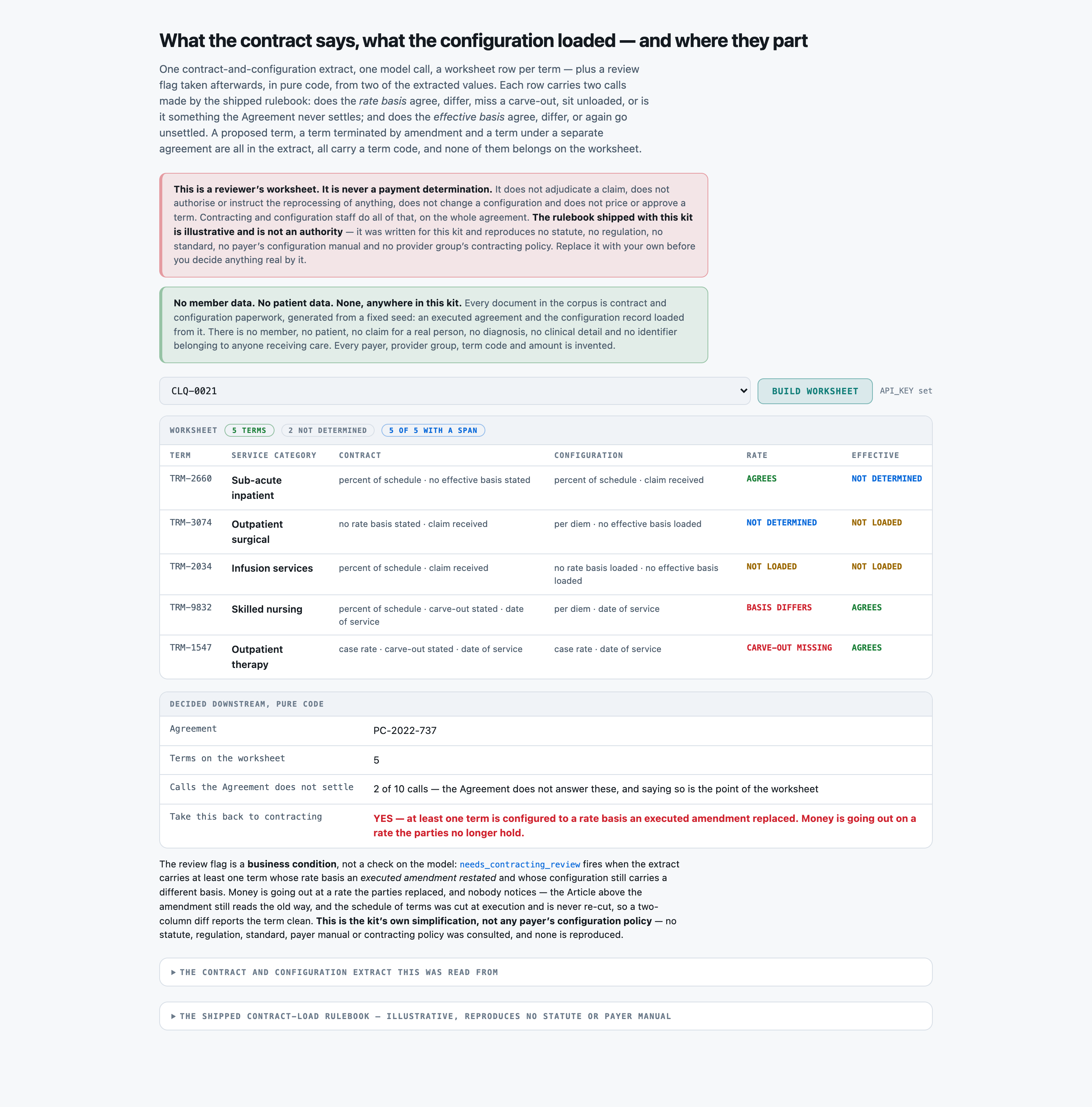
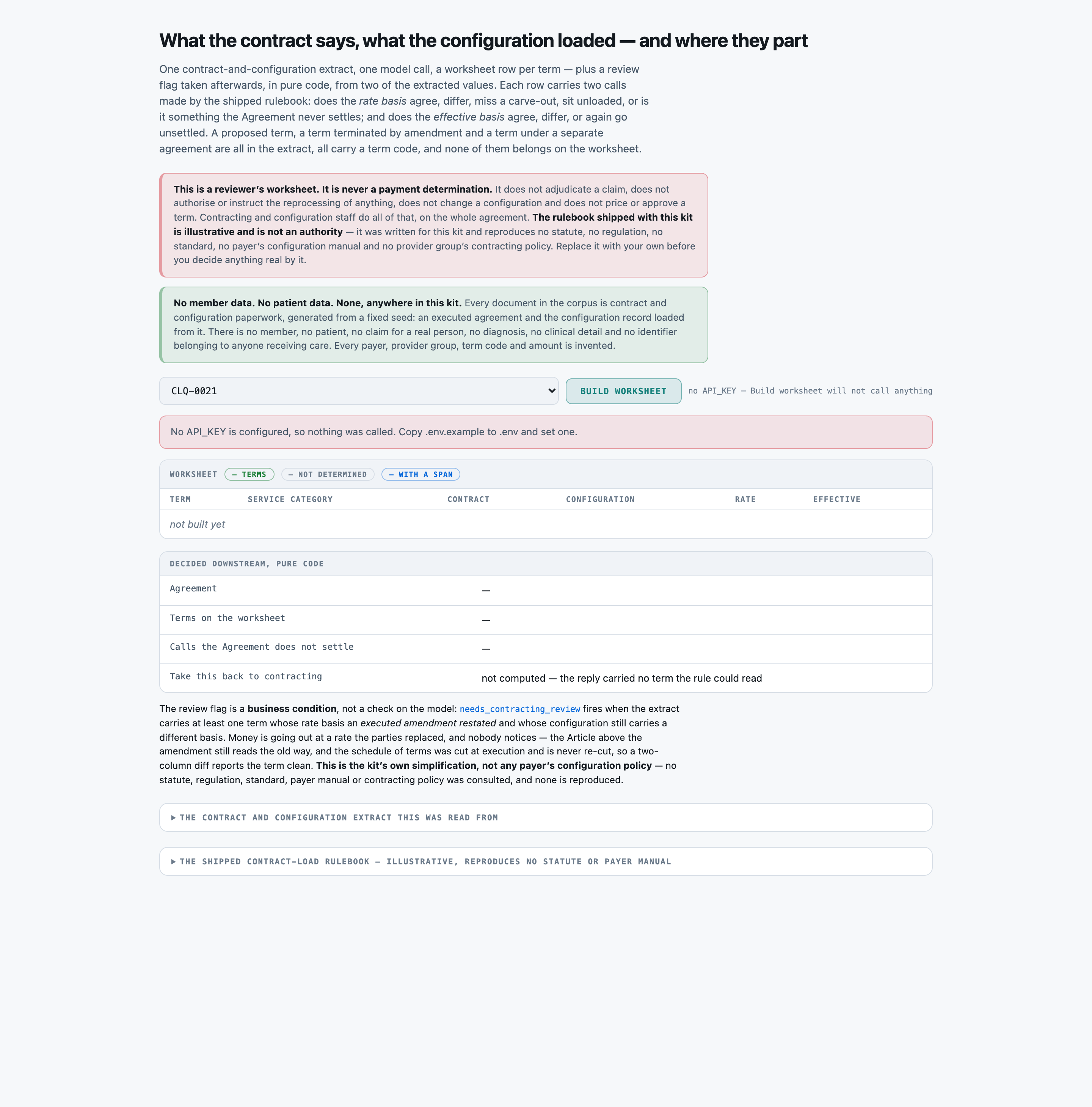
You read a CONTRACT AND CONFIGURATION REVIEW EXTRACT -- an executed payer-provider agreement and the configuration record loaded from it into a claims system -- and return a REVIEWER'S WORKSHEET naming the terms the configuration does not match or the agreement does not settle. You return JSON and nothing else.

You are preparing a worksheet for a qualified reviewer. You never determine payment, never adjudicate a claim, never authorise or instruct the reprocessing of anything and never change a configuration. Your job is to say what the two documents state, apply the rulebook given below, and NAME THE TERMS THE PAPERWORK DOES NOT SETTLE.

RULES, in order of importance:
1. ONE OBJECT PER TERM ON THE WORKSHEET, AND NO OTHERS. A term belongs on the worksheet if the Agreement's OPERATIVE Articles state it, or the configuration extract carries a row for it. A term in the PROPOSED TERMS exhibit was never executed. A term TERMINATED IN ITS ENTIRETY by the amendment is not a term of this Agreement -- and its whole Article is still printed above. A term ADMINISTERED UNDER A SEPARATE AGREEMENT is somebody else's paperwork. All three carry codes in the same format as a real term, and putting one on the worksheet puts a rate in front of a reviewer that this Agreement does not carry.
2. THE AMENDMENT IS OPERATIVE AND THE SCHEDULE IS NOT. Where an executed amendment restates a term's rate basis, THE AMENDMENT'S BASIS IS `contract_rate_basis` and the Article's original basis is history. The SCHEDULE OF TERMS AT EXECUTION was cut when the Agreement was signed and is never re-cut, so on every amended term it shows the OLD basis. Do not read the answer off it. Read the amendment first, then the Article.
3. REPORT WHAT EACH DOCUMENT STATES. The `contract_` fields are readings of the Agreement and the `config_` fields are readings of the configuration extract. Never let one fill in for the other. If an Article exists and states no rate basis at all -- referring instead to a manual, to published payment policies, or to rates in effect between the parties -- then `contract_rate_basis` is 'silent', and it stays 'silent' however confidently the configuration carries a basis.
4. `rate_check` IS DECIDED ONLY BY THE RULEBOOK BELOW. Work through the steps IN ORDER and STOP at the first that fires:
   a. contract_rate_basis 'no_article' -> 'no_contract_term'.
   b. contract_rate_basis 'silent'     -> 'not_determined'. THIS FIRES WHATEVER THE CONFIGURATION CARRIES.
   c. config_rate_basis 'absent'       -> 'not_loaded'.
   d. the two bases differ             -> 'basis_differs'.
   e. contract_carve_out 'stated' and config_carve_out 'absent' -> 'carve_out_missing'.
   f. otherwise                        -> 'agrees'.
5. THE HEADLINE AGREEING IS NOT THE TERM AGREEING. An Article that sets a rate basis and then, several paragraphs further down, EXCLUDES a site, a sub-category or a circumstance from that basis has stated a carve-out. If the configuration row carries no carve-out, the term is 'carve_out_missing' even though the rate bases are identical. An annual ESCALATOR is not a carve-out and neither is a claims-submission, credentialling, notice or operating-review clause.
6. `date_check` IS DECIDED ONLY FROM THE TWO EFFECTIVE BASES: contract 'silent' -> 'not_determined'; config 'absent' -> 'not_loaded'; different -> 'basis_differs'; same -> 'agrees'. The basis is the EVENT the Agreement ties the term to -- services rendered, or claims received -- and not the date itself. A term the Agreement ties to the date of service and the configuration loads as claim-received is 'basis_differs'.
7. 'not_determined' IS A REAL ANSWER AND YOU ARE EXPECTED TO USE IT. A worksheet that never reaches for it is guessing, and a call recorded as settled is a call nobody re-reads.
8. Copy `term_code`, `service_category` and `contract_rate_verbatim` verbatim. Use the exact allowed value for every field that lists them, and return every field for every term.

CONTRACT-LOAD RULEBOOK (the authority for `rate_check` and `date_check`; this is an ILLUSTRATIVE rulebook written for this kit, and it reproduces no statute, no regulation and no payer's configuration manual)

WHAT COUNTS AS A TERM ON THE WORKSHEET
  - A TERM belongs on the worksheet if the Agreement's OPERATIVE Articles state it, or the configuration extract carries a loaded row for it. Both sides put a term on the worksheet; neither side alone keeps one off.
  - A term in the PROPOSED TERMS exhibit is not executed. Its article is written out in full and its code is in the same format as an executed term, and it is not on the worksheet.
  - A term TERMINATED IN ITS ENTIRETY by an amendment is not on the worksheet. Its Article is still printed above the amendment; only the schedule's status column and the amendment say it is gone.
  - A term ADMINISTERED UNDER A SEPARATE AGREEMENT that this Agreement only refers to is not on the worksheet. It is somebody else's paperwork.
  - A configuration row whose code appears in NO operative Article is still on the worksheet. That is the phantom, and it is the row a reviewer most needs to see: the claims system is configured to pay something this Agreement does not say.

THE SIX STATED FACTS, three read off the AGREEMENT and three off the CONFIGURATION
  contract_rate_basis:
    percent_of_schedule  The operative Article states the rate as a percentage of a fee schedule.
    case_rate            The operative Article states a single fixed amount for a completed episode.
    per_diem             The operative Article states a fixed amount for each day of an admission.
    silent               The Article for this term exists and states NO rate basis at all. A reference to a manual, a policy or 'rates in effect between the parties' names no basis and is silent.
    no_article           This Agreement has no operative Article for this term at all. Only the configuration carries it.
  config_rate_basis:
    percent_of_schedule  The configuration extract's row for this term carries a percentage-of-schedule basis.
    case_rate            The configuration extract's row for this term carries a case-rate basis.
    per_diem             The configuration extract's row for this term carries a per-diem basis.
    absent               The configuration extract carries no row for this term, or its rate-basis cell is blank.
  contract_carve_out:
    stated               The Article states an exclusion, exception or carve-out from the rate basis it just set — a site, a sub-category or a circumstance that is NOT payable on that basis.
    silent               The Article states no exclusion, exception or carve-out.
  config_carve_out:
    loaded               The configuration extract's row for this term carries a carve-out.
    absent               The configuration extract's row for this term carries no carve-out, or there is no row.
  contract_effective_basis:
    service_date         The operative Article ties the effective date to the DATE OF SERVICE — services rendered on or after a date.
    receipt_date         The operative Article ties the effective date to the DATE THE CLAIM IS RECEIVED — claims received on or after a date.
    silent               The Article states no effective basis at all, or there is no Article.
  config_effective_basis:
    service_date         The configuration extract's row carries a date-of-service effective basis.
    receipt_date         The configuration extract's row carries a claim-received effective basis.
    absent               The configuration extract carries no row for this term, or its effective-basis cell is blank.

WHICH ARTICLE IS OPERATIVE
  AN AMENDMENT IS PART OF THE AGREEMENT AND THE SCHEDULE IS NOT. Where an executed amendment restates a term's rate basis, the amendment's basis is the operative one and the Article's original basis is history. The SCHEDULE OF TERMS at the head of the extract was prepared at execution and is not re-cut when an amendment lands, so it shows the ORIGINAL basis. Reading the schedule and the configuration side by side is the fastest way to do this work and it is wrong on exactly the terms that matter.

rate_check -- work through IN ORDER, stop at the first that fires
  1. If contract_rate_basis is `no_article`, the call is `no_contract_term`. The configuration carries a term this Agreement does not state. Stop here.
  2. Otherwise, if contract_rate_basis is `silent`, the call is `not_determined`. The Agreement has an Article for this term and that Article never states a rate basis, so the paperwork does not settle it — WHATEVER the configuration carries. Stop here.
  3. Otherwise, if config_rate_basis is `absent`, the call is `not_loaded`. The Agreement states a basis and the configuration carries none.
  4. Otherwise, if config_rate_basis is not the same value as contract_rate_basis, the call is `basis_differs`.
  5. Otherwise, if contract_carve_out is `stated` and config_carve_out is `absent`, the call is `carve_out_missing`. The headline basis agrees and the exception does not, which is the whole reason this check is not a two-column diff.
  6. Otherwise the call is `agrees`.

date_check -- work through IN ORDER, stop at the first that fires
  1. If contract_effective_basis is `silent`, the call is `not_determined`. Stop here — a configuration that carries an effective basis the Agreement never states is not evidence about the Agreement.
  2. Otherwise, if config_effective_basis is `absent`, the call is `not_loaded`.
  3. Otherwise, if config_effective_basis is not the same value as contract_effective_basis, the call is `basis_differs`. A service-date term loaded as a claim-received term is the commonest of these and it is not a rounding difference: the two select different work.
  4. Otherwise the call is `agrees`.

WHY `not_determined` IS A REAL ANSWER
  A worksheet that guesses is worse than a worksheet that names what the paperwork does not settle, because the guess is invisible downstream and the gap is not. `not_determined` is a finding ABOUT THE AGREEMENT and is the correct, complete answer whenever the Agreement does not say. It is never a way of saying the reader was unsure, and it is never overridden by what the configuration happens to carry — a loaded value is a claim about the claims system, not about the contract.

Return these:
- agreement_ref (string) -- the agreement reference from the header, verbatim (for example PC-2019-441)
- terms (array of objects) -- one object per WORKSHEET term, each carrying:
    - term_code (string) -- the term code, verbatim (for example TRM-4821). THIS IS THE KEY -- one object per term the OPERATIVE Agreement states, plus one for every configuration row whose code appears in no operative Article. A term in the PROPOSED TERMS exhibit, a term terminated in its entirety by an amendment, and a term administered under a separate agreement are NOT on the worksheet and must not appear
    - service_category (string) -- the service category this term covers, copied verbatim from the Article heading or, for a configuration-only term, from the configuration extract row
    - contract_rate_basis (enum) one of: percent_of_schedule, case_rate, per_diem, silent, no_article -- the rate basis the OPERATIVE Agreement states for this term. ⚠︎ OPERATIVE MEANS AFTER ANY EXECUTED AMENDMENT. Where an amendment restates the rate basis, the amendment's basis is the answer and the Article's original basis is history. The SCHEDULE OF TERMS was cut at execution and is never re-cut, so it shows the ORIGINAL basis -- do not read the answer off it. 'silent' when the Article exists and names no basis at all: a reference to a manual, a policy or 'rates in effect between the parties' names no basis. 'no_article' when this Agreement has no operative Article for the term and only the configuration carries it
    - config_rate_basis (enum) one of: percent_of_schedule, case_rate, per_diem, absent -- the rate basis the CONFIGURATION EXTRACT carries for this term. 'absent' when the extract has no row for the term, or the row's rate-basis cell is blank. Report what is loaded; this is the thing under review and is never evidence about the contract
    - contract_carve_out (enum) one of: stated, silent -- does the Article state an exclusion, exception or carve-out FROM the rate basis it just set -- a site, a sub-category or a circumstance that is not payable on that basis? ⚠︎ THE CARVE-OUT IS TYPICALLY SEVERAL PARAGRAPHS BELOW THE RATE SENTENCE and is the sentence most often skipped. An annual escalator is NOT a carve-out. 'silent' where the Article states no exclusion, or where there is no Article
    - config_carve_out (enum) one of: loaded, absent -- does the configuration extract's row for this term carry a carve-out? 'absent' when the carve-out cell reads none, is blank, or there is no row
    - contract_effective_basis (enum) one of: service_date, receipt_date, silent -- what event the operative Agreement ties this term's effective date to. 'service_date' for services rendered or provided on or after a date. 'receipt_date' for claims received or submitted on or after a date. 'silent' where the Article states no effective basis, or where there is no Article. A stated calendar date with no event named is 'silent' -- the basis is the EVENT, not the date
    - config_effective_basis (enum) one of: service_date, receipt_date, absent -- what event the configuration extract's row ties the term to. 'absent' when the extract has no row for the term, or the row's effective-basis cell is blank
    - superseded_by_amendment (enum) one of: yes, no -- does an executed amendment in this extract restate this term's rate basis? Recorded because it is the single most expensive thing to miss on this work -- it is reported here so the worksheet shows the amendment was READ, whether or not the configuration caught up with it
    - contract_rate_verbatim (string) -- the OPERATIVE rate sentence, copied verbatim from the Article or, where an amendment restated the basis, from the amendment. null where the Agreement states no rate basis for this term at all
    - rate_check (enum) one of: agrees, basis_differs, carve_out_missing, not_loaded, not_determined, no_contract_term -- THE RULEBOOK'S CALL, not your own view. Work through the rate_rule steps IN ORDER and stop at the first that fires. Do not reason to a call and then look for the step that agrees with it
    - date_check (enum) one of: agrees, basis_differs, not_loaded, not_determined -- THE RULEBOOK'S CALL for the effective basis, asked of every term independently of its rate call

Return a JSON object with exactly these top-level keys: agreement_ref, terms
`terms` is an array. Return it empty only if the extract carries no worksheet term at all.

CONTRACT AND CONFIGURATION EXTRACT
----------------------------------
RILLWATER HEALTH PLAN
PROVIDER CONTRACTING — CONTRACT AND CONFIGURATION REVIEW EXTRACT

SYNTHETIC RECORD. This is generated test paperwork. No member, patient or claim record of
any kind appears in it; the payer, the provider group, every code and every amount are
invented. It reproduces no statute, regulation, standard or real rate schedule.

Provider group:      Pinehollow Regional Group
Agreement ref:       PC-2022-737
Extract id:          CLQ-0021
Configuration load:  CFG-2022-4659

This extract pairs the executed Agreement with the configuration record loaded from it for
review. The Schedule below is the execution snapshot; the Articles set out each term; any
Amendment follows them; the Configuration Extract at the foot is what the claims system
carries today.

SCHEDULE OF TERMS AT EXECUTION
--------------------------------------------------------------------------------------------
CODE        SERVICE CATEGORY                RATE BASIS AT EXECUTION   STATUS
--------------------------------------------------------------------------------------------
TRM-2660    Sub-acute inpatient             percent of schedule       executed
TRM-3074    Outpatient surgical             not stated                executed
TRM-2034    Infusion services               percent of schedule       executed
TRM-9832    Skilled nursing                 per diem                  executed
TRM-1547    Outpatient therapy              case rate                 executed
--------------------------------------------------------------------------------------------

ARTICLE 1 — Sub-acute inpatient (TRM-2660)

  Compensation for this category is 97 per cent of the Payer's then-current fee schedule for the
  category.

  Provider shall maintain for the term of this Agreement the credentialling records this
  Agreement requires for the category.

  Provider shall submit claims in the format agreed between the parties and within the
  timely-filing window stated in Article 9.

ARTICLE 2 — Outpatient surgical (TRM-3074)

  Rates for this category are those in effect between the parties and are administered under the
  Payment Policy Manual referenced in Article 1.

  The parties shall meet annually to review the utilisation reporting produced for this category
  under Article 11.

  Either party may request a joint operating review of this category on thirty days written
  notice to the other.

  The terms of this Article take effect for claims received by the Payer on or after 15 July
  2020.

ARTICLE 3 — Infusion services (TRM-2034)

  Covered services in this category are payable at 119 per cent of the Payer's fee schedule then
  in effect.

  Provider shall maintain for the term of this Agreement the credentialling records this
  Agreement requires for the category.

  Provider shall notify the Payer of any change to the sites at which this category is
  delivered, within thirty days of the change.

  The terms of this Article take effect for claims received by the Payer on or after 1 August
  2025.

ARTICLE 4 — Skilled nursing (TRM-9832)

  Covered services in this category are payable at a per diem of USD 3,400 for each day of an
  admission.

  Provider shall submit claims in the format agreed between the parties and within the
  timely-filing window stated in Article 9.

  Provider shall notify the Payer of any change to the sites at which this category is
  delivered, within thirty days of the change.

  Either party may request a joint operating review of this category on thirty days written
  notice to the other.

  Implant devices supplied in this category are excluded from the rate basis stated above and
  are payable separately under Article 12.

  The terms of this Article take effect for services delivered on or after 1 October 2025.

ARTICLE 5 — Outpatient therapy (TRM-1547)

  Covered services in this category are payable at a case rate of USD 46,500 for each completed
  episode.

  The rate basis stated above escalates by 1.9 per cent on each anniversary of the Effective
  Date.

  Provider shall submit claims in the format agreed between the parties and within the
  timely-filing window stated in Article 9.

  Either party may request a joint operating review of this category on thirty days written
  notice to the other.

  Provider shall maintain for the term of this Agreement the credentialling records this
  Agreement requires for the category.

  Services in this category delivered at the Provider's Weldon Street site are excluded from the
  rate basis stated above and are payable under Article 12.

  The terms of this Article take effect for services delivered on or after 15 March 2022.

TERMS ADMINISTERED UNDER A SEPARATE AGREEMENT

  Ambulance transport (TRM-9347) is administered under the separate agreement between the
  parties dated 2011 and is neither established nor varied by this Agreement. Its rate basis is
  recorded in that agreement.

AMENDMENT — EXECUTED SUBSEQUENT TO THE ARTICLES ABOVE

  The rate basis for Skilled nursing (TRM-9832) is restated as follows, in place of the basis
  stated in the Article above. Compensation for this category is 96 per cent of the Payer's
  then-current fee schedule for the category.

CONFIGURATION EXTRACT — CLAIMS SYSTEM (LOAD CFG-2022-4659)

  This is what the claims system carries for this Agreement today. It is a configuration
  record, not a claim and not a payment: no member, patient or claim appears in it.

--------------------------------------------------------------------------------------------------------
CODE        SERVICE CATEGORY                RATE BASIS              CARVE-OUT           EFFECTIVE BASIS
--------------------------------------------------------------------------------------------------------
TRM-2660    Sub-acute inpatient             percent of schedule     none                claim received
TRM-3074    Outpatient surgical             per diem                none                (not loaded)
TRM-9832    Skilled nursing                 per diem                none                date of service
TRM-1547    Outpatient therapy              case rate               none                date of service
--------------------------------------------------------------------------------------------------------