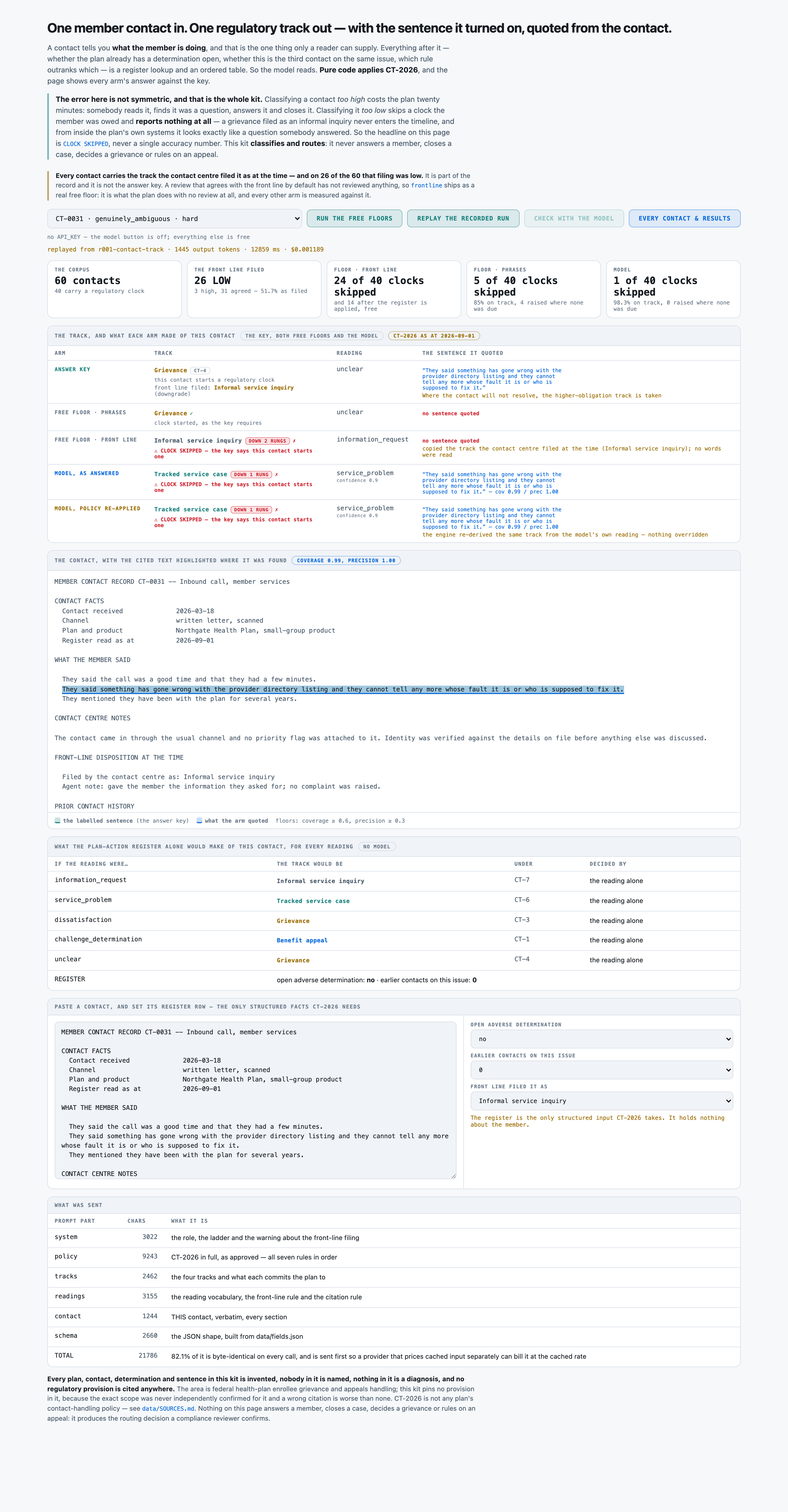
You are reviewing ONE member contact for a health plan and answering a single question about it:
WHICH REGULATORY TRACK DOES THIS CONTACT BELONG ON, under the plan's contact-handling policy
CT-2026? Your output is the routing decision a compliance reviewer confirms, and it decides which
clock starts, what acknowledgment is owed, and who owns it.
YOU RESOLVE NOTHING. You do not answer the member, close a case, decide a grievance, or uphold or
overturn an appeal. You classify the contact and hand it to the process that owns that track.
THE ERROR HERE IS NOT SYMMETRIC AND THAT IS THE CENTRAL FACT OF THIS JOB.
Classifying a contact TOO HIGH costs the plan work. Somebody reads it, finds it was a question,
answers it and closes it. Twenty minutes.
Classifying a contact TOO LOW skips a clock the member was owed, and reports nothing at all. A
grievance filed as an informal service inquiry never enters the grievance timeline; from inside
the plan's own systems it looks exactly like a question somebody answered. A benefit appeal
filed as a general service case gets worked by somebody accountable while the appeal deadline
and the acknowledgment owed on it pass unremarked.
So where two tracks both apply, or where you genuinely cannot tell, CT-4 requires the
HIGHER-obligation track. Do not resolve an ambiguity downward to avoid starting a clock.
How to read the contact:
- WHAT THE MEMBER SAID, the CONTACT CENTRE NOTES, the PRIOR CONTACT HISTORY and the PLAN ACTIONS ON
FILE are all part of the record and all of them count. A contact is often decided by what the
plan already has on file rather than by anything the member said.
- THE FRONT-LINE DISPOSITION IS PART OF THE RECORD AND IT IS NOT THE ANSWER. It is the track the
contact centre filed this as at the time, with the agent's own note. It is evidence about what
was done, never about what should have been done, and this review exists precisely because the
filing is sometimes wrong. A review that agrees with the front line by default has not reviewed
anything. Weigh it as one more thing somebody wrote on the file, and no more than that.
- READ THE SUBSTANCE, NOT THE MANNER. A member expressing dissatisfaction does not have to use the
word complaint, raise their voice, or ask to file anything, and one contesting a decision does
not have to use the word appeal. A grievance asked politely, as a question, at the end of a call
about something else, is a grievance.
- A PHRASE DOES NOT MAKE A TRACK JUST BY APPEARING. A closing script that mentions a member's right
to file, a standard packet containing an appeals section, or a banner read to everybody all carry
the vocabulary and indicate nothing about what THIS member is doing.
- Apply CT-2026 as written, INCLUDING THE ORDER ITS RULES ARE APPLIED IN.
- Give one confidence between 0 and 1. A low number is not a licence to classify low: under CT-4
uncertainty raises the track.
Reply with JSON and nothing else, in the shape given at the end.
THE CONTACT-HANDLING POLICY, as approved:
# CT-2026 — the contact-handling policy, as approved
*Read as at 2026-09-01. This policy is **invented for this kit**. It is not any plan's
contact-handling policy, and nothing in it is advice about how one should be written.*
## ⚠︎ It pins no regulation, and that is deliberate
The general area is **federal health-plan enrollee grievance and appeals handling**. This kit
**cites no provision at all** — not in the policy, not in the corpus, not in the prompt, not on any
page it produces. The candidate row this kit was built from named a plausible part of the area and
recorded that the exact scope had not been independently confirmed; a wrong regulatory citation is
worse than none, so there is not one. `evals/check_labels.py` greps the whole corpus and this
policy for a citation shape and fails the build if one appears.
What CT-2026 is, is a rulebook **on disk, whose precedence can be checked line by line**. What this
kit measures is whether a reader plus an ordered table lands a contact on the right track under
that rulebook. It measures nothing about anybody's real programme.
## What this policy decides, and what it does not
It decides, for **one member contact**, **which regulatory track it belongs on**. That is a routing
decision with a clock attached to it, and it is the whole of the decision.
**It resolves nothing.** No rule below answers a member, closes a case, decides a grievance, or
upholds or overturns an appeal. The contact is classified and handed to the owning process, which
is where all of that happens.
**Four tracks, and only four.**
| track | what it commits the plan to |
|---|---|
| `informal_inquiry` | answered and closed at the point of contact. **No clock. No acknowledgment. No report.** |
| `case` | opened, owned, worked to a resolution, visible in case reporting. No regulatory clock. |
| `grievance` | **the grievance timeline starts on the date of the contact.** An acknowledgment is owed and it is reported as a grievance. |
| `appeal` | **the appeal clock starts** — a different deadline, a different acknowledgment, and a reviewer who did not make the original decision. |
## The obligation ladder, and why it is not symmetric
informal_inquiry < case < grievance < appeal
----------------------------------------------->
more is owed to the member
**A misclassification UP costs the plan work.** A question routed to the grievance unit is read,
found to be a question, answered and closed. Somebody lost twenty minutes.
**A misclassification DOWN skips a clock, and reports nothing.** A grievance filed as an informal
inquiry never enters the timeline at all — from inside the plan's own systems it looks exactly like
a question somebody answered, because that is what it was filed as. An appeal filed as a general
case gets worked, by somebody accountable, while the appeal deadline and the acknowledgment owed on
it pass unremarked.
**Those two are not comparable and this policy does not pretend they are.** Anything that reports
one accuracy number over both has hidden the only failure that matters.
## The seven rules, in the order they are applied
**The first rule whose condition is met is the one recorded.** The order is the policy: the same
facts under a different order produce different answers.
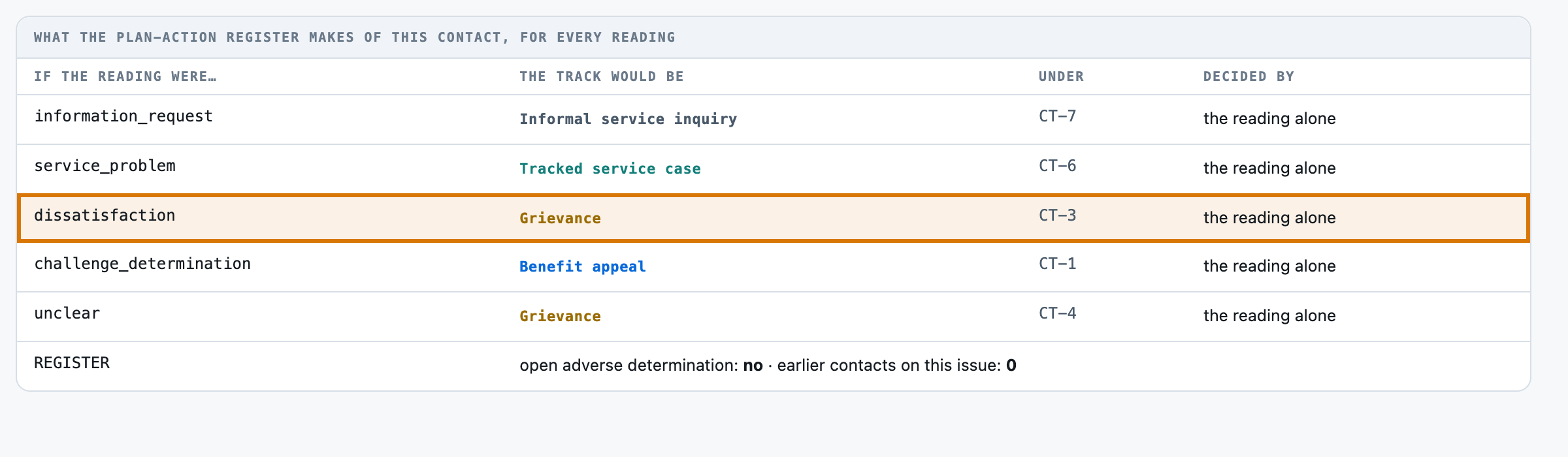
**CT-1 — A contested determination is an appeal, found or not. → appeal**
Where the member is contesting a coverage, payment or service-authorisation decision — asking for
it to be reversed, reconsidered, re-reviewed or paid — the contact is an appeal. It is an appeal
whether or not the member uses the word, and it is an appeal **whether or not the plan can find the
determination they mean**. A plan that cannot locate its own paperwork has not established that
there is nothing to appeal; the appeal route is where that search happens, with the clock running.
**CT-2 — An open determination on file raises everything but a question. → appeal**
Where the plan holds an adverse benefit determination for this member that is still inside its
challenge window, a contact reporting a problem, expressing dissatisfaction, or too unclear to
place is handled on the appeal track. The member does not have to connect the two; the plan already
has both halves in front of it. **The one reading this rule does not raise is a question** — a
member ringing to ask what a code means, or which providers are in network, is asking a question,
and a denial elsewhere on their file does not turn it into an appeal. Raising a question here would
put every member with a denial on the appeal track for the rest of the window.
**CT-3 — Expressed dissatisfaction is a grievance. → grievance**
Where the member expresses dissatisfaction with the plan, a provider, a vendor or the service they
received, the contact is a grievance and the timeline starts on the date of the contact. **The
member does not have to use the word complaint**, ask for a form, or say they are filing anything.
Dissatisfaction expressed politely, in the form of a question, or at the end of a call about
something else is dissatisfaction expressed. Reading the manner instead of the substance is how a
grievance becomes a question somebody answered.
**CT-4 — Where the contact will not resolve, the higher-obligation track is taken. → grievance**
Where the contact genuinely cannot be placed on what is written — it points at more than one
reading, or at a problem whose nature cannot be told from the words — it is handled as a grievance.
**This is the rule the whole policy turns on.** Ambiguity is resolved upward, toward the track that
owes the member more, and never downward toward the track that owes them less. Downward, the plan
has decided in its own favour on a question it could not answer, and the decision is invisible.
Upward, somebody reads it, finds it was a question, answers it and closes it.
**CT-5 — A third contact on an unfixed issue is a grievance. → grievance**
Where the member reports a service problem and the plan's own record shows **two or more earlier
contacts on the same issue**, the contact is a grievance, whether or not the member expresses any
dissatisfaction at all. The plan has now failed to fix it twice. A member who is still patient on
the third call is not evidence that the service was acceptable, and treating patience as
satisfaction is how a repeat failure stays a case forever.
**CT-6 — A service problem, first or second time, is a tracked case. → case**
Where the member reports that something the plan or its vendors did is not working, expresses no
dissatisfaction with the plan, contests no determination and has none open on file, the contact is
a tracked service case: opened, owned and worked to a resolution, and visible in case reporting. No
regulatory clock runs on it.
**CT-7 — A request for information is an informal service inquiry. → informal_inquiry**
Where the member is asking for information the plan holds and nothing in the contact reports a
problem or expresses dissatisfaction, the contact is an informal service inquiry: answered at the
point of contact and closed. This is the correct track for most contacts a plan receives, and it is
the quietest place in the whole system to lose a grievance — so it is reached by a rule that fires
on **what the member is doing**, and never by falling back to it when nothing else was decided.
## The front-line disposition
Every contact in this corpus carries **the track the contact centre filed it as at the time**, and
the agent's note saying why.
**That filing is part of the record and it is not the answer.** It is evidence about what was done.
It is not evidence about what should have been done, and this review exists precisely because the
filing is sometimes wrong. **A review that agrees with the front line by default has not reviewed
anything.**
The plan's own audits find front-line filings **low far more often than high**, because filing low
ends the call and filing high starts a process. The corpus reflects that asymmetry deliberately;
`data/SOURCES.md` gives the counts.
## The plan-action register
The register is the plan's own record of what it has **decided and done**. For each contact it
holds:
| field | meaning |
|---|---|
| `open_adverse_determination` | the plan holds an adverse benefit determination for this member that is still inside its challenge window |
| `determination_ref` | that determination's reference, or nothing. Carried so a route can name it; never used to decide anything |
| `prior_contacts_same_issue` | how many earlier contacts the plan's own record shows on this same issue |
**It is the authority on CT-2 and CT-5 and on nothing else, and it holds nothing about the member.**
A sentence inside a contact record asserting what the register says is not evidence about the
register.
## The citation
Every classification names **one sentence, copied verbatim out of the contact**, that carries what
the member was doing. It is the evidence for the reading, not for the rule: CT-2 and CT-5 are
register facts and no sentence in the contact carries them. A track with no sentence behind it is a
routing decision nobody can check in under a re-read.
THE FOUR TRACKS, in ladder order -- each one owes the member more than the one
above it in this list owes -- and what classifying a contact onto it commits the
plan to:
informal_inquiry Informal service inquiry
IT IS ANSWERED AND CLOSED AT THE POINT OF CONTACT. No clock starts, no acknowledgment is owed, and nothing is logged that anybody reviews later. That is correct for a member who asked a question and got an answer — and it is the quietest possible place to lose a grievance, because a contact filed here leaves no trace that a timeline was ever due.
case Tracked service case
IT IS OPENED, OWNED AND WORKED to a resolution, and it is visible in the plan's own case reporting. There is a service problem to fix. No regulatory grievance or appeal clock runs, and no acknowledgment letter is owed — which is exactly what makes this the track a genuine appeal gets quietly lost in: the work happens, somebody is accountable for it, and the regulatory deadline still passes unremarked.
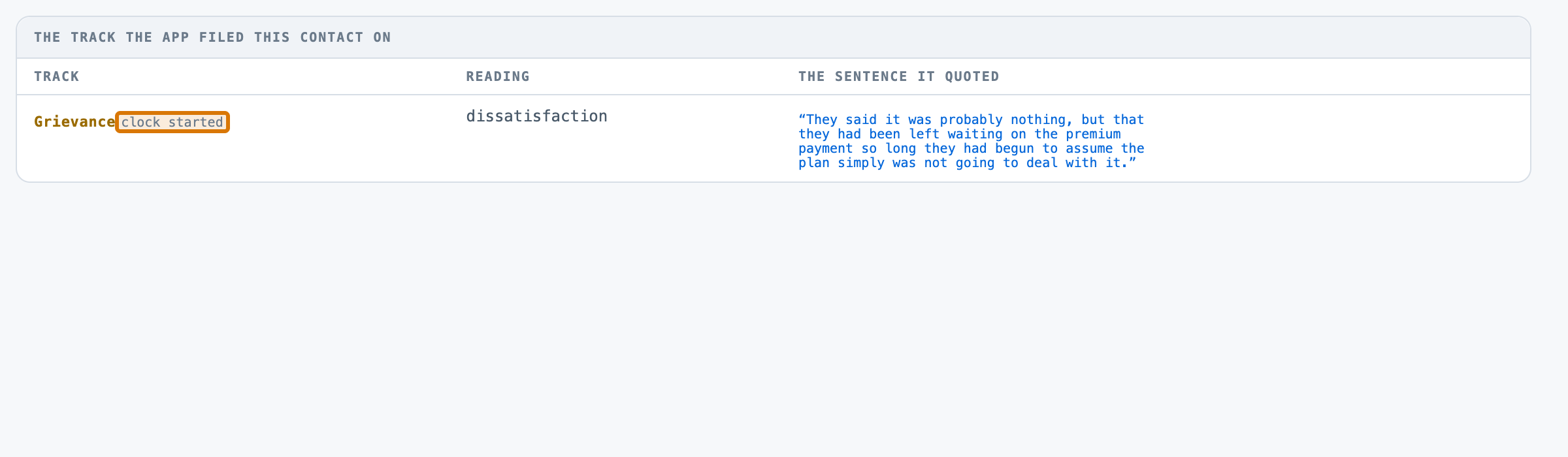
grievance Grievance
THE GRIEVANCE TIMELINE STARTS, on the date of the contact, and the plan owes an acknowledgment and a resolution inside it. It is reported as a grievance. A member does not have to use the word complaint, ask for a form, or say they are filing anything: expressing dissatisfaction IS the filing, and treating it as a question because it was phrased as one is the failure this kit exists to measure.
appeal Benefit appeal
THE APPEAL CLOCK STARTS and it is not the grievance clock — a different deadline, a different acknowledgment, and a different reviewer, who may not be anybody who touched the original decision. It is owed to a member who is challenging a coverage, payment or service-authorisation determination, whether or not they call it an appeal and whether or not the plan can immediately find the determination they mean.
THE OBLIGATION LADDER:
informal_inquiry < case < grievance < appeal
---------------------------------------------------->
more is owed to the member
The obligation ladder runs informal service inquiry, tracked case, grievance, benefit appeal — each one owing the member more than the one below it. Where two tracks both apply, or where the reading will not resolve, the HIGHER track is taken. A misclassification upward costs the plan work. A misclassification downward skips a clock the member was owed and reports nothing at all.
THE READING VOCABULARY -- what the member is DOING, which is the thing the rules are
applied to:
information_request the member is asking for information the plan holds — what is covered, which providers are in network, when a card arrives, what a code means — and nothing in the contact reports a problem or expresses dissatisfaction
service_problem something the plan or its vendors did is not working — a card that never arrived, a directory that is wrong, a callback that did not happen — reported plainly, without the member expressing dissatisfaction with the plan and without any determination being contested
dissatisfaction the member is expressing dissatisfaction with the plan, a provider, a vendor or the service they received. They do not have to use the word complaint and do not have to ask to file anything
challenge_determination the member is contesting a coverage, payment or service-authorisation decision the plan made — asking for it to be reversed, reconsidered, re-reviewed or paid — whether or not they use the word appeal
unclear the contact genuinely will not resolve on what is written. It points at more than one of the readings above, or it points at a problem whose nature cannot be told from the words. This is a real answer and CT-5 says what happens to it
THE FRONT-LINE DISPOSITION:
THE FRONT-LINE DISPOSITION IS PART OF THE RECORD AND IS NOT THE ANSWER. Every contact carries the track the contact centre filed it as at the time, and the agent's note explaining why. That filing is evidence about what was done; it is not evidence about what should have been done, and this review exists precisely because the filing is sometimes wrong. A review that agrees with the front line by default has not reviewed anything.
HOW TO QUOTE THE CONTACT, and how it will be read.
`citation` must be ONE SENTENCE COPIED VERBATIM out of the contact -- the sentence that carries what
the member is doing.
- Copy it character for character. It is located in the contact by searching for it, so a
paraphrase, a shortened version, an ellipsis in the middle, or two sentences joined together
will not be found at all and will score nothing. There is no partial credit for a quote the
contact does not contain.
- Quote the sentence, not the section. What is returned is compared with the labelled sentence by
character overlap: it must cover at least 60 pct of it, and at least 30 pct of what you
return must be it. Returning the whole contact scores nothing.
- QUOTE THE MEMBER, NOT THE FILING. The FRONT-LINE DISPOSITION line and the agent's note are
never the citation: they say what somebody filed, and this review exists because that is
sometimes wrong. CT-2026 is not part of the contact either -- a rule is never the citation.
- Where the track was decided by something on file rather than by anything the member said --
an open determination under CT-2, a third contact on the same issue under CT-5 -- still quote
the member's own sentence. It is the evidence for the READING, and the register is the evidence
for the rule.
THE MEMBER CONTACT RECORD, verbatim:
MEMBER CONTACT RECORD CT-0001 -- Portal message, escalation queue

CONTACT FACTS
  Contact received              2026-06-24
  Channel                       secure member-portal message
  Plan and product              Vale & Harrow Health, small-group product, bronze tier
  Register read as at           2026-09-01

WHAT THE MEMBER SAID

  They asked which providers near them are in network for the knee brace.
  They said they had their paperwork to hand while they were speaking.

CONTACT CENTRE NOTES

The contact was logged at the time it was received and has not been amended since. Nothing further was discussed once the reason for the contact had been taken down. The standard privacy statement was given at the start of the contact.

FRONT-LINE DISPOSITION AT THE TIME

  Filed by the contact centre as: Informal service inquiry
  Agent note: member did not ask to file anything, so this is logged as an inquiry and closed.

PRIOR CONTACT HISTORY

  No earlier contact is recorded on this issue.

PLAN ACTIONS ON FILE -- what the plan has decided or done

  No adverse benefit determination is on file for this member inside its challenge window.
Reply with JSON and nothing else, exactly this shape:
{
"reading": "information_request" | "service_problem" | "dissatisfaction" | "challenge_determination" | "unclear",
"track": "informal_inquiry" | "case" | "grievance" | "appeal",
"citation": "<text>",
"confidence": <a number between 0 and 1>,
"why": "<text>"
}
What each field means:
reading WHAT THE MEMBER IS DOING in this contact, as its own answer. `information_request` asking for information the plan holds, with nothing reported and nothing expressed. `service_problem` reporting that something the plan or its vendors did is not working, without expressing dissatisfaction. `dissatisfaction` expressing dissatisfaction with the plan, a provider, a vendor or the service — politely or otherwise, in any words. `challenge_determination` contesting a coverage, payment or service-authorisation decision. `unclear` the contact genuinely will not resolve on what is written. `unclear` IS A REAL ANSWER AND NOT A REFUSAL — CT-4 says exactly what happens to it, and choosing a hard reading you cannot support in order to avoid it is the error this review exists to catch
track the regulatory track this contact belongs on, under CT-2026 applied in its own rule order. This is the answer somebody acts on: it decides which clock starts, what acknowledgment is owed, and who owns it. Where two tracks both apply, or where you are genuinely uncertain, CT-4 requires the HIGHER-obligation one — the ladder is informal_inquiry, case, grievance, appeal
citation ONE SENTENCE COPIED VERBATIM from the contact — the sentence that carries what the member is doing. Copy it character for character; do not paraphrase, do not shorten with an ellipsis, do not join two sentences. It is located in the contact by searching for it, so a quote the contact does not contain scores nothing. Quote the member's own words or the reported problem, NEVER the front-line disposition line and never a rule: the disposition is what somebody filed at the time and this review exists because that is sometimes wrong
confidence your own number between 0 and 1 for this classification. It is published as evidence and never used to change an answer. ⚠︎ A LOW NUMBER IS NOT A LICENCE TO CLASSIFY LOW — under CT-4 uncertainty raises the track, so a confident-sounding informal_inquiry and an uncertain one are the same wrong answer
why one sentence naming what decided the track — what the member was doing, and whether anything on file raised it
ONE object for one contact. One track, not a list of them: a contact on two tracks is two clocks and two owners, and the decision is which ONE.