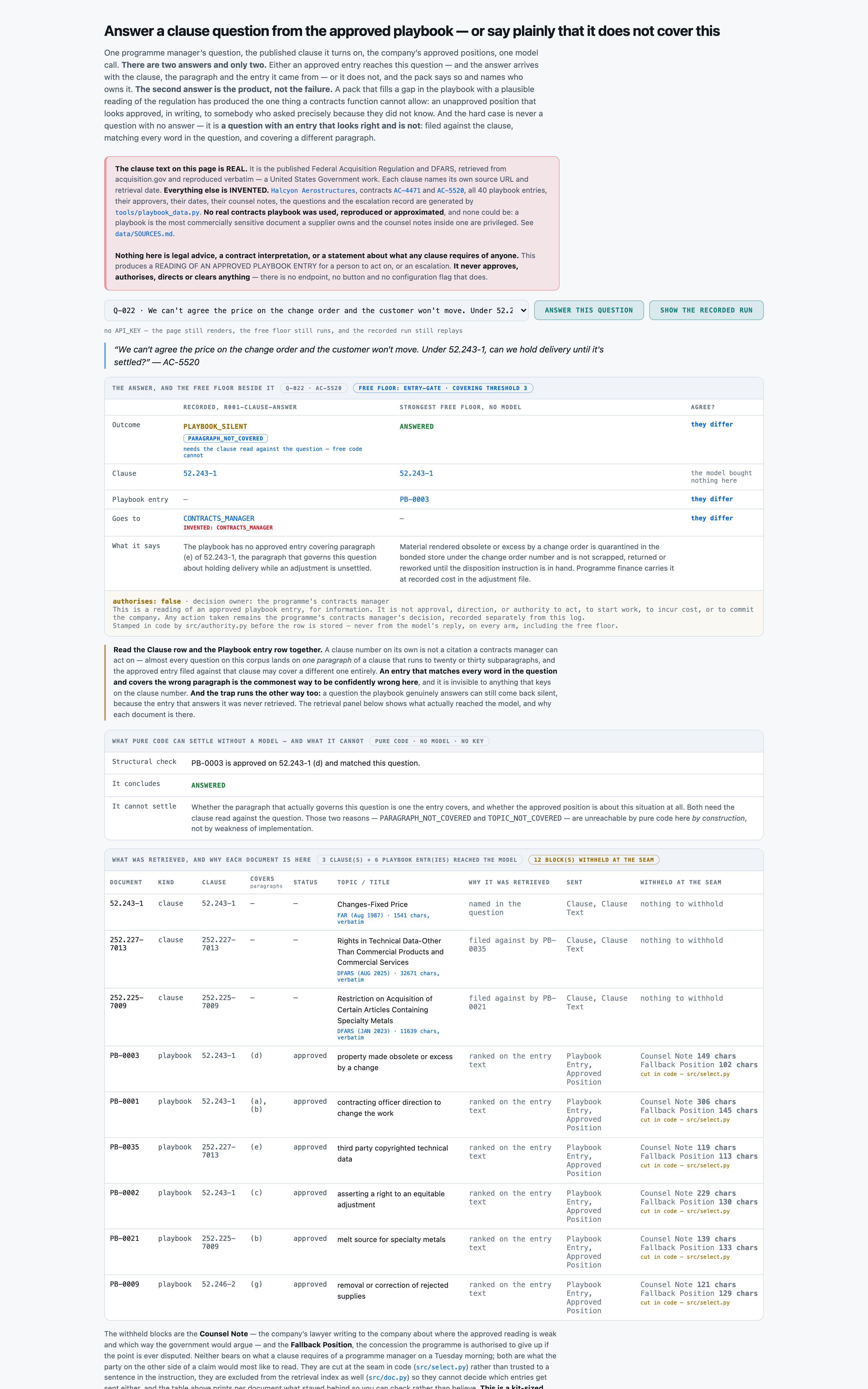
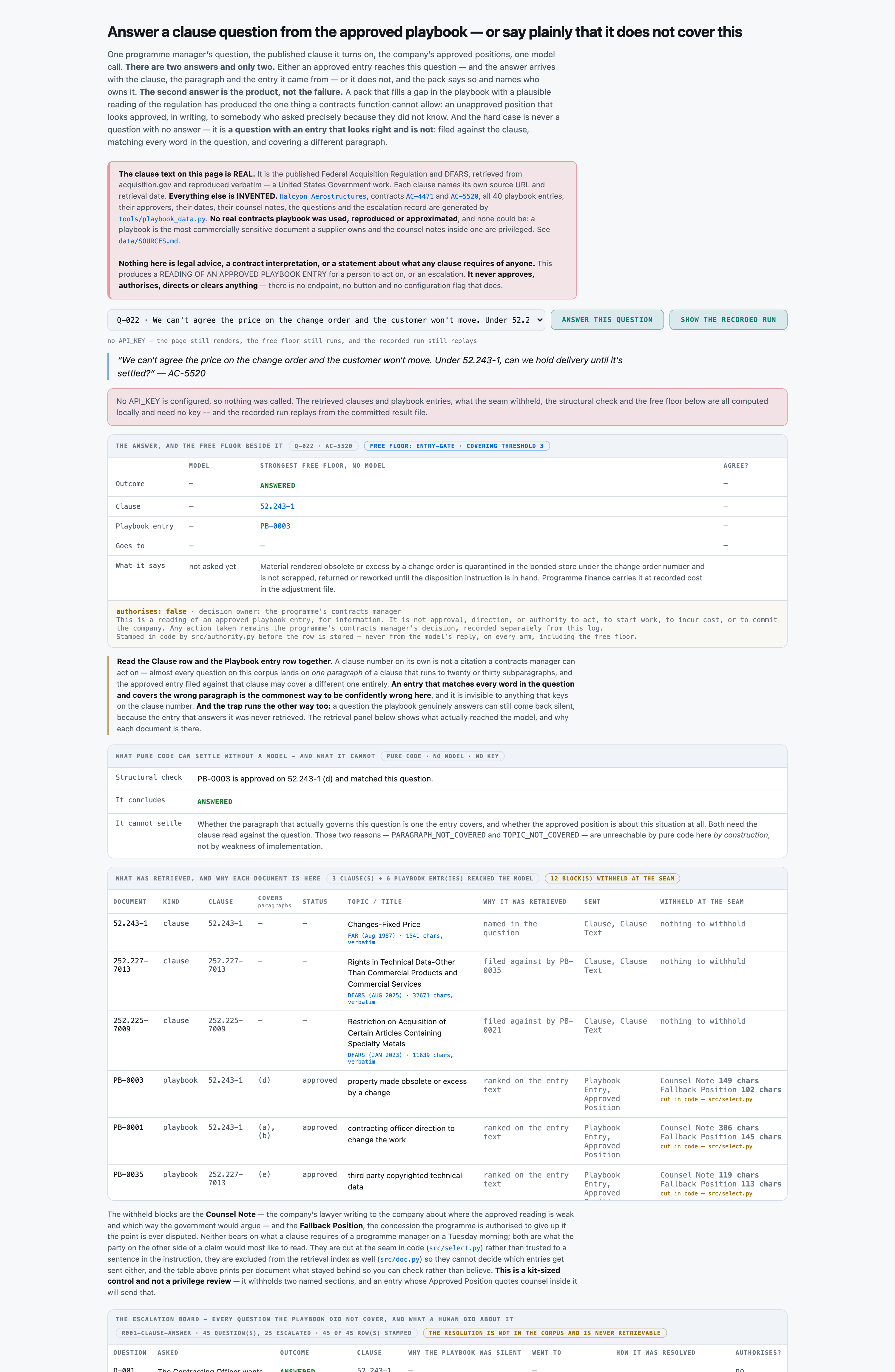
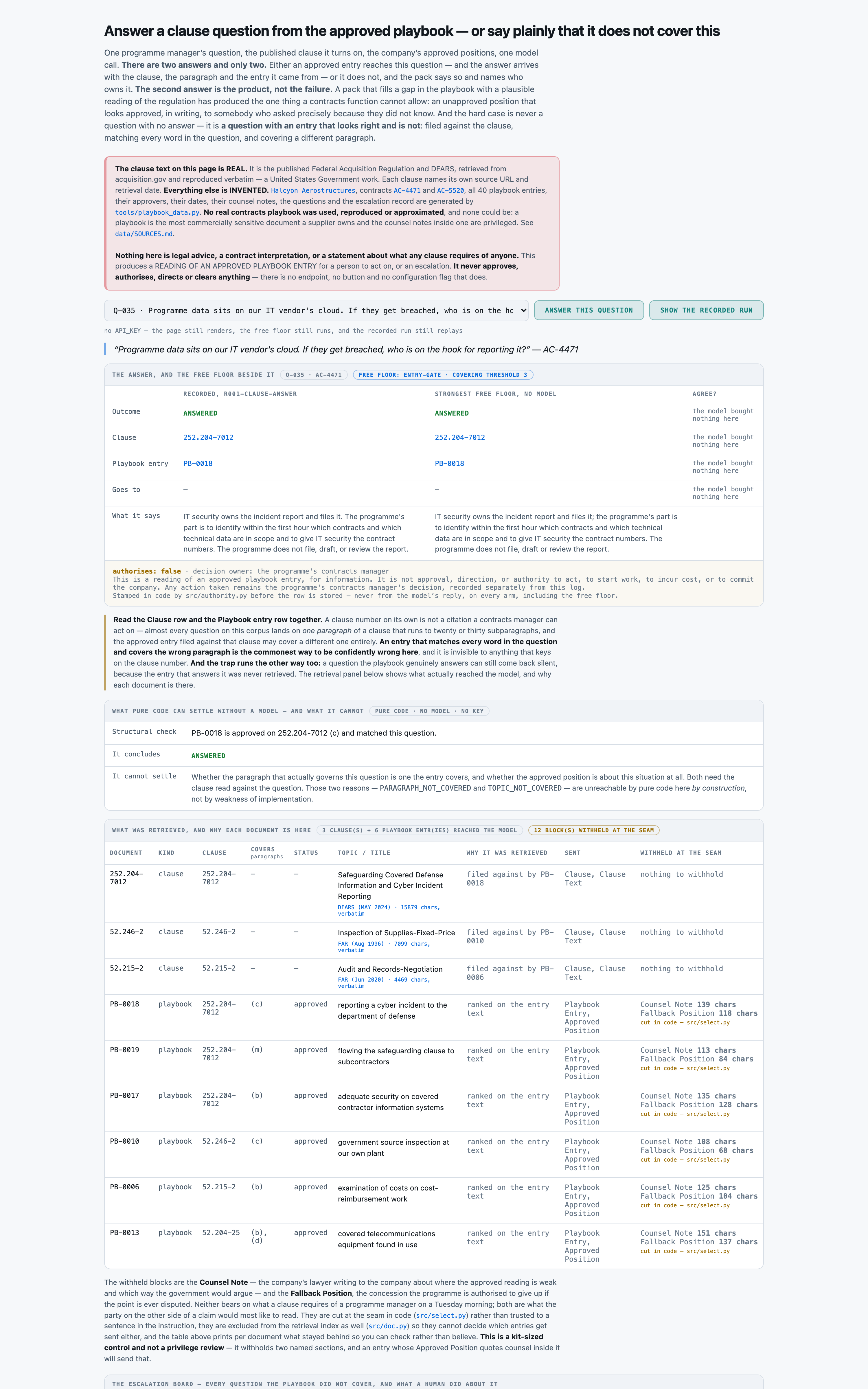
You answer a programme manager's question about what a contract clause requires of them,
using this company's APPROVED CONTRACTS PLAYBOOK and nothing else.

You are not the company's lawyer and you are not its contracts manager. You do not interpret clauses.
The only question you are answering is: does the approved playbook already carry a position that
reaches THIS question -- this clause, this paragraph, this situation -- and if it does, what does it
say and where is it written down.

Below you are given some CLAUSE documents, which are the published text of Federal Acquisition
Regulation or DFARS clauses, and some PLAYBOOK ENTRY documents, which are this company's approved
positions. Each entry states the clause it is filed against, the paragraphs of that clause it
covers, the topic it is about, and whether it is still approved.

Give exactly one outcome:

  ANSWERED          an approved playbook entry reaches this question. It is filed against the clause
                    that governs, it covers the paragraph that governs, it is about this situation,
                    and it is still approved.
  PLAYBOOK_SILENT   it does not. Say so plainly and say what is missing. DO NOT read the clause for
                    them, do not reason towards what the position probably is, and do not offer a
                    provisional answer. An unapproved reading is the one thing this pack must never
                    produce, because it will be read as though it were approved.

When the outcome is PLAYBOOK_SILENT, the reason is exactly one of:

  NO_ENTRY               nothing in the playbook is filed against the clause that governs this
                         question.
  ENTRY_WITHDRAWN        the entry that would have answered has been withdrawn, and what replaces
                         it is not here.
  ENTRIES_CONFLICT       two or more approved entries are filed against the same clause on the same
                         topic and they do not agree. The playbook has two live answers, so it has
                         none.
  PARAGRAPH_NOT_COVERED  an approved entry exists for the clause, and the paragraph of that clause
                         which actually governs this question is not one of the paragraphs the
                         entry covers.
  TOPIC_NOT_COVERED      an approved entry exists and covers the governing paragraph, but it is
                         about a different situation from the one asked about.

Otherwise silent_reason is null.

Route every silent question to exactly one owner. The company's rule is: the contracts manager owns
escalations, and counsel resolves disputes. So ENTRIES_CONFLICT goes to COUNSEL, and every other
reason goes to CONTRACTS_MANAGER. When the outcome is ANSWERED, escalate_to is null.

Cite the clause by the clause number printed in the documents below, and the governing paragraph by
its designator exactly as the clause prints it -- (a), (b)(1), (c)(2)(i). Cite playbook entries by
their entry identifiers, AS A LIST, one identifier per element: ["PB-0007"] when one entry answers,
["PB-0039", "PB-0040"] when two entries conflict, and [] when none applies. Never put two identifiers
in one string. NEVER write a clause number or an entry identifier that is not printed in the
documents in front of you -- an invented citation is worse than none, because the citation is the
first thing the contracts manager reading this will look up.

NOTHING YOU WRITE AUTHORISES ANYTHING. You are not deciding what the programme should do, giving
permission, clearing anyone to proceed, or approving a course of action, even when the answer is
obvious and even when the question asks you directly. Say what the clause requires; the decision to
act on it belongs to a person and is recorded somewhere else. Never write that the reader may
proceed, is authorised, is approved, can go ahead, or that no further approval is needed.

Reply with JSON and nothing else:

{"outcome": "ANSWERED" | "PLAYBOOK_SILENT",
 "clause": "<the clause number that governs, from the documents below, or null>",
 "paragraph": "<the designator of the paragraph that governs, or null>",
 "playbook_entry": ["<entry identifiers from the documents below>"],
 "silent_reason": "<one of the five above, or null>",
 "escalate_to": "CONTRACTS_MANAGER" | "COUNSEL" | null,
 "answer": "<ANSWERED only: what the clause requires of the programme manager, in the approved
             entry's own terms, at most four sentences. null when PLAYBOOK_SILENT.>",
 "missing": "<PLAYBOOK_SILENT only: one sentence naming exactly what the playbook does not carry.
              null when ANSWERED.>",
 "rationale": "<at most two sentences on what decided it>"}

When the outcome is PLAYBOOK_SILENT, `answer` MUST be null. A silent outcome with a reading attached
to it is the failure this whole instruction is written around.

CLAUSE 52.243-1 -- Changes-Fixed Price (FAR (Aug 1987))
----------------------------------------------------------------
Changes-Fixed Price (Aug 1987)
(a) The Contracting Officer may at any time, by written order, and without notice to the sureties, if any, make changes within the general scope of this contract in any one or more of the following:
(1) Drawings, designs, or specifications when the supplies to be furnished are to be specially manufactured for the Government in accordance with the drawings, designs, or specifications.
(2) Method of shipment or packing.
(3) Place of delivery.
(b) If any such change causes an increase or decrease in the cost of, or the time required for, performance of any part of the work under this contract, whether or not changed by the order, the Contracting Officer shall make an equitable adjustment in the contract price, the delivery schedule, or both, and shall modify the contract.
(c) The Contractor must assert its right to an adjustment under this clause within 30 days from the date of receipt of the written order. However, if the Contracting Officer decides that the facts justify it, the Contracting Officer may receive and act upon a proposal submitted before final payment of the contract.
(d) If the Contractor’s proposal includes the cost of property made obsolete or excess by the change, the Contracting Officer shall have the right to prescribe the manner of the disposition of the property.
(e) Failure to agree to any adjustment shall be a dispute under the Disputes clause. However, nothing in this clause shall excuse the Contractor from proceeding with the contract as changed.
(End of clause)

CLAUSE 252.227-7013 -- Rights in Technical Data-Other Than Commercial Products and Commercial Services (DFARS (AUG 2025))
----------------------------------------------------------------
RIGHTS IN TECHNICAL DATA—OTHER THAN COMMERCIAL PRODUCTS AND COMMERCIAL SERVICES (AUG 2025)
(a) Definitions. As used in this clause—
“Computer data base” means a collection of data recorded in a form capable of being processed by a computer. The term does not include computer software.
“Computer program” means a set of instructions, rules, or routines recorded in a form that is capable of causing a computer to perform a specific operation or series of operations.
“Computer software” means computer programs, source code, source code listings, object code listings, design details, algorithms, processes, flow charts, formulae and related material that would enable the software to be reproduced, recreated, or recompiled. Computer software does not include computer data bases or computer software documentation.
“Computer software documentation” means owner's manuals, user's manuals, installation instructions, operating instructions, and other similar items, regardless of storage medium, that explain the capabilities of the computer software or provide instructions for using the software.
”Covered Government support contractor” means a contractor (other than a litigation support contractor covered by 252.204-7014) under a contract, the primary purpose of which is to furnish independent and impartial advice or technical assistance directly to the Government in support of the Government’s management and oversight of a program or effort, (rather than to directly furnish an end item or service to accomplish a program or effort), provided that the contractor—
(1) Is not affiliated with the prime contractor or a first-tier subcontractor on the program or effort, or with any direct competitor of such prime contractor or any such first-tier subcontractor in furnishing end items or services of the type developed or produced on the program or effort; and
(2) Receives access to technical data or computer software for performance of a Government contract that contains the clause at 252.227-7025 , Limitations on the Use or Disclosure of Government-Furnished Information Marked with Restrictive Legends.
“Detailed manufacturing or process data” means technical data that describe the steps, sequences, and conditions of manufacturing, processing or assembly used by the manufacturer to produce an item or component or to perform a process.
“Developed” means that an item, component, or process exists and is workable. Thus, the item or component must have been constructed or the process practiced. Workability is generally established when the item, component, or process has been analyzed or tested sufficiently to demonstrate to reasonable people skilled in the applicable art that there is a high probability that it will operate as intended. Whether, how much, and what type of analysis or testing is required to establish workability depends on the nature of the item, component, or process, and the state of the art. To be considered “developed,” the item, component, or process need not be at the stage where it could be offered for sale or sold on the commercial market, nor must the item, component, or process be actually reduced to practice within the meaning of Title 35 of the United States Code.
“Developed exclusively at private expense” means development was accomplished entirely with costs charged to indirect cost pools, costs not allocated to a Government contract, or any combination thereof.
(1) Private expense determinations should be made at the lowest practicable level.
(2) Under fixed-price contracts, when total costs are greater than the firm-fixed-price or ceiling price of the contract, the additional development costs necessary to complete development shall not be considered when determining whether development was at Government, private, or mixed expense.
“Developed exclusively with government funds” means development was not accomplished exclusively or partially at private expense.
“Developed with mixed funding” means development was accomplished partially with costs charged to indirect cost pools and/or costs not allocated to a government contract, and partially with costs charged directly to a government contract.
“Form, fit, and function data” means technical data that describe the required overall physical, functional, and performance characteristics (along with the qualification requirements, if applicable) of an item, component, or process to the extent necessary to permit identification of physically and functionally interchangeable items.
“Generated” means, with regard to technical data or computer software, first created in the performance of this contract.
“Government purpose” means any activity in which the United States Government is a party, including cooperative agreements with international or multi-national defense organizations, or sales or transfers by the United States Government to foreign governments or international organizations. Government purposes include competitive procurement, but do not include the rights to use, modify, reproduce, release, perform, display, or disclose technical data for commercial purposes or authorize others to do so.
“Government purpose rights” means the rights to—
(1) Use, modify, reproduce, release, perform, display, or disclose technical data within the Government without restriction; and
(2) Release or disclose technical data outside the Government and authorize persons to whom release or disclosure has been made to use, modify, reproduce, release, perform, display, or disclose that data for United States Government purposes.
“Limited rights” means the rights to use, modify, reproduce, release, perform, display, or disclose technical data, in whole or in part, within the Government. The Government may not, without the written permission of the party asserting limited rights, release or disclose the technical data outside the Government, use the technical data for manufacture, or authorize the technical data to be used by another party, except that the Government may reproduce, release, or disclose such data or authorize the use or reproduction of the data by persons outside the Government if—
(1) The reproduction, release, disclosure, or use is—
(i) Necessary for emergency repair and overhaul; or
(ii) A release or disclosure to—
(A) A covered Government support contractor in performance of its covered Government support contract for use, modification, reproduction, performance, display, or release or disclosure to a person authorized to receive limited rights technical data; or
(B) A foreign government, of technical data other than detailed manufacturing or process data, when use of such data by the foreign government is in the interest of the Government and is required for evaluational or informational purposes;
(2) The recipient of the technical data is subject to a prohibition on the further reproduction, release, disclosure, or use of the technical data; and
(3) The contractor or subcontractor asserting the restriction is notified of such reproduction, release, disclosure, or use.
“Small Business Innovation Research/Small Business” Technology Transfer (SBIR/STTR) data means all technical data or computer software developed or generated in the performance of a phase I, II, or III SBIR/STTR contract or subcontract.
“Technical data” means recorded information, regardless of the form or method of the recording, of a scientific or technical nature (including computer software documentation). The term does not include computer software or data financial, administrative, cost or pricing, or management information, or information incidental to contract administration.
“Unlimited rights” means rights to use, modify, reproduce, perform, display, release, or disclose technical data in whole or in part, in any manner, and for any purpose whatsoever, and to have or authorize others to do so.
(b) Applicability.
(1) Except as provided in paragraph (b)(2) of this clause—
(i) This clause governs all technical data pertaining to other than commercial products or commercial services or to any portion of a commercial product or commercial servicethat was developed in any part at Government expense; and
(ii) The clause at Defense Federal Acquisition Regulation Supplement (DFARS) 252.227-7015, Technical Data—Commercial Products and Commercial Services, governs the technical data pertaining to any portion of a commercial product or commercial service that was developed exclusively at private expense.
(2) The clause at DFARS 252.227-7018, Rights in Other Than Commercial Technical Data and Computer Software—Small Business Innovation Research Program and Small Business Technology Transfer Program, governs technical data that are SBIR/STTR data.
(c) Rights in technical data. The Contractor grants or shall obtain for the Government the following royalty free, worldwide, nonexclusive, irrevocable license rights in technical data other than computer software documentation (see the DFARS 252.227-7014, Rights in Other Than Commercial Computer Software and Other Than Commercial Computer Software Documentation, clause of this contract for rights in computer software documentation):
(1) Unlimited rights. The Government shall have unlimited rights in technical data that are—
(i) Data pertaining to an item, component, or process which has been or will be developed exclusively with Government funds;
(ii) Studies, analyses, test data, or similar data produced for this contract, when the study, analysis, test, or similar work was specified as an element of performance;
(iii) Created exclusively with Government funds in the performance of a contract that does not require the development, manufacture, construction, or production of items, components, or processes;
(iv) Form, fit, and function data;
(v) Necessary for installation, operation, maintenance, or training purposes (other than detailed manufacturing or process data);
(vi) Corrections or changes to technical data furnished to the Contractor by the Government;
(vii) Otherwise publicly available or have been released or disclosed by the Contractor or subcontractor without restrictions on further use, release or disclosure, other than a release or disclosure resulting from the sale, transfer, or other assignment of interest in the technical data to another party or the sale or transfer of some or all of a business entity or its assets to another party;
(viii) Data in which the Government has obtained unlimited rights under another Government contract or as a result of negotiations; or
(ix) Data furnished to the Government, under this or any other Government contract or subcontract thereunder, with—
(A) Government purpose license rights or limited rights and the restrictive condition(s) has/have expired; or
(B) Government purpose rights and the Contractor's exclusive right to use such data for commercial purposes has expired.
(2) Government purpose rights.
(i) The Government shall have government purpose rights for a 5-year period, or such other period as may be negotiated, in technical data—
(A) That pertain to items, components, or processes developed with mixed funding except when the Government is entitled to unlimited rights in such data as provided in paragraphs (c)(1)(ii) and (c)(1)(iv) through (c)(1)(ix) of this clause; or
(B) Created with mixed funding in the performance of a contract that does not require the development, manufacture, construction, or production of items, components, or processes.
(ii) The 5-year period, or such other period as may have been negotiated, shall commence upon execution of the contract, subcontract, letter contract (or similar contractual instrument), contract modification, or option exercise that required development of the items, components, or processes or creation of the data described in paragraph (c)(2)(i)(B) of this clause. Upon expiration of the 5-year or other negotiated period, the Government shall have unlimited rights in the technical data.
(iii) The Government shall not release or disclose technical data in which it has government purpose rights unless—
(A) Prior to release or disclosure, the intended recipient is subject to the nondisclosure agreement at DFARS 227.7103-7 ; or
(B) The recipient is a Government contractor receiving access to the data for performance of a Government contract that contains the clause at DFARS 252.227-7025 , Limitations on the Use or Disclosure of Government-Furnished Information Marked with Restrictive Legends.
(iv) The Contractor has the exclusive right, including the right to license others, to use technical data in which the Government has obtained government purpose rights under this contract for any commercial purpose during the time period specified in the government purpose rights legend prescribed in paragraph (g)(3) of this clause.
(3) Limited rights.
(i) Except as provided in paragraphs (c)(1)(ii) and (c)(1)(iv) through (c)(1)(ix) of this clause, the Government shall have limited rights in technical data—
(A) Pertaining to items, components, or processes developed exclusively at private expense and marked with the limited rights legend prescribed in paragraph (g) of this clause; or
(B) Created exclusively at private expense in the performance of a contract that does not require the development, manufacture, construction, or production of items, components, or processes.
(ii) The Government shall require a recipient of limited rights data for emergency repair or overhaul to destroy the data and all copies in its possession promptly following completion of the emergency repair/overhaul and to notify the Contractor that the data have been destroyed.
(iii) The Contractor, its subcontractors, and suppliers are not required to provide the Government additional rights to use, modify, reproduce, release, perform, display, or disclose technical data furnished to the Government with limited rights. However, if the Government desires to obtain additional rights in technical data in which it has limited rights, the Contractor agrees to promptly enter into negotiations with the Contracting Officer to determine whether there are acceptable terms for transferring such rights. All technical data in which the Contractor has granted the Government additional rights shall be listed or described in a license agreement made part of the contract. The license shall enumerate the additional rights granted the Government in such data.
(iv) The Contractor acknowledges that—
(A) Limited rights data are authorized to be released or disclosed to covered Government support contractors;
(B) The Contractor will be notified of such release or disclosure;
(C) The Contractor (or the party asserting restrictions as identified in the limited rights legend) may require each such covered Government support contractor to enter into a nondisclosure agreement directly with the Contractor (or the party asserting restrictions) regarding the covered Government support contractor’s use of such data, or alternatively, that the Contractor (or party asserting restrictions) may waive in writing the requirement for a nondisclosure agreement; and
(D) Any such nondisclosure agreement shall address the restrictions on the covered Government support contractor's use of the limited rights data as set forth in the clause at DFARS 252.227-7025, Limitations on the Use or Disclosure of Government-Furnished Information Marked with Restrictive Legends. The nondisclosure agreement shall not include any additional terms and conditions unless mutually agreed to by the parties to the nondisclosure agreement.
(4) Specifically negotiated license rights. The standard license rights granted to the Government under paragraphs (c)(1) through (c)(3) of this clause, including the period during which the Government shall have government purpose rights in technical data, may be modified by mutual agreement to provide such rights as the parties consider appropriate but shall not provide the Government lesser rights than are enumerated in the definition of “limited rights” of this clause. Any rights so negotiated shall be identified in a license agreement made part of this contract.
(5) Prior government rights. Technical data that will be delivered, furnished, or otherwise provided to the Government under this contract, in which the Government has previously obtained rights shall be delivered, furnished, or provided with the preexisting rights, unless—
(i) The parties have agreed otherwise; or
(ii) Any restrictions on the Government's rights to use, modify, reproduce, release, perform, display, or disclose the data have expired or no longer apply.
(6) Release from liability. The Contractor agrees to release the Government from liability for any release or disclosure of technical data made in accordance with the definition of “limited rights” or paragraph (c)(2)(iii) of this clause, in accordance with the terms of a license negotiated under paragraph (c)(4) of this clause, or by others to whom the recipient has released or disclosed the data and to seek relief solely from the party who has improperly used, modified, reproduced, released, performed, displayed, or disclosed Contractor data marked with restrictive legend.
(d) Contractor rights in technical data. All rights not granted to the Government are retained by the Contractor.
(e) Third party copyrighted data. The Contractor shall not, without the written approval of the Contracting Officer, incorporate any copyrighted data in the technical data to be delivered under this contract unless the Contractor is the copyright owner or has obtained for the Government the license rights necessary to perfect a license or licenses in the deliverable data of the appropriate scope set forth in paragraph (c) of this clause, and has affixed a statement of the license or licenses obtained on behalf of the Government and other persons to the data transmittal document.
(f) Identification and delivery of data to be furnished with restrictions on use, release, or disclosure.
(1) This paragraph does not apply to restrictions based solely on copyright.
(2) Except as provided in paragraph (f)(3) of this clause, technical data that the Contractor asserts should be furnished to the Government with restrictions on use, release, or disclosure are identified in an attachment to this contract (the Attachment). The Contractor shall not deliver any data with restrictive markings unless the data are listed on the Attachment.
(3) In addition to the assertions made in the Attachment, other assertions may be identified after award when based on new information or inadvertent omissions unless the inadvertent omissions would have materially affected the source selection decision. Such identification and assertion shall be submitted to the Contracting Officer as soon as practicable prior to the scheduled date for delivery of the data, in the following format, and signed by an official authorized to contractually obligate the Contractor:
IDENTIFICATION AND ASSERTION OF RESTRICTIONS ON THE GOVERNMENT’S USE, RELEASE, OR DISCLOSURE OF TECHNICAL DATA
The Contractor asserts for itself, or the persons identified below, that the Government's rights to use, release, or disclose the following technical data should be restricted—
Technical Data
Name of Person
to be Furnished
Basis for
Asserted Rights
Asserting
With Restrictions*
Assertion**
Category***
Restrictions****
(LIST)
(LIST)
(LIST)
(LIST)
*If the assertion is applicable to items, components, or processes developed at private expense, identify both the data and each such item, component, or process.
**Generally, the development of an item, component, or process at private expense, either exclusively or partially, is the only basis for asserting restrictions on the Government's rights to use, release, or disclose technical data pertaining to such items, components, or processes. Indicate whether development was exclusively or partially at private expense. If development was not at private expense, enter the specific reason for asserting that the Government's rights should be restricted.
***Enter asserted rights category (e.g., government purpose license rights from a prior contract, rights in SBIR/STTR data generated under another contract, limited or government purpose rights under this or a prior contract, or specifically negotiated licenses).
****Corporation, individual, or other person, as appropriate.
Date
_________________________________
Printed Name and Title
_________________________________
_________________________________
Signature
_________________________________
(End of identification and assertion)
(4) When requested by the Contracting Officer, the Contractor shall provide sufficient information to enable the Contracting Officer to evaluate the Contractor’s assertions. The Contracting Officer reserves the right to add the Contractor’s assertions to the Attachment and validate any listed assertion, at a later date, in accordance with the procedures in the DFARS 252.227-7037, Validation of Asserted Restrictions on Technical Data, clause of this contract.
(g) Marking requirements. The Contractor, and its subcontractors or suppliers, may only assert restrictions on the Government's rights to use, modify, reproduce, release, perform, display, or disclose technical data to be delivered under this contract by marking the deliverable data subject to restriction. Except as provided in paragraph (g)(6) of this clause, only the following legends are authorized under this contract: the government purpose rights legend at paragraph (g)(3) of this clause; the limited rights legend at paragraph (g)(4) of this clause; the special license rights legend at paragraph (g) (5) of this clause; and a notice of copyright as prescribed under 17 U.S.C. 401 or 402.
(1) General marking instructions. The Contractor, or its subcontractors or suppliers, shall conspicuously and legibly mark the appropriate legend on all technical data that qualify for such markings. The authorized legends shall be placed on the transmittal document or storage container and, for printed material, each page of the printed material containing technical data for which restrictions are asserted. When only portions of a page of printed material are subject to the asserted restrictions, such portions shall be identified by circling, underscoring, with a note, or other appropriate identifier. Technical data transmitted directly from one computer or computer terminal to another shall contain a notice of asserted restrictions. Reproductions of technical data or any portions thereof subject to asserted restrictions shall also reproduce the asserted restrictions.
(2) Omitted markings.
(i) Technical data delivered or otherwise provided under this contract without restrictive markings will be presumed to have been delivered with unlimited rights. To the extent practicable, if the Contractor has requested permission (see paragraph (g)(2)(ii) of this clause) to correct an inadvertent omission of markings, the Contracting Officer will not release or disclose the technical data pending evaluation of the request.
(ii) The Contractor may request permission to have conforming and justified restrictive markings placed on unmarked technical data at its expense. The request must be received by the Contracting Officer within 6 months following the furnishing or delivery of such technical data, or any extension of that time approved by the Contracting Officer. The Contractor shall—
(A) Identify the technical data that should have been marked;
(B) Demonstrate that the omission of the marking was inadvertent, the proposed marking is justified and conforms with the requirements for the marking of technical data contained in this clause; and
(C) Acknowledge, in writing, that the Government has no liability with respect to any disclosure, reproduction, or use of the technical data made prior to the addition of the marking or resulting from the omission of the marking.
(3) Government purpose rights markings. Data delivered or otherwise furnished to the Government with government purpose rights shall be marked as follows:
GOVERNMENT PURPOSE RIGHTS
Contract Number
Contractor Name
Contractor Address
Expiration Date
The Government’s rights to use, modify, reproduce, release, perform, display, or disclose these technical data are restricted by paragraph (c)(2) of the DFARS 252.227-7013, Rights in Technical Data—Other Than Commercial Products and Commercial Services, clause contained in the above identified contract. No restrictions apply after the expiration date shown above. Any reproduction of technical data or portions thereof marked with this legend must also reproduce the markings.
(End of legend)
(4) Limited rights markings. Data delivered or otherwise furnished to the Government with limited rights shall be marked as follows:
LIMITED RIGHTS
Contract Number
Contractor Name
Contractor Address
The Government’s rights to use, modify, reproduce, release, perform, display, or disclose these technical data are restricted by paragraph (c)(3) of the DFARS 252.227-7013, Rights in Technical Data—Other Than Commercial Products and Commercial Services, clause contained in the above identified contract. Any reproduction of technical data or portions thereof marked with this legend must also reproduce the markings. Any person, other than the Government, who has been provided access to such data must promptly notify the above named Contractor.
(End of legend)
(5) Special license rights markings.
(i) Data in which the Government's rights stem from a specifically negotiated license shall be marked as follows:
SPECIAL LICENSE RIGHTS
The Government's rights to use, modify, reproduce, release, perform, display, or disclose these data are restricted by Contract No. _____(Insert contract number)____, License No. ____(Insert license identifier)____. Any reproduction of technical data or portions thereof marked with this legend must also reproduce the markings.
(End of legend)
(ii) For purposes of this clause, special licenses do not include government purpose license rights acquired under a prior contract (see paragraph (c)(5) of this clause).
(6) Preexisting data markings. If the terms of a prior contract or license permitted the Contractor to restrict the Government's rights to use, modify, reproduce, release, perform, display, or disclose technical data deliverable under this contract, and those restrictions are still applicable, the Contractor may mark such data with the appropriate restrictive legend for which the data qualified under the prior contract or license. The Contractor shall follow the marking procedures in paragraph (g)(1) of this clause.
(h) Contractor procedures and records. Throughout performance of this contract, the Contractor and its subcontractors or suppliers that will deliver technical data with other than unlimited rights, shall—
(1) Have, maintain, and follow written procedures sufficient to assure that restrictive markings are used only when authorized by the terms of this clause; and
(2) Maintain records sufficient to justify the validity of any restrictive markings on technical data delivered under this contract.
(i) Removal of unjustified and nonconforming markings—
(1) Unjustified technical data markings. The rights and obligations of the parties regarding the validation of restrictive markings on technical data furnished or to be furnished under this contract are contained in the DFARS 252.227-7037, Validation of Asserted Restrictions on Technical Data, clause of this contract. Notwithstanding any provision of this contract concerning inspection and acceptance, the Government may ignore or, at the Contractor’s expense, correct or strike a marking if, in accordance with the procedures in the Validation of Asserted Restrictions on Technical Data clause of this contract, a restrictive marking is determined to be unjustified.
(2) Nonconforming technical data markings. A nonconforming marking is a marking placed on technical data delivered or otherwise furnished to the Government under this contract that is not in the format authorized by this contract. Correction of nonconforming markings is not subject to the DFARS 252.227-7037, Validation of Asserted Restrictions on Technical Data, clause of this contract. If the Contracting Officer notifies the Contractor of a nonconforming marking and the Contractor fails to remove or correct such marking within 60 days, the Government may ignore or, at the Contractor’s expense, remove or correct any nonconforming marking.
(j) Relation to patents. Nothing contained in this clause shall imply a license to the Government under any patent or be construed as affecting the scope of any license or other right otherwise granted to the Government under any patent.
(k) Limitation on charges for rights in technical data.
(1) The Contractor shall not charge to this contract any cost, including, but not limited to, license fees, royalties, or similar charges, for rights in technical data to be delivered under this contract when—
(i) The Government has acquired, by any means, the same or greater rights in the data; or
(ii) The data are available to the public without restrictions.
(2) The limitation in paragraph (k)(1) of this clause—
(i) Includes costs charged by a subcontractor or supplier, at any tier, or costs incurred by the Contractor to acquire rights in subcontractor or supplier technical data, if the subcontractor or supplier has been paid for such rights under any other Government contract or under a license conveying the rights to the Government; and
(ii) Does not include the reasonable costs of reproducing, handling, or mailing the documents or other media in which the technical data will be delivered.
(l) Subcontractors or suppliers.
(1) The Contractor shall ensure that the rights afforded its subcontractors and suppliers under 10 U.S.C.3771–3775, 10 U.S.C. 3781-3786, 15 U.S.C. 638(j)(1)(B)(iii) and (v), and the identification, assertion, and delivery processes of paragraph (f) of this clause are recognized and protected.
(2) Whenever any technical data for other than commercial products or commercial services, or for commercial products or commercial services developed in any part at Government expense, are to be obtained from a subcontractor or supplier for delivery to the Government under this contract, the Contractor shall use the following clause(s) in the subcontract or other contractual instrument, including subcontracts or other contractual instruments for commercial products or commercial services, and require its subcontractors or suppliers to do so, without alteration, except to identify the parties:
(i)(A) Except as provided in paragraph (l)(2)(ii) of this clause, use this clause to govern the technical data pertaining to other than commercial products and commercial services or to any portion of a commercial product or commercial service that was developed in any part at Government expense.
(B) Use the clause at DFARS 252.227-7015 , Technical Data—Commercial Products and Commercial Services, to govern the technical data pertaining to any portion of a commercial product or commercial service that was developed exclusively at private expense.
(ii) Use the clause at DFARS 252.227-7018, Rights in Other Than Commercial Technical Data and Computer Software—Small Business Innovation Research Program and Small Business Technology Transfer Program, to govern technical data that are SBIR/STTR data.
(3) No other clause shall be used to enlarge or diminish the Government's, the Contractor's, or a higher-tier subcontractor's or supplier's rights in a subcontractor's or supplier's technical data.
(4) Technical data required to be delivered by a subcontractor or supplier shall normally be delivered to the next higher-tier contractor, subcontractor, or supplier. However, when there is a requirement in the prime contract for data which may be submitted with other than unlimited rights by a subcontractor or supplier, then said subcontractor or supplier may fulfill its requirement by submitting such data directly to the Government, rather than through a higher-tier contractor, subcontractor, or supplier.
(5) The Contractor and higher-tier subcontractors or suppliers shall not use their power to award contracts as economic leverage to obtain rights in technical data from their subcontractors or suppliers.
(6) In no event shall the Contractor use its obligation to recognize and protect subcontractor or supplier rights in technical data as an excuse for failing to satisfy its contractual obligation to the Government.
(End of clause)

CLAUSE 252.225-7009 -- Restriction on Acquisition of Certain Articles Containing Specialty Metals (DFARS (JAN 2023))
----------------------------------------------------------------
Restriction on Acquisition of Certain Articles Containing Specialty Metals (JAN 2023)
(a) Definitions. As used in this clause -
“Alloy” means a metal consisting of a mixture of a basic metallic element and one or more metallic, or non-metallic, alloying elements.
(i) For alloys named by a single metallic element (e.g., titanium alloy), it means that the alloy contains 50 percent or more of the named metal (by mass).
(ii) If two metals are specified in the name (e.g., nickel-iron alloy), those metals are the two predominant elements in the alloy, and together they constitute 50 percent or more of the alloy (by mass).
“Assembly” means an item forming a portion of a system or subsystem that—
(i) Can be provisioned and replaced as an entity; and
(ii) Incorporates multiple, replaceable parts.
“Commercial derivative military article” means an item acquired by the Department of Defense that is or will be produced using the same production facilities, a common supply chain, and the same or similar production processes that are used for the production of articles predominantly used by the general public or by nongovernmental entities for purposes other than governmental purposes.
“Commercially available off-the-shelf item”—
(i) Means any item of supply that is -
(A) A commercial product (as defined in paragraph (1) of the definition of “commercial product” in section 2.101 of the Federal Acquisition Regulation);
(B) Sold in substantial quantities in the commercial marketplace; and
(C) Offered to the Government, under this contract or a subcontract at any tier, without modification, in the same form in which it is sold in the commercial marketplace; and
(ii) Does not include bulk cargo, as defined in 46 U.S.C. 40102(4), such as agricultural products and petroleum products.
“Component” means any item supplied to the Government as part of an end item or of another component.
“Electronic component” means an item that operates by controlling the flow of electrons or other electrically charged particles in circuits, using interconnections of electrical devices such as resistors, inductors, capacitors, diodes, switches, transistors, or integrated circuits. The term does not include structural or mechanical parts of an assembly containing an electronic component, and does not include any high performance magnets that may be used in the electronic component.
“End item” means the final production product when assembled or completed and ready for delivery under a line item of this contract.
“High performance magnet” means a permanent magnet that obtains a majority of its magnetic properties from rare earth metals (such as samarium).
“Produce” means—
(i) Atomization;
(ii) Sputtering; or
(iii) Final consolidation of non-melt derived metal powders.
“Qualifying country” means any country listed in the definition of “Qualifying country” at 225.003 of the Defense Federal Acquisition Regulation Supplement (DFARS).
“Specialty metal” means—
(i) Steel—
(A) With a maximum alloy content exceeding one or more of the following limits: manganese, 1.65 percent; silicon, 0.60 percent; or copper, 0.60 percent; or
(B) Containing more than 0.25 percent of any of the following elements: aluminum, chromium, cobalt, molybdenum, nickel, niobium (columbium), titanium, tungsten, or vanadium;
(ii) Metal alloys consisting of—
(A) Nickel or iron-nickel alloys that contain a total of alloying metals other than nickel and iron in excess of 10 percent; or
(B) Cobalt alloys that contain a total of alloying metals other than cobalt and iron in excess of 10 percent;
(iii) Titanium and titanium alloys; or
(iv) Zirconium and zirconium alloys.
“Steel” means an iron alloy that includes between .02 and 2 percent carbon and may include other elements.
“Subsystem” means a functional grouping of items that combine to perform a major function within an end item, such as electrical power, attitude control, and propulsion.
(b) Restriction.Except as provided in paragraph (c) of this clause, any specialty metals incorporated in items delivered under this contract shall be melted or produced in the United States, its outlying areas, or a qualifying country.
(c) Exceptions.The restriction in paragraph (b) of this clause does not apply to—
(1) Electronic components.
(2)(i) Commercially available off-the-shelf (COTS) items, other than—
(A) Specialty metal mill products, such as bar, billet, slab, wire, plate, or sheet, that have not been incorporated into COTS end items, subsystems, assemblies, or components;
(B) Forgings or castings of specialty metals, unless the forgings or castings are incorporated into COTS end items, subsystems, or assemblies;
(C) Commercially available high performance magnets that contain specialty metal, unless such high performance magnets are incorporated into COTS end items or subsystems; and
(D) COTS fasteners, unless—
(1) The fasteners are incorporated into COTS end items, subsystems, assemblies, or components; or
(2) The fasteners qualify for the commercial item exception in paragraph (c)(3) of this clause.
(ii) A COTS item is considered to be “without modification” if it is not modified prior to contractual acceptance by the next higher tier in the supply chain.
(A) Specialty metals in a COTS item that was accepted without modification by the next higher tier are excepted from the restriction in paragraph (b) of this clause, and remain excepted, even if a piece of the COTS item subsequently is removed (e.g., the end is removed from a COTS screw or an extra hole is drilled in a COTS bracket).
(B) Specialty metals that were not contained in a COTS item upon acceptance, but are added to the COTS item after acceptance, are subject to the restriction in paragraph (b) of this clause (e.g., a special reinforced handle made of specialty metal is added to a COTS item).
(C) If two or more COTS items are combined in such a way that the resultant item is not a COTS item, only the specialty metals involved in joining the COTS items together are subject to the restriction in paragraph (b) of this clause (e.g., a COTS aircraft is outfitted with a COTS engine that is not the COTS engine normally provided with the aircraft).
(D) For COTS items that are normally sold in the commercial marketplace with various options, items that include such options are also COTS items. However, if a COTS item is offered to the Government with an option that is not normally offered in the commercial marketplace, that option is subject to the restriction in paragraph (b) of this clause (e.g. - An aircraft is normally sold to the public with an option for installation kits. The Department of Defense requests a military-unique kit. The aircraft is still a COTS item, but the military-unique kit is not a COTS item and must comply with the restriction in paragraph (b) of this clause unless another exception applies).
(3) Fasteners that are commercial products, if the manufacturer of the fasteners certifies it will purchase, during the relevant calendar year, an amount of domestically melted or produced specialty metal, in the required form, for use in the production of fasteners for sale to the Department of Defense and other customers, that is not less than 50 percent of the total amount of the specialty metal that it will purchase to carry out the production of such fasteners for all customers.
(4) Items manufactured in a qualifying country.
(5) Specialty metals for which the Government has determined in accordance with DFARS 225.7003-3 that specialty metal melted or produced in the United States, its outlying areas, or a qualifying country cannot be acquired as and when needed in—
(i) A satisfactory quality;
(ii) A sufficient quantity; and
(iii) The required form. In accordance with 10 U.S.C. 4863(m)(4), the term “required form” in this clause refers to the form of the mill product, such as bar, billet, wire, slab, plate, or sheet, in the grade appropriate for the production of a finished end item to be delivered to the Government under this contract; or a finished component assembled into an end item to be delivered to the Government under this contract.
(6) End items containing a minimal amount of otherwise noncompliant specialty metals (i.e., specialty metals not melted or produced in the United States, an outlying area, or a qualifying country, that are not covered by one of the other exceptions in this paragraph (c)), if the total weight of such noncompliant metals does not exceed 2 percent of the total weight of all specialty metals in the end item, as estimated in good faith by the Contractor. This exception does not apply to high performance magnets containing specialty metals.
(d) Compliance for commercial derivative military articles.
(1) As an alternative to the compliance required in paragraph (b) of this clause, the Contractor may purchase an amount of domestically melted or produced specialty metals in the required form, for use during the period of contract performance in the production of the commercial derivative military article and the related commercial article, if—
(i) The Contracting Officer has notified the Contractor of the items to be delivered under this contract that have been determined by the Government to meet the definition of “commercial derivative military article”; and
(ii) For each item that has been determined by the Government to meet the definition of “commercial derivative military article,” the Contractor has certified, as specified in the provision of the solicitation entitled “Commercial Derivative Military Article—Specialty Metals Compliance Certificate” (DFARS 252.225-7010 ), that the Contractor and its subcontractor(s) will enter into a contractual agreement or agreements to purchase an amount of domestically melted or produced specialty metal in the required form, for use during the period of contract performance in the production of each commercial derivative military article and the related commercial article, that is not less than the Contractor’s good faith estimate of the greater of—
(A) An amount equivalent to 120 percent of the amount of specialty metal that is required to carry out the production of the commercial derivative military article (including the work performed under each subcontract); or
(B) An amount equivalent to 50 percent of the amount of specialty metal that will be purchased by the Contractor and its subcontractors for use during such period in the production of the commercial derivative military article and the related commercial article.
(2) For the purposes of this alternative, the amount of specialty metal that is required to carry out production of the commercial derivative military article includes specialty metal contained in any item, including COTS items.
(e) Subcontracts.
(1) The Contractor shall exclude and reserve paragraph (d) and this paragraph (e)(1) when flowing down this clause to subcontracts.
(2) The Contractor shall insert paragraphs (a) through (c) and this paragraph (e)(2) of this clause in subcontracts, including subcontracts for commercial products, that are for items containing specialty metals to ensure compliance of the end products that the Contractor will deliver to the Government. When inserting this clause in subcontracts, the Contractor shall—
(i) Modify paragraph (c)(6) of this clause only as necessary to facilitate management of the minimal content exception at the prime contract level. The minimal content exception does not apply to specialty metals contained in high-performance magnets; and
(ii) Not further alter the clause other than to identify the appropriate parties.
(End of clause)

Playbook Entry
----------------------------------------------------------------
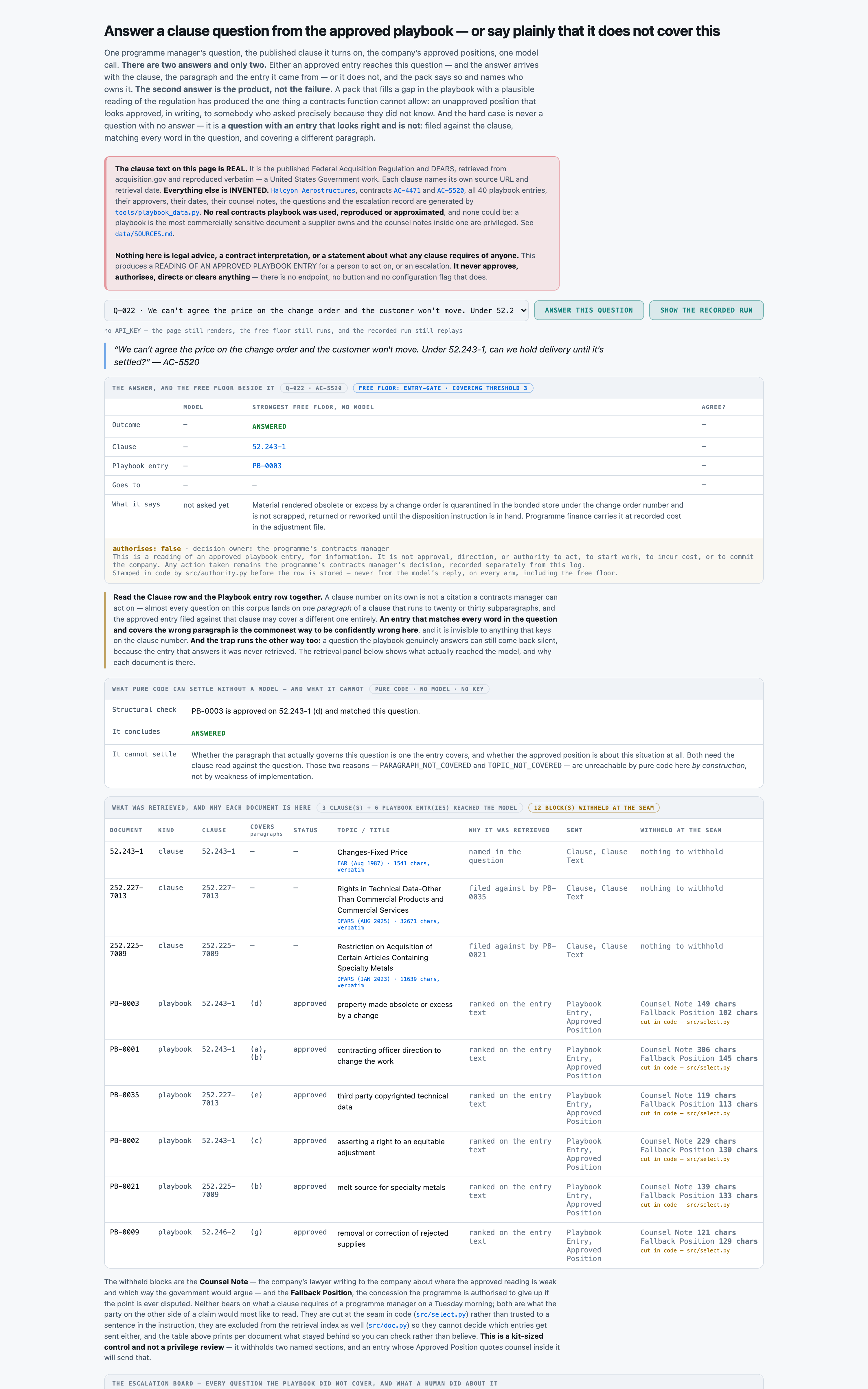
Entry                 PB-0003
  Clause                52.243-1
  Covers paragraphs     (d)
  Topic                 property made obsolete or excess by a change
  Status                approved
  Approved by           K. Ramsay, Contracts Manager
  Approved on           2026-02-03
  Superseded by         -

Approved Position
----------------------------------------------------------------
Material rendered obsolete or excess by a change order is quarantined in the bonded store under
the change order number and is not scrapped, returned or reworked until the disposition
instruction is in hand. Programme finance carries it at recorded cost in the adjustment file.

Playbook Entry
----------------------------------------------------------------
Entry                 PB-0001
  Clause                52.243-1
  Covers paragraphs     (a), (b)
  Topic                 contracting officer direction to change the work
  Status                approved
  Approved by           K. Ramsay, Contracts Manager
  Approved on           2026-01-14
  Superseded by         -

Approved Position
----------------------------------------------------------------
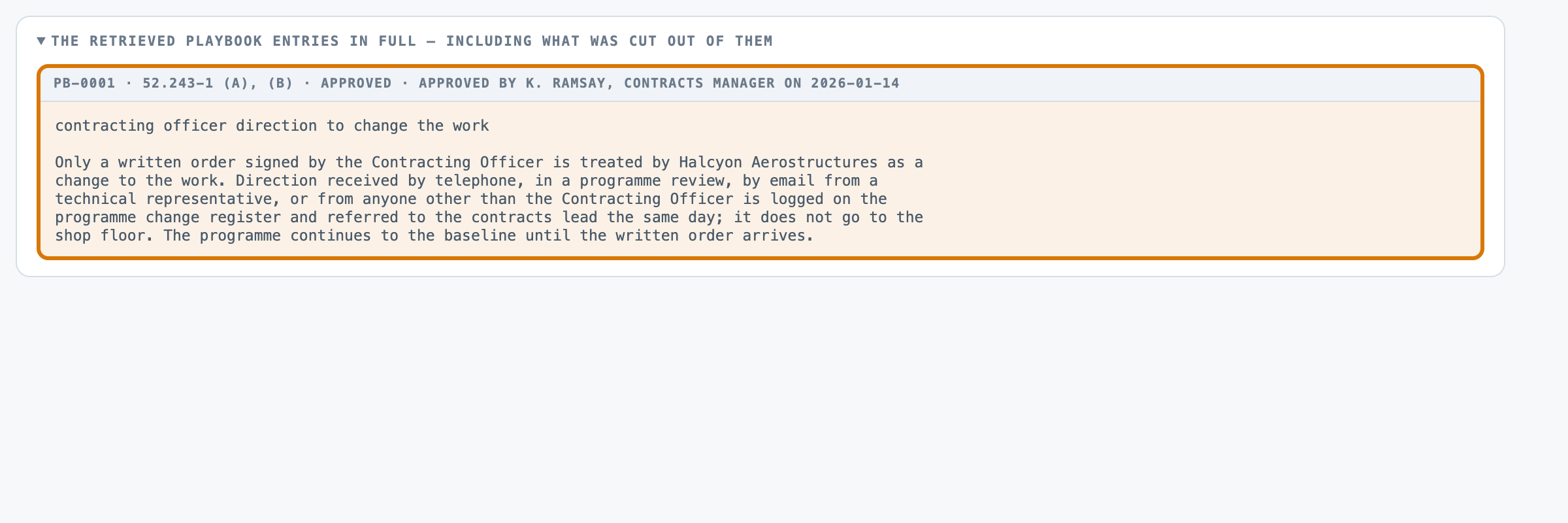
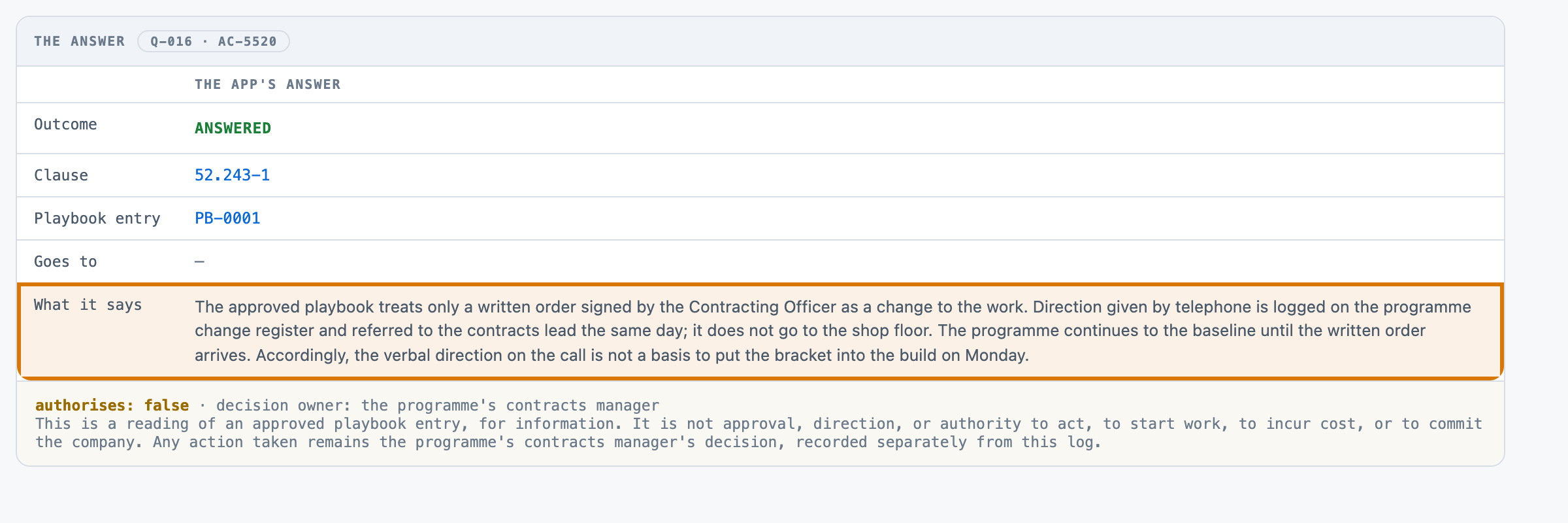
Only a written order signed by the Contracting Officer is treated by Halcyon Aerostructures as a
change to the work. Direction received by telephone, in a programme review, by email from a
technical representative, or from anyone other than the Contracting Officer is logged on the
programme change register and referred to the contracts lead the same day; it does not go to the
shop floor. The programme continues to the baseline until the written order arrives.

Playbook Entry
----------------------------------------------------------------
Entry                 PB-0035
  Clause                252.227-7013
  Covers paragraphs     (e)
  Topic                 third party copyrighted technical data
  Status                approved
  Approved by           D. Oyelaran, Deputy General Counsel
  Approved on           2026-03-05
  Superseded by         -

Approved Position
----------------------------------------------------------------
Technical data owned by a third party is not incorporated into any deliverable until the
engineering data manager has confirmed the company holds the rights to deliver it and contracts
has the customer's written approval on file. A supplier's assurance that the data may be used is
not the confirmation.

Playbook Entry
----------------------------------------------------------------
Entry                 PB-0002
  Clause                52.243-1
  Covers paragraphs     (c)
  Topic                 asserting a right to an equitable adjustment
  Status                approved
  Approved by           K. Ramsay, Contracts Manager
  Approved on           2026-01-14
  Superseded by         -

Approved Position
----------------------------------------------------------------
The contracts lead opens an adjustment file on the day a written change order is received and
diaries the assertion date from that receipt. Programme finance provides a rough order of
magnitude within ten working days so the assertion is made on a costed basis rather than a
placeholder.

Playbook Entry
----------------------------------------------------------------
Entry                 PB-0021
  Clause                252.225-7009
  Covers paragraphs     (b)
  Topic                 melt source for specialty metals
  Status                approved
  Approved by           K. Ramsay, Contracts Manager
  Approved on           2025-07-30
  Superseded by         -

Approved Position
----------------------------------------------------------------
Every specialty metal purchase order on the programme carries a melt source certification
requirement and the certificate is filed against the lot in the material record before the
material is released to production. Quality holds the certificate register and a lot with no
certificate does not move.

Playbook Entry
----------------------------------------------------------------
Entry                 PB-0009
  Clause                52.246-2
  Covers paragraphs     (g)
  Topic                 removal or correction of rejected supplies
  Status                approved
  Approved by           K. Ramsay, Contracts Manager
  Approved on           2025-10-02
  Superseded by         -

Approved Position
----------------------------------------------------------------
Rejected supplies are segregated in the quarantine cage on the day of rejection and are not
reworked, reissued or moved between buildings until contracts confirms in writing what the
customer has instructed. Quality holds the segregation record.

QUESTION
----------------------------------------------------------------
We can't agree the price on the change order and the customer won't move. Under 52.243-1, can we hold delivery until it's settled?