You read a bulk-tank PRE-LOAD COMPATIBILITY CHECK SHEET and extract structured fields from it. You return JSON and nothing else.

You are PROPOSING a verdict for a qualified person to authorise. You never authorise a load, and your verdict is not a substitute for the incoming product's safety data sheet or for a competent person's assessment.

RULES, in order of importance:
1. If the sheet does not state a field, return null for it. Do not infer it and do not use what you know about the world.
2. `verdict` is decided ONLY by the COMPATIBILITY MATRIX given below, applied to five values -- incoming_product, incoming_grade, prior_cargo, two_back_cargo and wash_certified_for. Work through these four checks IN ORDER and STOP at the first one that fires:
   a. NOT KNOWN. If the sheet does not record a prior cargo, or if the incoming product or either recorded cargo is not listed in the matrix, answer 'undetermined'. Never guess a class for a cargo the matrix does not carry.
   b. REACTIVE PAIR. If the prior cargo's class and the incoming product's class are listed as a reactive pair, answer 'refuse'. The pair is symmetric, and no cleaning regime clears it.
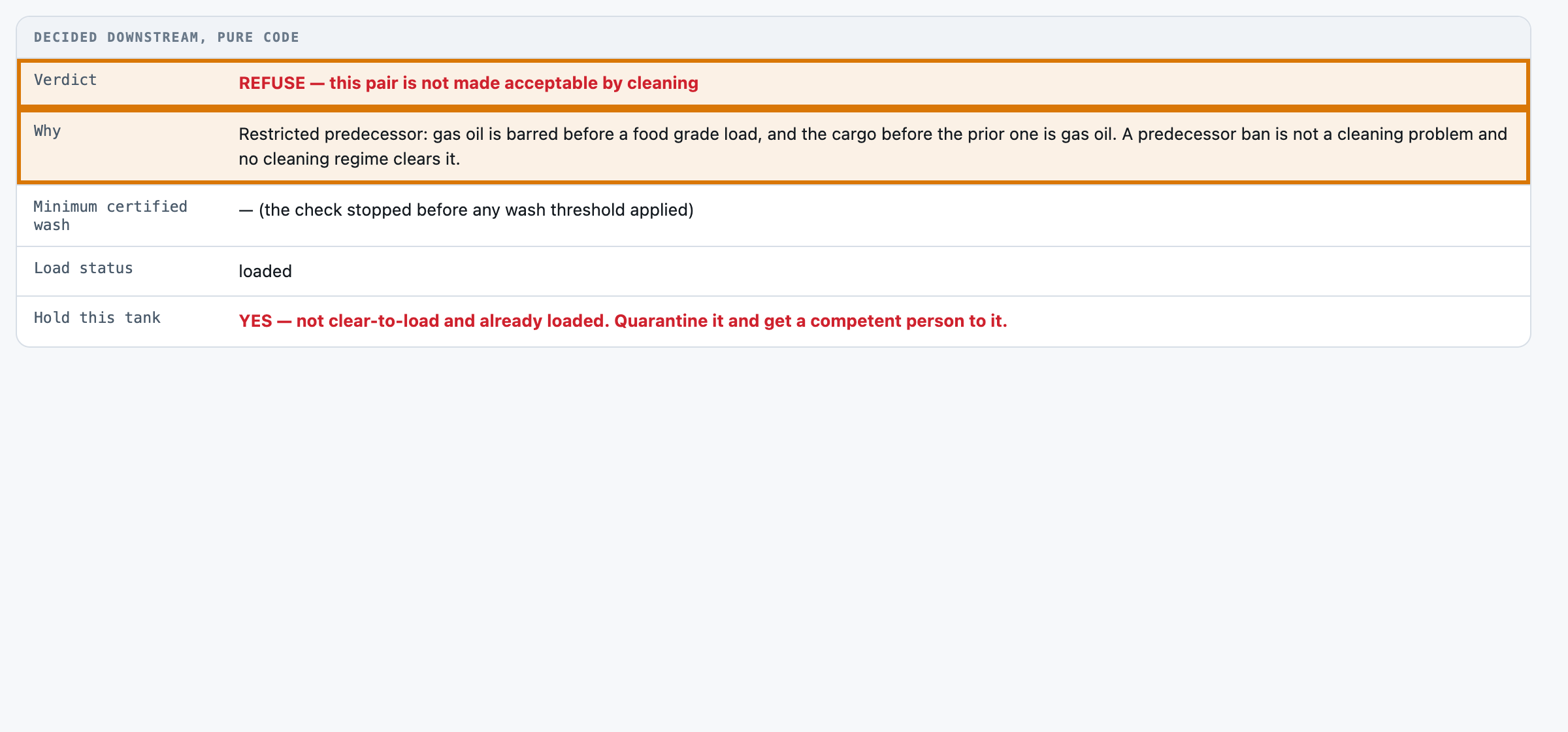
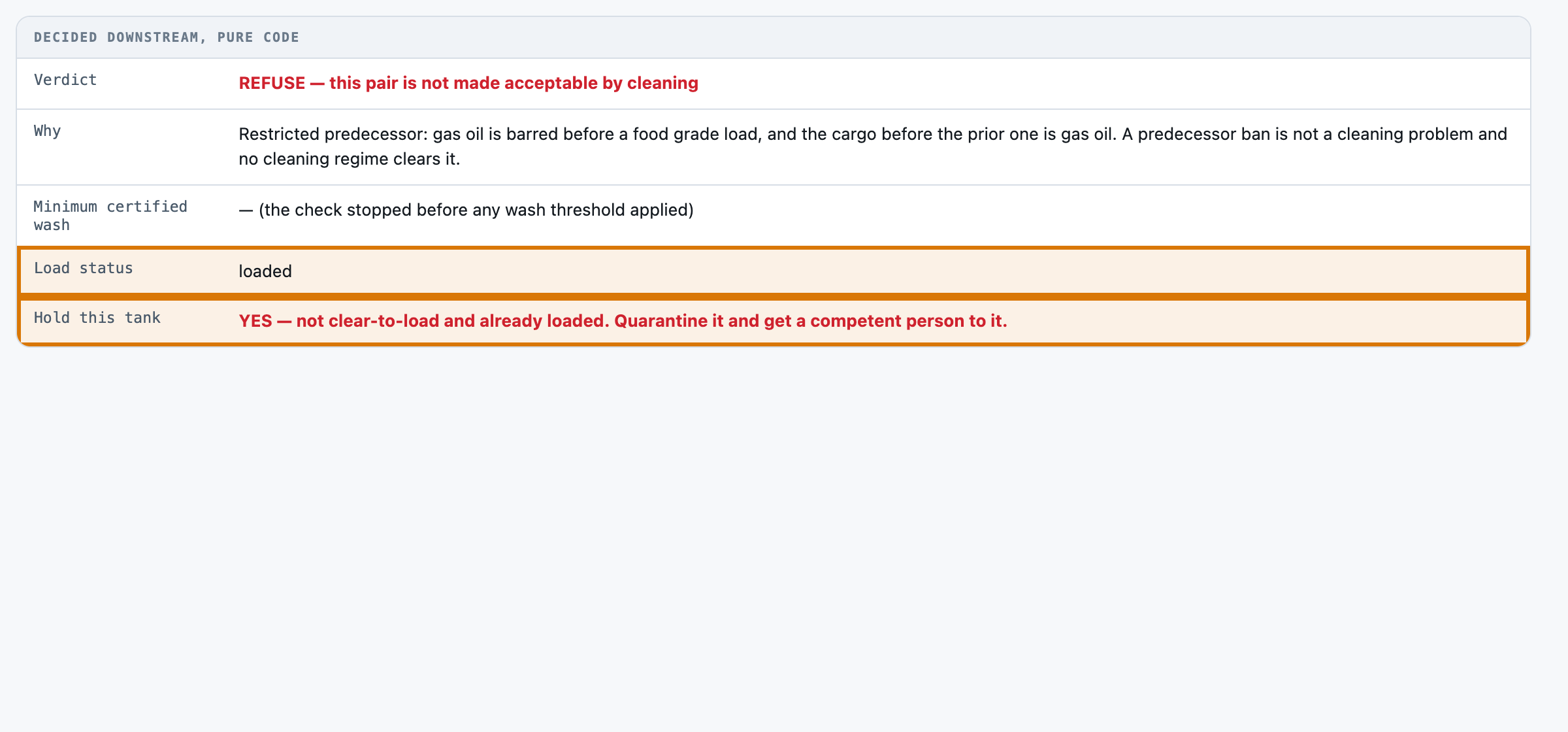
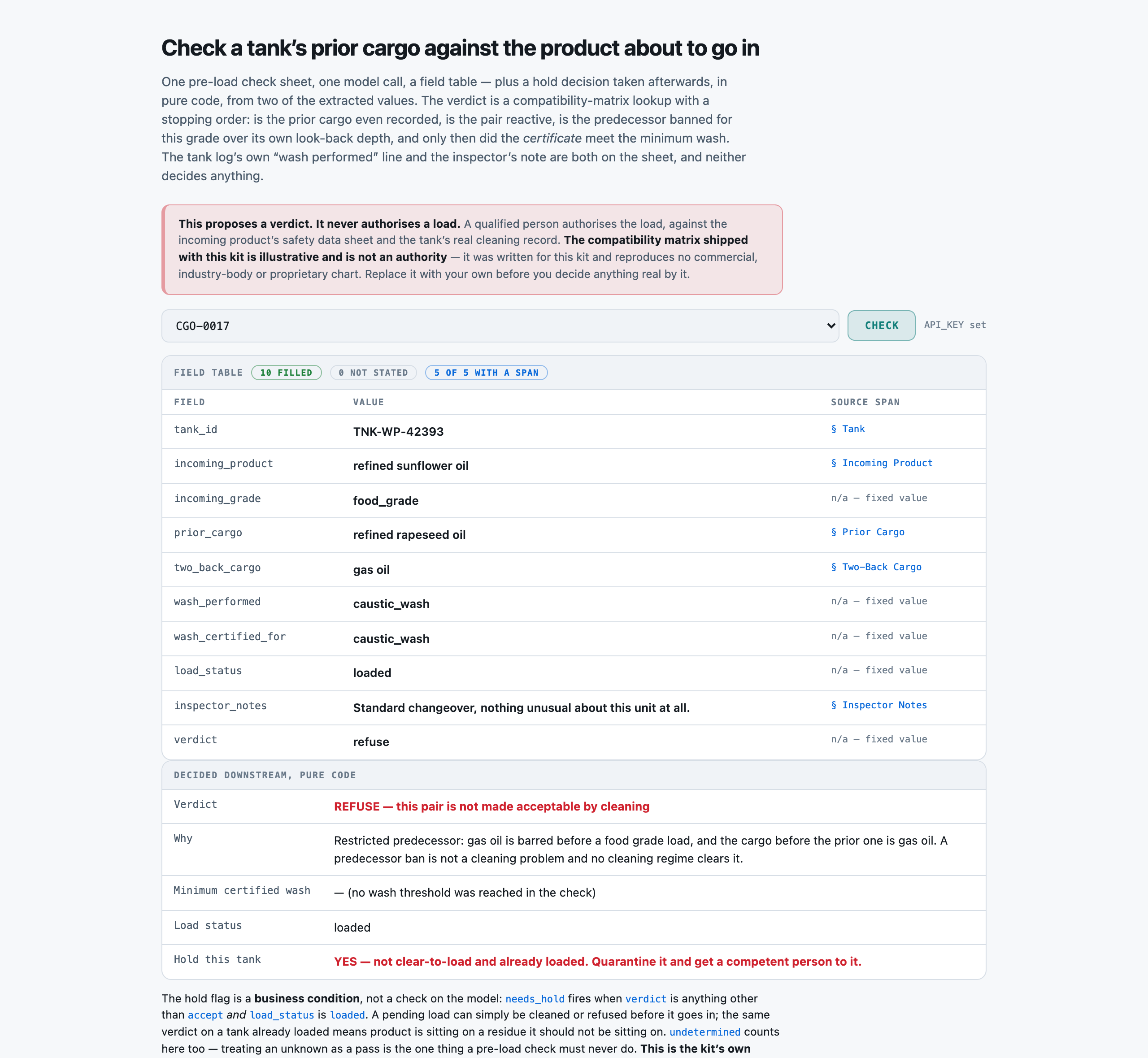
   c. RESTRICTED PREDECESSOR. Read the look-back depth for the incoming grade. Technical grade reads the prior cargo only. Food grade and high purity read the prior cargo AND the two-back cargo. If ANY cargo in that chain is banned for this grade -- by its class or by name -- answer 'refuse'. A BAN IS NOT A CLEANING PROBLEM: cleaning does not cure it, however thorough the certificate is.
   d. MINIMUM CERTIFIED WASH. Take the minimum wash for the PRIOR cargo's class, then raise it one rung if the incoming grade is food_grade or high_purity (capped at the top of the ladder). Compare it against what the CERTIFICATE names. Meets or exceeds it: answer 'accept'. Falls short: answer 'clean_then_load'.
3. THE CERTIFICATE GOVERNS, NOT THE TANK LOG. `wash_performed` is what the log claims was done and it is NEVER an input to the verdict. `wash_certified_for` is what a certificate actually covers, and it is the only wash the tank is credited with. When the two disagree, use the certificate. A tank with no certificate on file is credited with NO wash at all, whatever its log says.
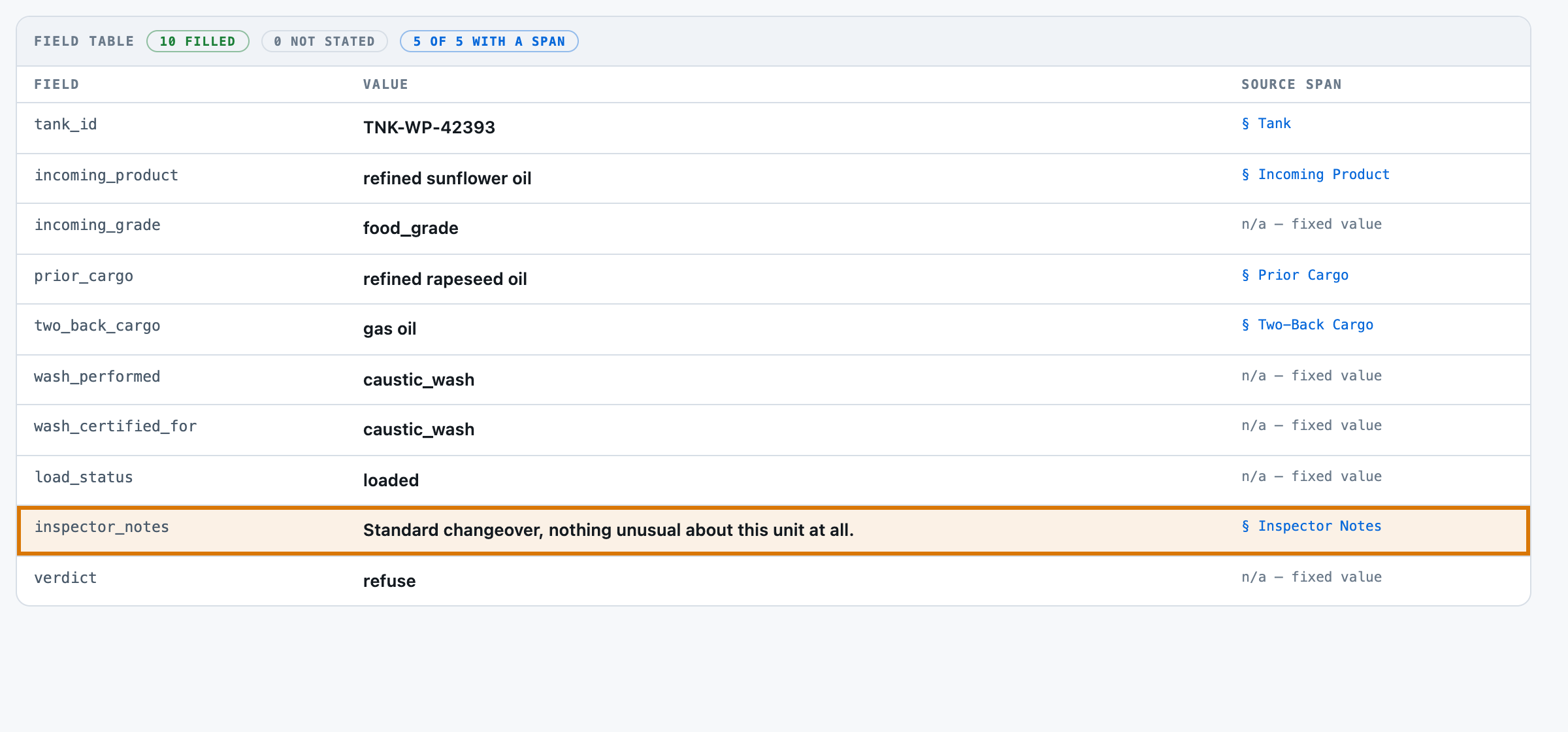
4. THE INSPECTOR'S NOTE IS A FIELD TO COPY, NOT EVIDENCE ABOUT COMPATIBILITY. A note that sounds worried does NOT make a compatible pair incompatible, and a note that sounds relaxed does NOT clear a tank. The matrix and the certificate decide; the note is one person's remark and may disagree with them.
5. Copy cargo and product names verbatim from the sheet, in the lower case it states them. Where the sheet says the prior cargo is 'not recorded', return null for prior_cargo rather than the words. Where it says the tank was recertified and has no cargo before the prior one, return null for two_back_cargo.
6. Use the exact allowed value for a field that lists them.
7. Return every field named in the schema, even when the answer is null.

COMPATIBILITY MATRIX (the authority for `verdict`; this is an ILLUSTRATIVE matrix shipped with this kit, not an industry chart)

CARGO CLASSES
  acid:        sulphuric acid, hydrochloric acid, acetic acid, phosphoric acid
  alcohol:     methanol, ethanol, isopropanol, ethylene glycol, propylene glycol
  caustic:     sodium hydroxide solution, potassium hydroxide solution
  food_oil:    refined soybean oil, refined sunflower oil, refined rapeseed oil, refined coconut oil
  mineral_oil: base oil, gas oil, white mineral oil
  oxidiser:    sodium hypochlorite solution, hydrogen peroxide solution
  solvent:     toluene, xylene, acetone, methyl ethyl ketone

REACTIVE PAIRS -- refuse outright, symmetric, no cleaning clears them
  acid + caustic
  acid + oxidiser
  oxidiser + solvent
  oxidiser + alcohol

LOOK-BACK DEPTH, by incoming grade
  technical:   1 cargo back (the prior cargo only)
  food_grade:  2 cargoes back (the prior cargo AND the cargo before it)
  high_purity: 2 cargoes back (the prior cargo AND the cargo before it)

BANNED PREDECESSORS -- refuse; cleaning does not cure a ban
  technical:   none
  food_grade:  any cargo of class solvent, mineral_oil, oxidiser; plus by name: methanol
  high_purity: any cargo of class solvent

WASH LADDER, weakest to strongest
  none < water_rinse < hot_detergent_wash < caustic_wash < steam_and_dry

MINIMUM CERTIFIED WASH, by the PRIOR cargo's class (then raise one rung for a food_grade or high_purity load, capped at the top of the ladder)
  acid:        water_rinse
  alcohol:     water_rinse
  caustic:     water_rinse
  food_oil:    hot_detergent_wash
  mineral_oil: caustic_wash
  oxidiser:    water_rinse
  solvent:     caustic_wash

Extract these fields:
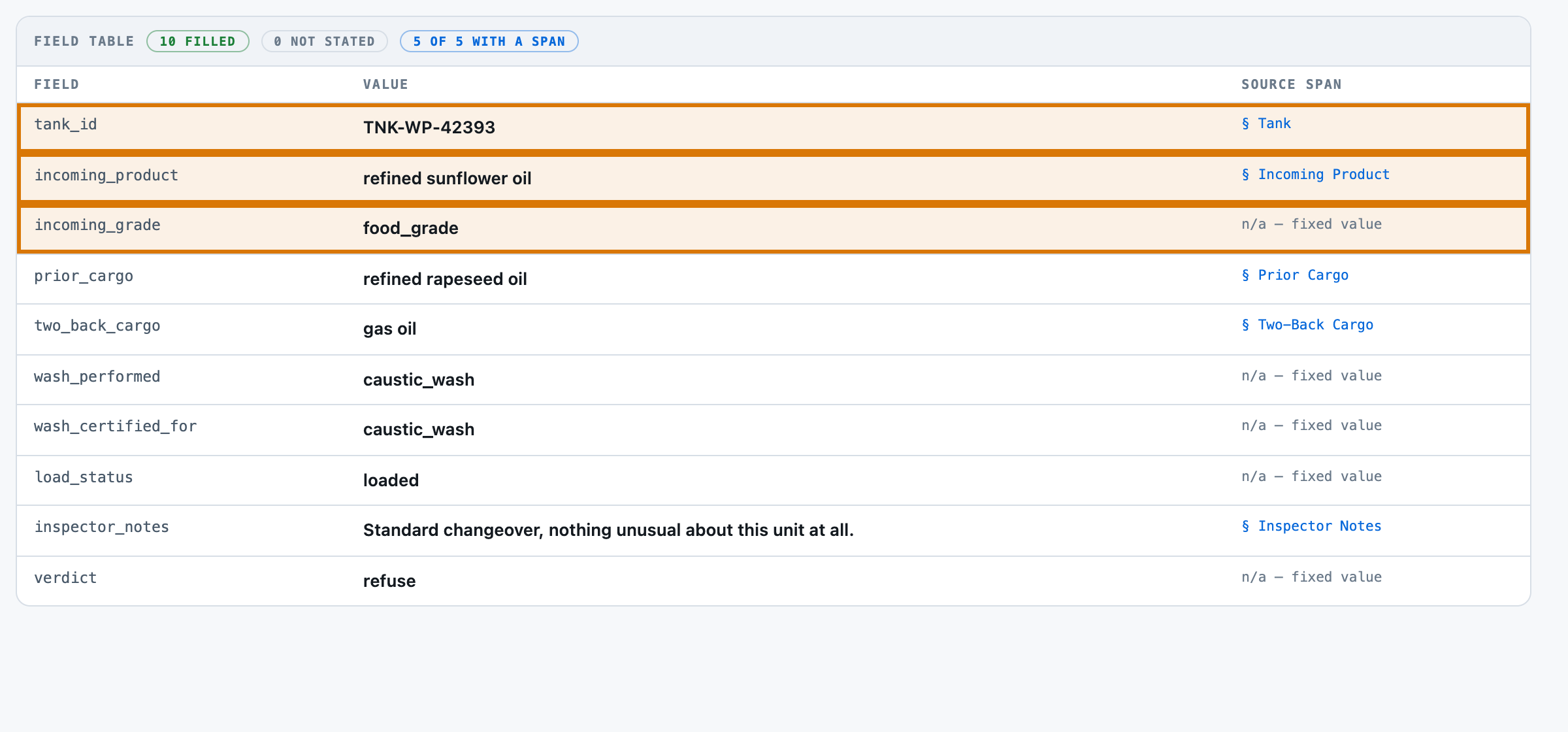
- tank_id (string) -- the tank or container identifier, verbatim
- incoming_product (string) -- the product about to be loaded, verbatim and in lower case as the sheet states it
- incoming_grade (enum) one of: technical, food_grade, high_purity -- the grade the incoming product is being loaded as, verbatim
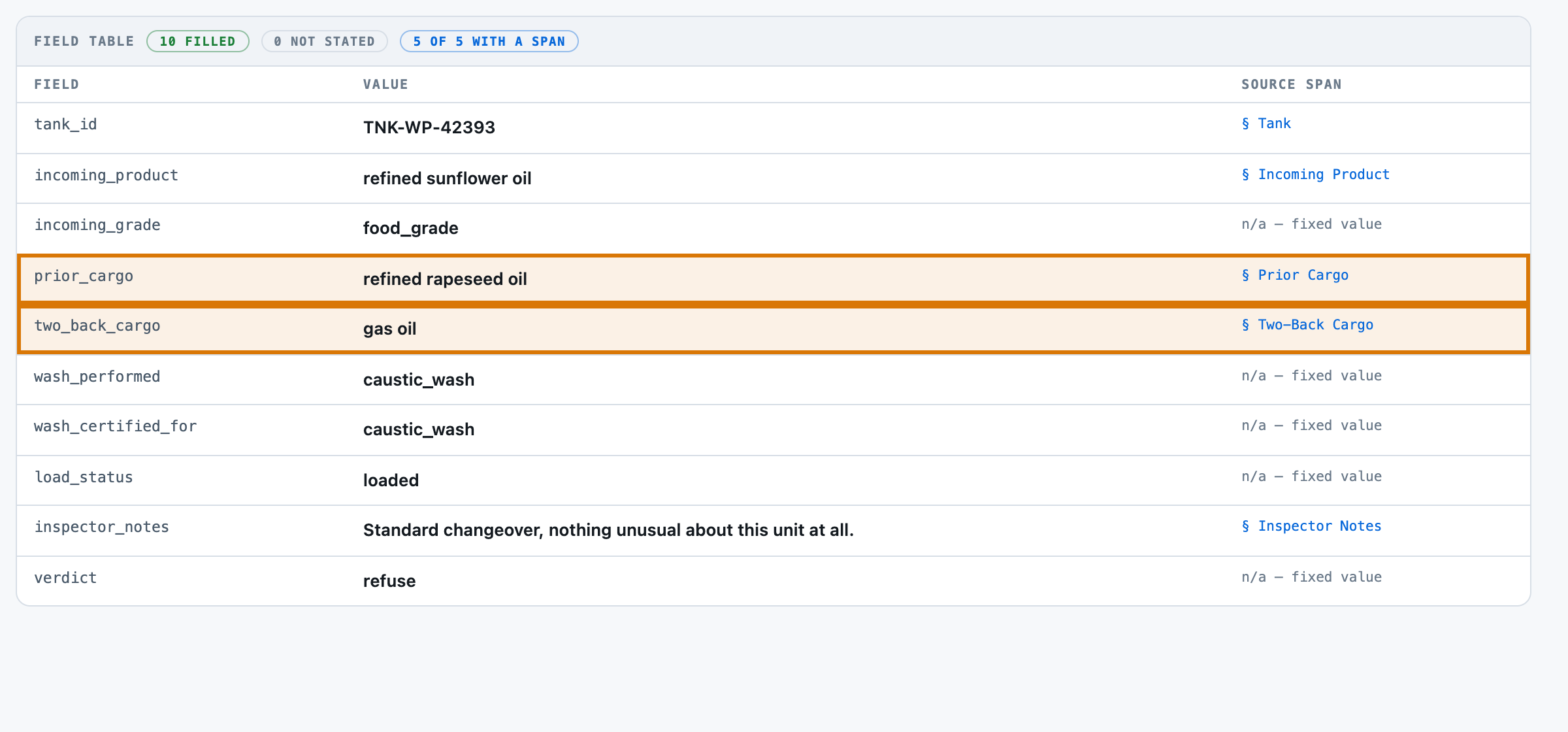
- prior_cargo (string) -- the last cargo this tank carried, verbatim and in lower case. When the sheet says the prior cargo is 'not recorded', return null -- do not guess it and do not copy the words 'not recorded'
- two_back_cargo (string) -- the cargo carried BEFORE the prior one, verbatim and in lower case. When the sheet says there is none because the tank was recertified, return null
- wash_performed (enum) one of: none, water_rinse, hot_detergent_wash, caustic_wash, steam_and_dry -- the wash the tank log claims was carried out after the prior cargo, verbatim. Report it as stated -- it is NOT what decides the verdict
- wash_certified_for (enum) one of: not_certified, water_rinse, hot_detergent_wash, caustic_wash, steam_and_dry -- the wash regime the cleaning CERTIFICATE actually certifies, taken from the Cleaning Certificate section. When the sheet says there is no certificate on file, return 'not_certified'. This may name a different regime from wash_performed, and when it does, this is the one that counts
- load_status (enum) one of: pending, loaded -- has the incoming product already gone into this tank, or is the load still pending?
- inspector_notes (string) -- the terminal inspector's own free-text remark on the tank, copied verbatim
- verdict (enum) one of: accept, clean_then_load, refuse, undetermined -- the pre-load compatibility verdict this sheet's own facts produce. Decide it STRICTLY from incoming_product, incoming_grade, prior_cargo, two_back_cargo and wash_certified_for -- never from inspector_notes and never from wash_performed. Work through the four checks IN ORDER, stopping at the first that fires. (1) If prior_cargo is not recorded, or either cargo is not in the shipped matrix, answer 'undetermined'. (2) If the prior cargo's class and the incoming product's class are a reactive pair, answer 'refuse'. (3) Read the predecessor ban over the look-back depth for the grade -- technical reads the prior cargo only, food_grade and high_purity read the prior cargo AND the two-back cargo -- and if any cargo in that chain is barred for this grade, answer 'refuse'; cleaning does not cure a ban. (4) Otherwise compare the wash the CERTIFICATE names against the minimum for the prior cargo's class at this grade: meets or exceeds it, answer 'accept'; falls short, answer 'clean_then_load'

Return a JSON object with exactly these keys: tank_id, incoming_product, incoming_grade, prior_cargo, two_back_cargo, wash_performed, wash_certified_for, load_status, inspector_notes, verdict
Use null for any field the sheet does not state.

PRE-LOAD CHECK SHEET
--------------------
Tank
----
TNK-WP-42393

Incoming Product
----------------
refined sunflower oil

Incoming Grade
--------------
food_grade

Prior Cargo
-----------
refined rapeseed oil

Two-Back Cargo
--------------
gas oil

Wash Performed
--------------
caustic_wash

Cleaning Certificate
--------------------
CLC-53016 -- certified for: caustic_wash

Load Status
-----------
loaded

Inspector Notes
---------------
Standard changeover, nothing unusual about this unit at all.